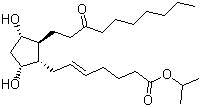
Isopropyl unoprostone
CAS 120373-24-2
Isopropyl unoprostone illustrates how an ester in an eye formulation can become a different chemical form in tissue.
Read on chemBlink: https://www.chemblink.com/en/products/120373-24-2.htm
Isopropyl unoprostone shows why a molecule in a formulation can differ from the molecule detected after metabolism. Its isopropyl group forms an ester with the carboxyl group of unoprostone. Hydrolysis can then restore the corresponding free acid, changing the terminal group without rebuilding the entire molecular framework. Historical labeling for Rescula documents an ophthalmic formulation containing the ester and describes conversion to the acid. It also records the use of the formulation to lower elevated pressure inside the eye. These are separate levels of explanation: the chemical identity in the formulation, the transformation in tissue, and a measured clinical outcome. Knowing one level does not establish all the others or make related prostaglandin analogues interchangeable. The free acid and ester also require separate analytical identification.
Published:
2026-11-11