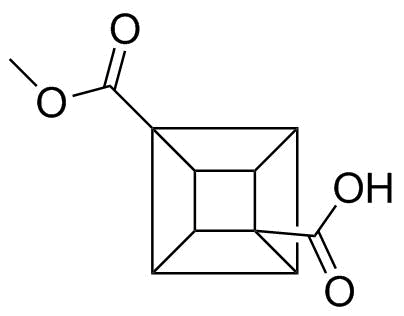
4-Methoxycarbonylcubanecarboxylic acid
CAS 24539-28-4
A cubane cage with one free acid and one methyl ester turns molecular geometry into selective synthetic chemistry.
A carbon cube becomes useful when chemists can connect it selectively. 4-(Methoxycarbonyl)cubane-1-carboxylic acid has two different handles on opposite cage corners: a free carboxylic acid and a methyl ester. That difference lets the two ends play separate roles during synthesis. The rigid cubane framework has also inspired research into alternatives to selected benzene rings, but a saturated cage is not electronically identical to an aromatic ring. Any biological advantage must be tested in the finished molecule. The free acid can even become an iodine-bearing connection through documented iododecarboxylation chemistry. This reagent's interest lies in combining a distinctive three-dimensional shape with differentiated functionality, turning a geometric curiosity into a practical starting point for experiments. Shape suggests possibilities; careful chemistry and measurement determine what actually works.
Published:
2026-10-21