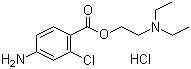
Chloroprocaine hydrochloride (CAS 3858-89-7) has a chemical story that connects molecular identity with practical chemistry. Chloroprocaine hydrochloride is the hydrochloride salt of 2-chloroprocaine, an ester local anesthetic introduced in the early 1950s. Foldes and McNall published the early clinical description in 1952 as '2-Chloroprocaine: a new local anesthetic agent.' Chemically it is a chlorinated derivative of procaine. Like other local anesthetics, chloroprocaine blocks voltage-gated sodium-channel-dependent nerve impulse conduction and produces reversible loss of sensation. Its distinguishing feature is rapid hydrolysis by plasma pseudocholinesterase, contributing to short duration and relatively rapid recovery. This profile supports selected regional and spinal anesthesia uses where a brief block is advantageous.
The exact CAS identity matters because related salts, stereoisomers, intermediates and finished medicines can play very different roles even when their names look closely related.
Its story also shows why synthesis and analytical control belong together: chemists must create the intended structure, distinguish it from process-related species and verify the form actually being handled.

Global Chemical Database