Absolutely.
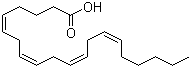
One of the best examples is arachidonic acid.
This naturally occurring fatty acid is an essential component of cell membranes throughout the body. Most of the time it sits quietly as part of the membrane structure, doing nothing at all.
But when a cell is injured or detects an infection, everything changes.
Enzymes rapidly release arachidonic acid from the membrane, where it becomes the starting material for a remarkable family of signaling molecules called eicosanoids. Within minutes, these compounds can trigger inflammation, pain, fever, blood clotting, blood vessel dilation, or immune responses.

Global Chemical Database