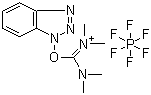
2-(1H-Benzotriazole-1-yl)-1,1,3,3-tetramethyluronium hexafluorophosphate
CAS 94790-37-1
HBTU became a peptide-chemistry workhorse by making one of biology's most important bonds faster and more reliable to construct.
2-(1H-Benzotriazole-1-yl)-1,1,3,3-tetramethyluronium hexafluorophosphate (CAS 94790-37-1) has a chemical story that connects molecular identity with practical chemistry. CAS 94790-37-1 is universally known in peptide chemistry as HBTU, a benzotriazole-based coupling reagent widely used in Fmoc solid-phase peptide synthesis. HBTU activates a carboxylic acid so an amino group can attack efficiently to form an amide bond. Literature and commercial references emphasize rapid reactions, high coupling yields and relatively low racemization. A notable structural detail emerged from crystallographic and solution studies: HBTU is better represented by an aminium or guanidinium N-oxide structure than the simple 'uronium' formulation suggested by its traditional name. Repeated solid-phase peptide synthesis demands reliable activation over many cycles, explaining why HBTU became a classic workhorse. Its role is synthetic rather than biological: it facilitates peptide-bond construction and is not intended to remain in the final peptide.
Published:
2026-09-21