
Online Database of Chemicals from Around the World
| Colourise Industries | India | |||
|---|---|---|---|---|
 | www.colourise.in | |||
 | +91 (79) 2685-3684 2685-7684 | |||
 | +91 (79) 2685-7684 | |||
 | info@colourise.in | |||
| Chemical manufacturer since 1978 | ||||
| chemBlink Standard supplier since 2010 | ||||
| BOC Sciences | USA | |||
|---|---|---|---|---|
| www.bocsci.com | |||
| +1 (631) 485-4226 | |||
| +1 (631) 614-7828 | |||
| info@bocsci.com | |||
| Chemical manufacturer | ||||
| chemBlink Standard supplier since 2010 | ||||
| Shen Zhen Reagent Biotechnology Co., Ltd. | China | |||
|---|---|---|---|---|
| www.haoreagent.com | |||
| +86 (755) 8945-9231 | |||
| sales@haoreagent.com | |||
| Chemical distributor since 2016 | ||||
| chemBlink Standard supplier since 2024 | ||||
| Classification | Dyes and pigments >> Dyes >> Reactive dye (reactive dye) |
|---|---|
| Name | Reactive Black 31 |
| Synonyms | Duasyn Black KRL-SF; Duasyn Black RL-SF-VP 228; Remazol Black RL; Remazol Black RL-ID |
| Molecular Structure | 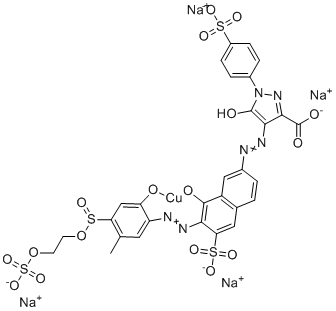 |
| Molecular Formula | C29H18CuN6Na4O17S4 |
| Molecular Weight | 1006.25 |
| CAS Registry Number | 12731-63-4 |
| EC Number | 603-199-8 |
| SMILES | C1(=CC=C(C=C1)[S]([O-])(=O)=O)[N]2C(=C(C(=N2)C(=O)[O-])N=NC3=CC4=C(C=C3)C=C(C6=C4O[Cu]OC5=CC(=C(C=C5N=N6)C)[S](=O)OCCO[S](=O)([O-])=O)[S]([O-])(=O)=O)O.[Na+].[Na+].[Na+].[Na+] |
 chemBlink Chemical Story
|
Reactive Black 31 is a synthetic dye renowned for its deep, rich black color and its versatility in various dyeing applications. First introduced in the late 20th century, it belongs to the class of reactive dyes, which are known for their ability to form covalent bonds with fibers, ensuring strong colorfastness and durability. The development of Reactive Black 31 was part of a broader effort to create dyes with improved performance characteristics, including better stability and ease of application across a range of textile materials. One of the primary applications of Reactive Black 31 is in the textile industry. It is used extensively for dyeing natural fibers such as cotton and wool, as well as synthetic fibers like nylon and polyester. The dye’s reactive groups enable it to form chemical bonds with the fiber molecules, resulting in a high level of colorfastness. This characteristic is particularly valuable for applications where the durability and resistance to washing and light exposure are crucial. Reactive Black 31 is commonly employed in the production of clothing, upholstery, and other fabric-based products, where its deep black color provides a stylish and sophisticated appearance. In addition to its use in textiles, Reactive Black 31 is utilized in the paper industry. It is incorporated into the production process to impart a rich black hue to paper products, enhancing their visual appeal and functionality. The dye’s stability ensures that the color remains consistent and does not fade over time, making it suitable for high-quality printing applications such as books, magazines, and packaging materials. Reactive Black 31 also finds applications in the field of cosmetics and personal care products. It is used in formulations such as hair dyes and makeup products to provide a deep, lasting black color. The dye’s stability and performance in these products contribute to their aesthetic appeal and effectiveness, ensuring that the color remains vibrant and true throughout the product’s usage. Despite its beneficial applications, the use of Reactive Black 31, like other synthetic dyes, is subject to scrutiny regarding environmental and health impacts. Ongoing research aims to assess and mitigate any potential risks associated with its use, ensuring that it is applied in a safe and responsible manner. |
| Market Analysis Reports |