
Online Database of Chemicals from Around the World
| BOC Sciences | USA | |||
|---|---|---|---|---|
 | www.bocsci.com | |||
 | +1 (631) 485-4226 | |||
 | +1 (631) 614-7828 | |||
 | info@bocsci.com | |||
| Chemical manufacturer | ||||
| chemBlink Standard supplier since 2010 | ||||
| Shen Zhen Reagent Biotechnology Co., Ltd. | China | |||
|---|---|---|---|---|
| www.haoreagent.com | |||
| +86 (755) 8945-9231 | |||
| sales@haoreagent.com | |||
| Chemical distributor since 2016 | ||||
| chemBlink Standard supplier since 2024 | ||||
| Advanced Synthesis | USA | |||
|---|---|---|---|---|
| www.advancedsynthesis.com | |||
| +1 (619) 423-7821 | |||
| +1 (619) 423-7793 | |||
| sales@advancedsynthesis.com | |||
| Chemical manufacturer | ||||
| Name | (Z)-7-Dodecen-1-ol acetate |
|---|---|
| Synonyms | (Z)-7-Dodecenyl acetate; Looplure; MK 26 |
| Molecular Structure | 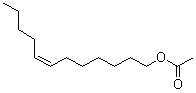 |
| Molecular Formula | C14H26O2 |
| Molecular Weight | 226.36 |
| CAS Registry Number | 14959-86-5 |
| EC Number | 239-031-1 |
| SMILES | CCCC/C=CCCCCCCOC(=O)C |
| Solubility | Practically insoluble (0.038 g/L) (25 °C), Calc.* |
|---|---|
| Density | 0.881±0.06 g/cm3 (20 °C 760 Torr), Calc.* |
| Boiling point | 300.1±21.0 °C (760 Torr), Calc.* |
| Refractive index | 1.4485 (20 °C)*** |
| Flash point | 96.5±20.4 °C, Calc.* |
| * | Calculated using Advanced Chemistry Development (ACD/Labs) Software V11.02 (©1994-2013 ACD/Labs) |
| *** | Ishmuratov, G. Yu. |
| Hazard Symbols |  GHS07 Warning Details GHS07 Warning Details |
|---|---|
| Risk Statements | H315-H319-H335 Details |
| Safety Statements | P261-P264-P271-P280-P302+P352-P304+P340-P305+P351+P338-P312-P313-P337+P313-P362-P403+P233-P405-P501 Details |
| SDS | Available |
 chemBlink Chemical Story
|
(Z)-7-Dodecen-1-ol acetate is an organic compound characterized by its role as a pheromone and a chemical intermediate in various industrial applications. Its discovery, which occurred in the late 20th century, marked a significant advancement in both chemical synthesis and the understanding of pheromone chemistry. One of the primary applications of (Z)-7-Dodecen-1-ol acetate is in the field of pest control. It is utilized as a pheromone in integrated pest management systems, particularly for the control of insect populations. The compound mimics the natural sex pheromones of certain moth species, such as the oriental fruit moth. By deploying (Z)-7-Dodecen-1-ol acetate in traps, it helps to attract and monitor pest populations, thereby providing a means to manage and reduce their numbers effectively. This approach is environmentally friendly and reduces the reliance on broad-spectrum insecticides, aligning with sustainable agricultural practices. In addition to its use in pest control, (Z)-7-Dodecen-1-ol acetate finds applications in the fragrance industry. Its pleasant odor profile makes it a valuable ingredient in the formulation of perfumes and other scented products. The compound contributes to the overall aroma profile of these products, enhancing their appeal and effectiveness. Its stability and compatibility with other fragrance ingredients make it a popular choice for perfumers seeking to create complex and appealing scents. Furthermore, (Z)-7-Dodecen-1-ol acetate serves as a chemical intermediate in the synthesis of other organic compounds. Its reactivity allows it to be used in various chemical reactions, facilitating the production of substances with specific desired properties. This makes it a useful building block in the chemical industry for the development of new materials and products. Despite its beneficial uses, the application of (Z)-7-Dodecen-1-ol acetate requires careful consideration of safety and environmental impact. Ongoing research and regulation ensure that its use remains safe and effective, minimizing any potential risks associated with its applications. References 2016. A Facile Synthesis of the Sex Pheromone of the Cabbage Looper Trichoplusia ni. Chemistry of Natural Compounds, 52(5). DOI: 10.1007/s10600-016-1800-7 2020. A plant volatile alters the perception of sex pheromone blend ratios in a moth. Journal of Comparative Physiology A, 206(4). DOI: 10.1007/s00359-020-01420-y 2021. Performance and efficiency of trap designs baited with sex pheromone for monitoring Spodoptera frugiperda males in corn crops. International Journal of Tropical Insect Science, 41(4). DOI: 10.1007/s42690-021-00595-4 |
| Market Analysis Reports |