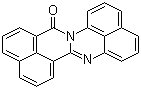
Solvent Red 179 is an azo dye commonly used as a coloring agent in a variety of industrial applications. The chemical substance is known for its bright red hue and is typically utilized in the coloration of oils, plastics, fuels, and lubricants. It is characterized by its chemical structure, which includes an azo group (-N=N-) connecting aromatic rings. This structure is responsible for the dye’s distinctive color properties.
The discovery of Solvent Red 179 is closely tied to the development of synthetic dyes in the early 20th century. As with many other azo dyes, it was synthesized through a process involving the reaction of an aromatic compound with a diazonium salt. The resulting dye is designed to be soluble in non-aqueous solvents, making it ideal for use in applications where water solubility is not required. This property of Solvent Red 179 is what qualifies it as a "solvent" dye, distinguishing it from other dyes used in aqueous systems.
One of the primary uses of Solvent Red 179 is in the coloring of fuel products. It is added to gasoline, diesel fuel, and other petroleum-based products to give them a red color, which is often used to distinguish various grades of fuel or to mark products for tax purposes. For example, in some regions, red-colored diesel fuel indicates that it is intended for non-road use and is exempt from certain fuel taxes. This application of Solvent Red 179 helps with regulatory compliance and provides visual differentiation of fuels.
Beyond its use in fuels, Solvent Red 179 is also employed in the coloration of lubricants, oils, and other industrial products. Its ability to remain stable in non-aqueous environments, where it does not dissolve or leach out easily, makes it an effective dye for these applications. Additionally, the dye is used in some polymer and plastic products, where it imparts a durable, stable red color.
Solvent Red 179 has also been utilized in the testing of oil products and is occasionally used in laboratory experiments to simulate and study the behavior of certain chemical processes or materials. The stability of the dye under various conditions makes it a useful tool in a variety of testing scenarios.
Despite its widespread use, Solvent Red 179 is regulated in many countries due to potential health and environmental concerns associated with some azo dyes. These regulations typically govern the concentration of the dye in consumer products, particularly those that may come into direct contact with humans, to minimize any risks. The compound’s potential toxicity and its impact on aquatic life have led to restrictions on its use in some applications, particularly those that could result in environmental exposure.
In conclusion, Solvent Red 179 is a synthetic azo dye widely used in industrial applications for coloring fuels, lubricants, and plastics. It was developed as part of the broader movement to create synthetic dyes in the 20th century and remains an important chemical in various sectors. Although its use is regulated due to environmental and health concerns, it continues to serve critical functions in many industrial processes, particularly in the petroleum industry.
References
1973. Research on perinone compounds. Chemistry of Heterocyclic Compounds, 9(10).
DOI: 10.1007/bf00477464
1998. Dyes for the mass coloration of plastics. Polymer Science and Technology Series.
DOI: 10.1007/978-94-011-5862-6_25
2012. Dialkyl‐14H‐benzo[4,5]isoquino[2,3‐a]perimidin‐14‐one‐3,4,10,11‐tetracarboxylic diimides: A New Family of n‐Type Organic Semiconductors. Chemistry - An Asian Journal, 7(11).
DOI: 10.1002/asia.201200412
|




 GHS07 Warning Details
 chemBlink Chemical Story