
Online Database of Chemicals from Around the World
| Shandong Huimeng Biotech Co., Ltd. | China | |||
|---|---|---|---|---|
 | www.huimengchem.com | |||
 | +86 (530) 884-2888 +86 18523002917 | |||
 | +86 (530) 884-2666 | |||
 | cindy@szgoldenunion.com | |||
| Chemical manufacturer since 2013 | ||||
| chemBlink Standard supplier since 2016 | ||||
| Classification | Pharmaceutical intermediate >> Heterocyclic compound intermediate >> Pyridine compound |
|---|---|
| Name | 2,3,6-Trichloro-5-(trifluoromethyl)pyridine |
| Molecular Structure | 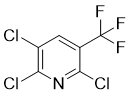 |
| Molecular Formula | C6HCl3F3N |
| Molecular Weight | 250.43 |
| CAS Registry Number | 80289-91-4 |
| EC Number | 878-725-4 |
| SMILES | C1=C(C(=NC(=C1Cl)Cl)Cl)C(F)(F)F |
| Density | 1.6±0.1 g/cm3, Calc.* |
|---|---|
| Index of Refraction | 1.491, Calc.* |
| Boiling Point | 231.7±35.0 °C (760 mmHg), Calc.* |
| Flash Point | 93.9±25.9 °C, Calc.* |
| * | Calculated using Advanced Chemistry Development (ACD/Labs) Software. |
| Hazard Symbols |   GHS05;GHS07 Danger Details GHS05;GHS07 Danger Details |
|---|---|
| Risk Statements | H302+H312+H332-H315-H318-H335 Details |
| Safety Statements | P261-P264-P264+P265-P270-P271-P280-P301+P317-P302+P352-P304+P340-P305+P354+P338-P317-P319-P321-P330-P332+P317-P362+P364-P403+P233-P405-aP501 Details |
| SDS | Available |
 chemBlink Chemical Story
|
2,3,6-Trichloro-5-(trifluoromethyl)pyridine is a compound of great importance in the field of agrochemistry. This substance, with the molecular formula C6Cl3F3N, is widely used due to its role as an intermediate in the synthesis of various agrochemicals, especially herbicides. The discovery of 2,3,6-Trichloro-5-(trifluoromethyl)pyridine can be traced back to the extensive research and development efforts carried out in the mid-20th century to create effective and efficient agrochemicals. Scientists focused on developing compounds that could increase agricultural productivity by more effectively controlling weeds and pests. This led to the synthesis and identification of this compound, which exhibits good properties as a chemical intermediate. From a chemical point of view, 2,3,6-Trichloro-5-(trifluoromethyl)pyridine is a chlorinated pyridine derivative. Its structure consists of a pyridine ring substituted with three chlorine atoms and a trifluoromethyl group. The presence of these electronegative substituents imparts unique chemical properties to the compound, making it a valuable component in organic synthesis, especially in the agrochemical industry. While 2,3,6-trichloro-5-(trifluoromethyl)pyridine itself is not typically used directly as a herbicide, it plays a vital role in the synthesis of a wide range of herbicides. During chemical synthesis, it acts as an intermediate that can be further modified to produce active herbicidal compounds. These compounds, in turn, are designed to interfere with specific biological pathways in plants, thereby inhibiting weed growth and thus protecting crops from unwanted plants. The main application of 2,3,6-trichloro-5-(trifluoromethyl)pyridine is in the production of herbicides. Herbicides synthesized using this compound as an intermediate have been widely used in agriculture to manage and control the growth of weeds. By targeting specific plant enzymes and metabolic pathways, these herbicides can effectively eliminate unwanted plants without damaging crops. The versatility of this compound as an intermediate has enabled the development of a range of herbicidal products with different modes of action. This adaptability is particularly valuable in addressing evolving challenges in weed management, such as the development of herbicide-resistant weed species. By modifying the chemical structure of the intermediate, researchers can design herbicides that are effective against resistant strains, thereby ensuring sustainable agricultural practices. The use of 2,3,6-trichloro-5-(trifluoromethyl)pyridine in agrochemical synthesis offers several advantages. Its chemical stability and reactivity make it an ideal intermediate for the production of a wide range of herbicides. The resulting herbicides are often very effective at low application rates, thereby reducing the overall chemical load to the environment. Additionally, the specificity of these herbicides minimizes the impact on non-target plants and organisms, contributing to more environmentally friendly agricultural practices. Like many chemicals, the handling and use of 2,3,6-trichloro-5-(trifluoromethyl)pyridine requires appropriate safety measures. It is important to follow proper safety protocols, including the use of personal protective equipment (PPE) and adherence to handling guidelines to prevent exposure. The compound should be stored in a cool, dry place away from incompatible materials to ensure its stability and prevent hazardous reactions. |
| Market Analysis Reports |