
Online Database of Chemicals from Around the World
| Simagchem Corporation | China | |||
|---|---|---|---|---|
 | www.simagchem.com | |||
 | +86 13806087780 | |||
 | +86 (592) 268-0237 | |||
 | sale@simagchem.com | |||
| Chemical manufacturer since 2002 | ||||
| chemBlink Standard supplier since 2008 | ||||
| Discovery Fine Chemicals Ltd. | UK | |||
|---|---|---|---|---|
| www.discofinechem.com | |||
| +44 (1202) 874-517 | |||
| +44 (845) 094-4385 | |||
| pjc@discofinechem.com | |||
| Chemical manufacturer | ||||
| chemBlink Standard supplier since 2009 | ||||
| Struchem Co., Ltd | China | |||
|---|---|---|---|---|
| www.struchem.com | |||
| +86 (21) 3353-8390 | |||
| +86 (21) 3208-2820 | |||
| sales@struchem.com | |||
| Chemical manufacturer | ||||
| chemBlink Standard supplier since 2009 | ||||
| Hefei TNJ Chemical Industry Co., Ltd. | China | |||
|---|---|---|---|---|
| www.tnjchem.com | |||
| +86 (551) 6541-8684 | |||
| +86 (551) 6541-8697 | |||
| sales@tnjchem.com | |||
| Chemical manufacturer since 2001 | ||||
| chemBlink Standard supplier since 2010 | ||||
| Hangzhou Mole's Science&Technology Co., Ltd. | China | |||
|---|---|---|---|---|
| www.mole-scitech.com | |||
| +86 (571) 5688-0228 | |||
| +86 (571) 5685-4558 | |||
| amy@mole-scitech.com | |||
| Chemical manufacturer | ||||
| chemBlink Standard supplier since 2011 | ||||
| LOBA Feinchemie AG | Austria | |||
|---|---|---|---|---|
| www.loba.co.at | |||
| +43 (223) 277-391 | |||
| +43 (223) 276-677 | |||
| sales@loba.co.at | |||
| Chemical distributor | ||||
| chemBlink Standard supplier since 2012 | ||||
| Hangzhou Leap Chem Co., Ltd. | China | |||
|---|---|---|---|---|
| www.leapchem.com | |||
| +86 (571) 8771-1850 | |||
| market19@leapchem.com | |||
 | QQ Chat | |||
| Chemical manufacturer since 2006 | ||||
| chemBlink Standard supplier since 2015 | ||||
| Zeus Chem Co., Ltd. | China | |||
|---|---|---|---|---|
| www.zeuschem.cn | |||
| +86 18071545453 | |||
| info@zeuschem.cn | |||
| QQ Chat | |||
 | WeChat: 18071545453 | |||
| Chemical manufacturer since 2019 | ||||
| chemBlink Standard supplier since 2019 | ||||
| Organica Feinchemie GmbH | Germany | |||
|---|---|---|---|---|
| www.organica.de | |||
| +49 (3494) 63-6215 | |||
| +49 (3494) 63-6165 | |||
| dmi@weylchem-organica.com | |||
| Chemical manufacturer | ||||
| Rieke Metals, Inc. | USA | |||
|---|---|---|---|---|
| www.riekemetals.com | |||
| +1 (402) 434-2775 | |||
| +1 (402) 434-2777 | |||
| sales@riekemetals.com | |||
| Chemical manufacturer | ||||
| Sinova Corporation | USA | |||
|---|---|---|---|---|
| www.sinovainc.com | |||
| +1 (301) 961-1525 | |||
| +1 (240) 235-4288 | |||
| sales@sinovainc.com | |||
| Chemical manufacturer | ||||
| Cambridge Isotope Laboratories, Inc. | USA | |||
|---|---|---|---|---|
| www.isotope.com | |||
| +1 (978) 749-8000 | |||
| +1 (978) 749-2768 | |||
| cilsales@isotope.com | |||
| Chemical manufacturer | ||||
| Anvia Chemicals, LLC | USA | |||
|---|---|---|---|---|
| www.anviachem.com | |||
| +1 (414) 534-7845 | |||
| +1 (414) 762-5539 | |||
| sales@anviachem.com | |||
| Chemical manufacturer | ||||
| Avonchem/Chromos Express Ltd. | UK | |||
|---|---|---|---|---|
| www.avonchem.co.uk | |||
| +44 (1625) 434-300 | |||
| +44 (1625) 869-777 | |||
| info@avonchem.co.uk | |||
| Chemical manufacturer | ||||
| Classification | Organic raw materials >> Aldehyde |
|---|---|
| Name | 4-Dimethylaminobenzaldehyde |
| Synonyms | p-Dimethylaminobenzaldehyde; p-Formyl-N,N-dimethylaniline; N,N-Dimethyl-4-amino benzaldehyde; Ehrlich's Reagent |
| Molecular Structure | 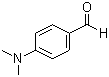 |
| Molecular Formula | C9H11NO |
| Molecular Weight | 149.19 |
| Protein Sequence | v |
| CAS Registry Number | 100-10-7 |
| EC Number | 202-819-0 |
| SMILES | CN(C)C1=CC=C(C=C1)C=O |
| Density | 1.1±0.1 g/cm3 Calc.* |
|---|---|
| Melting point | 72 - 75 °C (Expl.) |
| Boiling point | 266.5±23.0 °C 760 mmHg (Calc.)*, 176 - 177 °C (17 mmHg) (Expl.) |
| Flash point | 103.3±12.0 °C (Calc.)*, 164 °C (Expl.) |
| Solubility | water: slightly soluble 0.3 g/L (20 °C), alcohol, ether, chloroform, acetic acid: soluble (Expl.) |
| Index of refraction | 1.596 (Calc.)* |
| * | Calculated using Advanced Chemistry Development (ACD/Labs) Software. |
| Hazard Symbols |   GHS07;GHS09 Warning Details GHS07;GHS09 Warning Details | ||||||||||||||||||||||||||||||||||||||||||||
|---|---|---|---|---|---|---|---|---|---|---|---|---|---|---|---|---|---|---|---|---|---|---|---|---|---|---|---|---|---|---|---|---|---|---|---|---|---|---|---|---|---|---|---|---|---|
| Risk Statements | H317-H319-H411 Details | ||||||||||||||||||||||||||||||||||||||||||||
| Safety Statements | P261-P264+P265-P272-P273-P280-P302+P352-P305+P351+P338-P321-P333+P317-P337+P317-P362+P364-P391-P501 Details | ||||||||||||||||||||||||||||||||||||||||||||
| Hazard Classification | |||||||||||||||||||||||||||||||||||||||||||||
| |||||||||||||||||||||||||||||||||||||||||||||
| SDS | Available | ||||||||||||||||||||||||||||||||||||||||||||
 chemBlink Chemical Story
|
4‑Dimethylaminobenzaldehyde (para‑dimethylaminobenzaldehyde, DMAB) is an aromatic aldehyde with formula C9H11NO. It bears a formyl group (–CHO) para to a dimethylamino substituent (–N(CH3)2), giving it an electron‑donating and electrophilic character that underpins its utility in analytical, biochemical, and synthetic applications. DMAB was first used in the early 20th century in microbiological spot tests, most notably as the active chromogenic component in Ehrlich’s reagent and Kovács reagent. In these tests, DMAB in a strong acid medium reacts with indole moieties (derived from tryptophan metabolism) to produce a red to violet rosindole dye, enabling rapid identification of indole‑producing bacteria and detection of indole alkaloids in clinical and forensic settings ([ResearchGate][1], [Wikipedia][2]). Comparative studies have demonstrated its sensitivity: the Ehrlich reagent detected indole in over 92 % of positive strains under optimized conditions, while Kovács reagent (with DMAB) showed slightly lower sensitivity ([PubMed][3]). In analytical chemistry, DMAB serves as a reagent for quantifying hydrazine and related compounds: in acidic medium it forms a stable yellow hydrazone detectable spectrophotometrically, and this method has been applied for trace analysis in environmental and industrial samples ([ScienceDirect][4]). In synthetic chemistry, the donor‑acceptor structure of DMAB allows it to condense with active methylene or amine compounds, forming Schiff bases and conjugated systems that are exploited in dye synthesis, molecular sensors, and optoelectronic materials. Its conjugation facilitates π‑electron delocalization, making DMAB‑derived compounds interesting for non‑linear optical studies and fluorescent probes ([ResearchGate][1], [globalresearchonline.net][5]). Safety considerations: DMAB is a yellow‑white crystalline powder, melting at approximately 74 °C and boiling around 176–177 °C, with limited water solubility (~0.3 g/L) but greater solubility in organic solvents such as ethanol or methanol ([Wikipedia][6]). It should be handled with care due to potential irritation of skin, eyes, and mucous membranes. The aldehyde functionality and amine moiety necessitate proper protective measures in use and disposal. In summary, DMAB is a versatile compound whose robust chromogenic reaction with indole and hydrazine, coupled with its reactivity in condensation and conjugation chemistry, has cemented its role in microbiology, clinical diagnostics, analytical assays, and material synthesis. Its wide utility over more than a century reflects both its chemical stability and functional flexibility. References Miller JM, Wright JW (1982) Spot indole test: evaluation of four reagents. Journal of Clinical Microbiology 15 4 589–592 DOI: 10.1128/JCM.15.4.589-592.1982 Lamb AC, Federico‑Perez RA, Xue Z‑L et al. (2015) Product in indole detection by Ehrlich’s reagent. Analytical Biochemistry 484 1–6 DOI: 10.1016/j.ab.2015.04.033 |
| Market Analysis Reports |