Online Database of Chemicals from Around the World

Terephthaloyl chloride
[CAS# 100-20-9]

List of Suppliers
Epochem Co., Ltd. China Inquire
www.epochem.com
+86 (21) 6760-1595
6760-1597
+86 (21) 6760-1605
seth_wang@epochem.com
QQ Chat
Chemical manufacturer since 2006
chemBlink Standard supplier since 2005
Simagchem Corporation China Inquire
www.simagchem.com
+86 13806087780
+86 (592) 268-0237
sale@simagchem.com
Chemical manufacturer since 2002
chemBlink Standard supplier since 2008
Twin Lake Chemical, Inc. USA Inquire
www.twinlakechemical.com
+1 (716) 433-3824
twinlakechemical@aol.com
Chemical manufacturer
chemBlink Standard supplier since 2009
Hefei TNJ Chemical Industry Co., Ltd. China Inquire
www.tnjchem.com
+86 (551) 6541-8684
+86 (551) 6541-8697
sales@tnjchem.com
Chemical manufacturer since 2001
chemBlink Standard supplier since 2010
BOC Sciences USA Inquire
www.bocsci.com
+1 (631) 485-4226
+1 (631) 614-7828
info@bocsci.com
Chemical manufacturer
chemBlink Standard supplier since 2010
Hangzhou Chemtech Inductry Co., Ltd. China Inquire
www.zjchemtech.com
+86 (571) 5671-5668
+86 (571) 85423167
info@zjchemtech.com
Chemical manufacturer since 2013
chemBlink Standard supplier since 2014
Hangzhou Leap Chem Co., Ltd. China Inquire
www.leapchem.com
+86 (571) 8771-1850
market19@leapchem.com
QQ Chat
Chemical manufacturer since 2006
chemBlink Standard supplier since 2015
HanChem Co., Ltd. Head Office South Korea Inquire
www.hanchem.net
+82 (42) 931-2640
+82 (42) 931-2643
sales@hanchem.net
Chemical manufacturer since 1999
ChemPur GmbH Germany Inquire
www.chempur.de
+49 (721) 933-840
+49 (721) 47-2001
info@chempur.de
Chemical manufacturer
Changzhou Kefeng Chemical Co., Ltd. China Inquire
kefengcz.com
+86 (519) 8383-0888
+86 18961220888
+86 (519) 8363-8829
syf588@kefengcz.com
Chemical manufacturer

Identification
ClassificationChemical reagent >> Organic reagent >> Acid halide
NameTerephthaloyl chloride
Synonyms1,4-Benzenedicarbonyl dichloride; 1,4-Benzenedicarbonyl chloride; Terephthaloyl dichloride; TCl
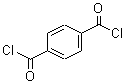
Molecular StructureCAS # 100-20-9, Terephthaloyl chloride
Molecular FormulaC8H4Cl2O2
Molecular Weight203.02
CAS Registry Number100-20-9
EC Number202-829-5
SMILESC1=CC(=CC=C1C(=O)Cl)C(=O)Cl
Properties
Density1.4±0.1 g/cm3, Calc.*
Melting point79-83 °C
Index of Refraction1.571, Calc.*
Boiling Point266.0±0.0 °C (760 mmHg), Calc.*, 265 °C
Flash Point143.1±18.2 °C, Calc.*, 180 °C
Water solubilityREACTS
*Calculated using Advanced Chemistry Development (ACD/Labs) Software.
Safety Data
Hazard Symbolssymbol symbol   GHS05;GHS06 Danger  Details
Risk StatementsH314-H331  Details
Safety StatementsP260-P261-P264-P271-P280-P301+P330+P331-P302+P361+P354-P304+P340-P305+P354+P338-P316-P321-P363-P403+P233-P405-P501  Details
Hazard Classification
up    Details
HazardClassCategory CodeHazard Statement
Acute toxicityAcute Tox.3H331
Skin corrosionSkin Corr.1AH314
Serious eye damageEye Dam.1H318
Specific target organ toxicity - single exposureSTOT SE3H335
Substances or mixtures corrosive to metalsMet. Corr.1H290
Skin corrosionSkin Corr.1BH314
Skin irritationSkin Irrit.2H315
Eye irritationEye Irrit.2H319
Skin sensitizationSkin Sens.1H317
Transport InformationUN 2928
SDSAvailable
up Discovery and Applications
Terephthaloyl chloride, a diacid chloride with the molecular formula C₈H₄Cl₂O₂, is a key industrial chemical known for its application in producing high-performance polymers. First synthesized in the early 20th century, terephthaloyl chloride gained prominence as the need for strong, durable, and heat-resistant synthetic materials increased. This compound is derived from terephthalic acid, where two chlorine atoms replace the hydroxyl groups, forming an acyl chloride. Its high reactivity with compounds containing hydroxyl or amine groups enables it to form robust polymer chains, which makes it invaluable in polymer chemistry.

In terms of structure, terephthaloyl chloride has two acyl chloride groups attached to a benzene ring in a para configuration. This arrangement allows for symmetrical, linear polymerization, which contributes to the mechanical strength and stability of the polymers it forms. Its synthesis typically involves the reaction of terephthalic acid with a chlorinating agent, often thionyl chloride or oxalyl chloride. Terephthaloyl chloride's reactivity is both an asset and a limitation, as it must be handled under controlled conditions to prevent unwanted reactions with moisture or air.

The most well-known application of terephthaloyl chloride is in the production of aramid fibers, specifically Kevlar and Nomex, which are widely used for their outstanding strength-to-weight ratios and thermal resistance. In these applications, terephthaloyl chloride reacts with p-phenylenediamine to form poly-paraphenylene terephthalamide, a polymer known for its ability to withstand high temperatures and resist deformation under stress. These properties make aramid fibers ideal for protective clothing, such as bulletproof vests, fire-resistant suits, and various industrial applications where durability and safety are essential.

Terephthaloyl chloride is also used in manufacturing polyesters and high-performance thermoplastics. In the production of polyesters, its reactivity with diols produces linear, high-molecular-weight polymers that find applications in packaging, textiles, and engineering plastics. Due to its high reactivity and corrosive nature, strict handling and storage conditions are necessary, typically under inert atmospheres to avoid hydrolysis and other side reactions.

The discovery and development of terephthaloyl chloride have been pivotal in advancing materials science, particularly in creating resilient and high-temperature-resistant polymers. As demand for lightweight, durable materials continues to grow, terephthaloyl chloride remains a crucial compound in polymer synthesis and an essential material in various safety and industrial products.

References

1. Synthesis: Morgan, P. W. (1965). "Synthesis of terephthaloyl chloride via phosgenation." Journal of Polymer Science Part A, 3(1), 209-216.
DOI: 10.1002/pol.1965.100030118

2. Applications: Carothers, W. H., et al. (1931). "Polyester synthesis using terephthaloyl chloride." Journal of the American Chemical Society, 53(11), 4203-4210.
DOI: 10.1021/ja01362a031

3. Review: Eastmond, G. C. (2000). "Polyamides and polyesters: Terephthaloyl chloride." Progress in Polymer Science, 25(6), 743-779.
DOI: 10.1016/S0079-6700(00)00016-8
Market Analysis Reports
List of Reports Available for Terephthaloyl chloride
Related Products
Terephthalic Ac...  Terephthalic ac...  Terephthalic Ac...  Terephthalic ac...  Terephthalic Ac...  Terephthalic ac...  Terephthalic ac...  Terephthalimida...  alpha,alpha'-Te...  1,1'-Terephthal...  Terephthaloyl D...  Terephthaloyl d...  N,N'-Terephthal...  Terephthalylide...  Terephthalylide...  Tereticornate A  Terfenadine  Terfluranol  Terguride  S-(-)-Terguride...