
Online Database of Chemicals from Around the World
| SRI Neelima Laboratories | India | |||
|---|---|---|---|---|
 | www.srineelimalaboratories.com | |||
 | +91 (984) 973-6989 | |||
 | sales@srineelimalaboratories.com | |||
| Chemical manufacturer | ||||
| chemBlink Standard supplier since 2011 | ||||
| Biosynth AG. | Switzerland | |||
|---|---|---|---|---|
| www.biosynth.com | |||
| +41 (71) 858-2020 | |||
 | +41 (71) 858-2030 | |||
| welcome@biosynth.ch | |||
| Chemical manufacturer | ||||
| chemBlink Standard supplier since 2014 | ||||
| Labseeker Inc | USA | |||
|---|---|---|---|---|
| www.labseeker.com | |||
| +1 (858) 750-1632 | |||
| +1 (858) 412-1220 | |||
| marketing@labseeker.com | |||
| Chemical manufacturer since 2002 | ||||
| chemBlink Standard supplier since 2015 | ||||
| Kemystery Chemicals Private Limited | India | |||
|---|---|---|---|---|
| www.kemystery.com | |||
| +91 9963066966 | |||
| sales@kemystery.com | |||
| Chemical manufacturer since 2019 | ||||
| chemBlink Standard supplier since 2019 | ||||
| R&D Scientific Inc. | Canada | |||
|---|---|---|---|---|
| www.rdscientific.com | |||
| +1 (226) 600-0236 | |||
| sales@rdscientific.com | |||
| Chemical manufacturer since 2016 | ||||
| chemBlink Standard supplier since 2023 | ||||
| Shenzhen Geneseqtools Bioscience & Technology Co. Ltd. | China | |||
|---|---|---|---|---|
| geneseqtools.com | |||
| +86 (0755) 2325-1735 | |||
| sales@geneseqtools.com | |||
 | QQ Chat | |||
 | WeChat: 13302967066 | |||
| Chemical manufacturer since 2015 | ||||
| chemBlink Standard supplier since 2025 | ||||
| Santa Cruz Biotechnology, Inc. | USA | |||
|---|---|---|---|---|
| www.scbt.com | |||
| +1 (831) 457-3800 | |||
| +1 (831) 457-3801 | |||
| scbt@scbt.com | |||
| Chemical manufacturer | ||||
| Melford Laboratories Limited | UK | |||
|---|---|---|---|---|
| www.melford.co.uk | |||
| +44 (1449) 741-178 | |||
| +44 (1449) 741-217 | |||
| pfranklin@melford.co.uk sales@melford.co.uk | |||
| Chemical manufacturer since 1985 | ||||
| Classification | Organic raw materials >> Heterocyclic compound >> Indoles |
|---|---|
| Name | 5-Bromo-4-chloro-3-indolyl phosphate disodium salt |
| Synonyms | disodium (5-bromo-4-chloro-1H-indol-3-yl) phosphate |
| Molecular Structure | 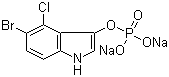 |
| Molecular Formula | C8H4BrClNO4P.2Na |
| Molecular Weight | 370.43 |
| CAS Registry Number | 102185-33-1 |
| EC Number | 600-286-2 |
| SMILES | C1=CC(=C(C2=C1NC=C2OP(=O)([O-])[O-])Cl)Br.[Na+].[Na+] |
| Melting point | 300 °C (Expl.) |
|---|---|
| Solubility | H2O: 20 mg/mL (Expl.) |
| Hazard Symbols |  GHS07 Warning Details GHS07 Warning Details |
|---|---|
| Risk Statements | H319-H315-H335 Details |
| Safety Statements | P261-P271-P280 Details |
| SDS | Available |
 chemBlink Chemical Story
|
5-Bromo-4-chloro-3-indolyl phosphate disodium salt is a synthetic chromogenic substrate widely used in molecular biology and biochemistry for the detection of enzymatic activity, particularly that of alkaline phosphatase. This compound is structurally derived from indole, substituted at the 5- and 4-positions with bromine and chlorine atoms, respectively, and features a phosphate ester moiety at the 3-position, forming a disodium salt to enhance water solubility. The compound was developed as part of efforts to create sensitive and stable substrates for use in immunoassays and blotting techniques. Its utility stems from its ability to yield a colored precipitate upon enzymatic cleavage. In the presence of alkaline phosphatase, 5-bromo-4-chloro-3-indolyl phosphate (BCIP) undergoes dephosphorylation to form an indolyl intermediate, which spontaneously dimerizes and oxidizes in situ to generate a blue-purple precipitate. This visible product enables the qualitative and semi-quantitative detection of phosphatase activity directly on membranes or in tissue samples. BCIP is frequently used in conjunction with nitro blue tetrazolium (NBT) in colorimetric detection systems. When both substrates are used together, alkaline phosphatase catalyzes the conversion of BCIP, and the oxidized indolyl intermediate reduces NBT to an insoluble dark blue formazan product. This system provides a highly sensitive and permanent signal that is stable under ambient light and storage conditions. It is particularly useful in applications such as Western blotting, in situ hybridization, immunohistochemistry, and enzyme-linked immunosorbent assays (ELISAs), where it allows visualization of antibody or probe binding. In molecular biology research, BCIP/NBT is often employed as a detection method for probes bound to nucleic acids on nitrocellulose or nylon membranes. The technique facilitates the analysis of gene expression patterns and the presence of specific DNA or RNA sequences. The resulting blue coloration indicates successful hybridization or antigen detection, and its intensity can be correlated to the amount of target molecule present. In histological studies, BCIP has also been used for localization of phosphatase enzyme activity in tissue samples. The insoluble product formed remains fixed at the site of enzymatic activity, allowing microscopic examination of cellular and tissue-specific expression patterns. This has been valuable in developmental biology, pathology, and the study of cellular differentiation. The substrate is typically provided as a disodium salt to improve solubility in aqueous buffers and to ensure compatibility with biological samples. It is generally stable under standard storage conditions and can be prepared as a stock solution in water or dimethylformamide for experimental use. Although highly effective in non-radioactive labeling systems, precautions must be taken when handling BCIP due to its potential as an irritant. Laboratory safety guidelines recommend the use of gloves and protective eyewear, and solutions should be handled in well-ventilated areas. Waste disposal should be conducted in accordance with local environmental regulations due to the generation of halogenated aromatic byproducts. The development and application of 5-bromo-4-chloro-3-indolyl phosphate disodium salt represent a significant advancement in the field of bioanalytical chemistry, providing researchers with a reliable, sensitive, and visually discernible method to detect and quantify enzyme activity and molecular interactions across a wide range of biological and diagnostic systems. References 1998. A mitogen‐activated protein (MAP) kinase homologue of Leishmania mexicana is essential for parasite survival in the infected host. The EMBO Journal, 17(9). DOI: 10.1093/emboj/17.9.2619 2014. Discovery of novel enzymes with industrial potential from a cold and alkaline environment by a combination of functional metagenomics and culturing. Microbial Cell Factories, 13(72). DOI: 10.1186/1475-2859-13-72 2024. Paper Analytical Device for the Colourimetric Detection of Alkaline Phosphatase in Serum and Saliva. Journal of Analysis and Testing, 8(3). DOI: 10.1007/s41664-024-00304-3 |
| Market Analysis Reports |