
Online Database of Chemicals from Around the World
| Shenzhen Geneseqtools Bioscience & Technology Co. Ltd. | China | |||
|---|---|---|---|---|
 | geneseqtools.com | |||
 | +86 (0755) 2325-1735 | |||
 | sales@geneseqtools.com | |||
 | QQ Chat | |||
 | WeChat: 13302967066 | |||
| Chemical manufacturer since 2015 | ||||
| chemBlink Standard supplier since 2025 | ||||
| Ambinter | France | |||
|---|---|---|---|---|
| www.ambinter.com | |||
| +33 (1) 4524-4860 | |||
 | +33 (1) 4524-6241 | |||
| contact@ambinter.com | |||
| Chemical manufacturer | ||||
| Classification | Pharmaceutical intermediate >> Heterocyclic compound intermediate >> Pyran compound |
|---|---|
| Name | 2-Chloro-4-nitrophenyl 2-(acetylamino)-2-deoxy-beta-D-glucopyranoside |
| Synonyms | N-[(2S,3R,4R,5S,6R)-2-(2-chloro-4-nitrophenoxy)-4,5-dihydroxy-6-(hydroxymethyl)oxan-3-yl]acetamide |
| Molecular Structure | 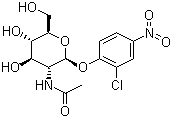 |
| Molecular Formula | C14H17ClN2O8 |
| Molecular Weight | 376.75 |
| CAS Registry Number | 103614-82-0 |
| SMILES | CC(=O)N[C@@H]1[C@H]([C@@H]([C@H](O[C@H]1OC2=C(C=C(C=C2)[N+](=O)[O-])Cl)CO)O)O |
| Density | 1.6±0.1 g/cm3 Calc.* |
|---|---|
| Boiling point | 700.8±60.0 °C 760 mmHg (Calc.)* |
| Flash point | 377.7±32.9 °C (Calc.)* |
| Index of refraction | 1.629 (Calc.)* |
| * | Calculated using Advanced Chemistry Development (ACD/Labs) Software. |
| Hazard Symbols |  GHS07 Warning Details GHS07 Warning Details |
|---|---|
| Risk Statements | H317-H319 Details |
| Safety Statements | P280-P305+P351+P338 Details |
| SDS | Available |
 chemBlink Chemical Story
|
2-Chloro-4-nitrophenyl 2-(acetylamino)-2-deoxy-β-D-glucopyranoside is a synthetic compound widely utilized in biochemical research, particularly in enzymology for the study of glycosidase activity. This molecule is structurally characterized as a chromogenic substrate for β-N-acetylglucosaminidase, an enzyme involved in the hydrolysis of N-acetyl-β-D-glucosaminides, commonly found in lysosomes and other biological systems. The compound features a glucopyranoside moiety bearing an acetylamino group at the 2-position, linked to a 2-chloro-4-nitrophenyl aglycone, which serves as a chromophore. The discovery and subsequent synthesis of this compound emerged from efforts to develop reliable and sensitive assays for detecting specific glycosidase activities. Traditional methods for enzyme activity assessment relied on natural substrates, which often lacked sufficient sensitivity and specificity for analytical applications. The use of chromogenic or fluorogenic substrates addressed this limitation by enabling direct spectrophotometric or fluorometric detection of enzymatic reactions. Among chromogenic moieties, the 2-chloro-4-nitrophenyl group is particularly effective due to its distinct absorbance properties upon enzymatic cleavage, releasing 2-chloro-4-nitrophenol, which absorbs strongly at 400 nm under alkaline conditions. 2-Chloro-4-nitrophenyl 2-(acetylamino)-2-deoxy-β-D-glucopyranoside has become an established tool in the biochemical characterization of β-N-acetylglucosaminidase activity in a variety of organisms and tissues. It is extensively used in clinical enzymology to monitor lysosomal function, as well as in microbiology and plant sciences to study the role of glycosidases in cell wall remodeling and degradation of chitin and other glycopolymers. In the context of human pathology, assays involving this substrate assist in the diagnosis of lysosomal storage diseases, where abnormal activity levels of glycosidases may be indicative of genetic defects such as those found in Tay-Sachs disease or Sandhoff disease. The substrate's utility also extends to pharmacological research, where it is employed in high-throughput screening of potential inhibitors targeting glycosidases. Inhibitors of β-N-acetylglucosaminidase are of interest due to their potential therapeutic applications in cancer, neurodegenerative diseases, and immune modulation. By using 2-chloro-4-nitrophenyl-linked glucosides, researchers can efficiently identify compounds that modulate enzyme activity through inhibition kinetics measured spectrophotometrically. Another application is found in synthetic biology and enzymatic engineering, where this compound is used to evaluate the activity of engineered or mutated glycosidases. It provides a rapid and quantifiable means of comparing enzyme variants and optimizing biocatalytic efficiency for specific industrial or therapeutic uses. In practical laboratory settings, 2-chloro-4-nitrophenyl 2-(acetylamino)-2-deoxy-β-D-glucopyranoside is typically prepared in aqueous buffer systems and used under controlled pH conditions to ensure optimal enzyme-substrate interactions and accurate detection. The liberated 2-chloro-4-nitrophenol product can be monitored continuously, allowing real-time measurement of enzymatic kinetics. This property makes it particularly suitable for mechanistic studies and enzyme inhibition assays. The synthesis of this compound involves glycosylation of the acetylated glucosamine derivative with 2-chloro-4-nitrophenol under conditions that favor β-glycosidic linkage formation. The resulting product is purified and characterized using standard analytical techniques such as NMR spectroscopy and HPLC, ensuring the correct stereochemistry and purity necessary for quantitative assays. The development of chromogenic substrates such as 2-chloro-4-nitrophenyl 2-(acetylamino)-2-deoxy-β-D-glucopyranoside represents a significant advancement in enzymology and diagnostics. Its sensitivity, specificity, and ease of use have made it an indispensable reagent in both research and clinical laboratories worldwide. References 1988. Kinetic rate assay of urinary N-acetyl-beta-D-glucosaminidase with 2-chloro-4-nitrophenyl-N-acetyl-beta-D-glucosaminide as substrate. Clinical Chemistry, 34(10). DOI: 10.1093/clinchem/34.10.2140 1990. Improved kinetic rate assay of urinary N-acetyl-beta-D-glucosaminidase with 2-chloro-4-nitrophenyl-N-acetyl-beta-D-glucosaminide as substrate. Clinical Chemistry, 36(2). DOI: 10.1093/clinchem/36.2.319 |
| Market Analysis Reports |