
Online Database of Chemicals from Around the World
| Simagchem Corporation | China | |||
|---|---|---|---|---|
 | www.simagchem.com | |||
 | +86 13806087780 | |||
 | +86 (592) 268-0237 | |||
 | sale@simagchem.com | |||
| Chemical manufacturer since 2002 | ||||
| chemBlink Standard supplier since 2008 | ||||
| Nanjing MSN Chemical Co., Ltd. | China | |||
|---|---|---|---|---|
| www.msnchem.com | |||
| +86 (25) 5701-5632 +86 18013328036 | |||
| +86 (25) 5701-9235 | |||
| info@msnchem.com | |||
 | QQ Chat | |||
 | Skype Chat | |||
| Chemical manufacturer since 2013 | ||||
| chemBlink Standard supplier since 2008 | ||||
| Yancheng Chunzhu Aroma Co., Ltd. | China | |||
|---|---|---|---|---|
| www.chunzhuaroma.com | |||
| +86 (515) 8870-1066 | |||
| +86 (515) 8870-4773 | |||
| sales@chunzhuaroma.com | |||
| Chemical manufacturer since 1986 | ||||
| chemBlink Standard supplier since 2009 | ||||
| Extrasynthese Chemical S.A.S. | France | |||
|---|---|---|---|---|
| www.extrasynthese.com | |||
| +33 (47) 898-2034 | |||
| +33 (47) 898-1945 | |||
| info@extrasynthese.com | |||
| Chemical manufacturer | ||||
| chemBlink Standard supplier since 2009 | ||||
| Hefei TNJ Chemical Industry Co., Ltd. | China | |||
|---|---|---|---|---|
| www.tnjchem.com | |||
| +86 (551) 6541-8684 | |||
| +86 (551) 6541-8697 | |||
| sales@tnjchem.com | |||
| Chemical manufacturer since 2001 | ||||
| chemBlink Standard supplier since 2010 | ||||
| Neostar United (Changzhou) Industrial Co., Ltd. | China | |||
|---|---|---|---|---|
| www.neostarunited.com | |||
| +86 (519) 8555-7386 +86 18015025600 | |||
| +86 (519) 8555-7389 | |||
| marketing1@neostarunited.com | |||
| Chemical distributor since 2014 | ||||
| chemBlink Standard supplier since 2020 | ||||
| Clinivex Enterprises Inc | Canada | |||
|---|---|---|---|---|
| theclinivex.com | |||
| +1 (877) 861-1996 | |||
| info@theclinivex.com | |||
| Chemical distributor since 2018 | ||||
| chemBlink Standard supplier since 2021 | ||||
| Santa Cruz Biotechnology, Inc. | USA | |||
|---|---|---|---|---|
| www.scbt.com | |||
| +1 (831) 457-3800 | |||
| +1 (831) 457-3801 | |||
| scbt@scbt.com | |||
| Chemical manufacturer | ||||
| Yancheng China Flavor Chemicals Co., Ltd. | China | |||
|---|---|---|---|---|
| www.qia-aina.com | |||
| +86 (515) 8788-3448 +86 13004488068 | |||
| +86 (515) 8788-3148 | |||
| sales@qia-aina.com | |||
| Chemical manufacturer since 1996 | ||||
| Interchim | France | |||
|---|---|---|---|---|
| www.interchim.com | |||
| +33 (4) 7003-7301 | |||
| interfine@mail.interchim.fr | |||
| Chemical manufacturer | ||||
| Shanghai Worldyang Chemical Co., Ltd. | China | |||
|---|---|---|---|---|
| www.worldyachem.com | |||
| +86 13651600618 +86 (21) 5679-5779 | |||
| +86 (21) 5679-5266 | |||
| sales7777@worldyachem.com | |||
| QQ Chat | |||
 | WeChat: 13651600618 | |||
 | WhatsApp:+86 13651600618 | |||
| Chemical manufacturer since 2012 | ||||
| Classification | Flavors and spices >> Synthetic spice >> Carboxylic acid and ester perfume >> Aliphatic carboxylate |
|---|---|
| Name | Ethyl isovalerate |
| Synonyms | ethyl 3-methylbutanoate |
| Molecular Structure | 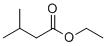 |
| Molecular Formula | C7H14O2 |
| Molecular Weight | 130.19 |
| CAS Registry Number | 108-64-5 |
| EC Number | 203-602-3 |
| FEMA | 2463 |
| SMILES | CCOC(=O)CC(C)C |
| Density | 0.9±0.1 g/cm3 Calc.*, 0.864 g/mL (Expl.) |
|---|---|
| Melting point | -99 °C (Expl.) |
| Boiling point | 135.1±8.0 °C 760 mmHg (Calc.)*, 131 - 133 °C (Expl.) |
| Flash point | 26.7 °C (Calc.)*, 27 °C (Expl.) |
| Index of refraction | 1.404 (Calc.)*, 1.396 (Expl.) |
| * | Calculated using Advanced Chemistry Development (ACD/Labs) Software. |
| Hazard Symbols |   GHS02;GHS07 Warning Details GHS02;GHS07 Warning Details | ||||||||||||||||||||
|---|---|---|---|---|---|---|---|---|---|---|---|---|---|---|---|---|---|---|---|---|---|
| Risk Statements | H226-H315 Details | ||||||||||||||||||||
| Safety Statements | P210-P233-P240-P241-P242-P243-P264-P280-P302+P352-P303+P361+P353-P321-P332+P317-P362+P364-P370+P378-P403+P235-P501 Details | ||||||||||||||||||||
| Hazard Classification | |||||||||||||||||||||
| |||||||||||||||||||||
| Transport Information | UN 1993 | ||||||||||||||||||||
| SDS | Available | ||||||||||||||||||||
 chemBlink Chemical Story
|
Ethyl isovalerate is an organic ester with the molecular formula C7H14O2. Structurally, it is the ethyl ester of isovaleric acid (3-methylbutanoic acid), formed by the condensation of isovaleric acid with ethanol. The compound is a clear, colorless liquid at room temperature and is known for its pleasant, fruity odor reminiscent of apple or pineapple, which contributes to its widespread use in flavorings and fragrances. The compound was first characterized in the 19th century during early investigations into natural product chemistry and the synthesis of esters from carboxylic acids and alcohols. Like many simple esters, ethyl isovalerate can be synthesized by Fischer esterification, a classical method that involves heating isovaleric acid with ethanol in the presence of an acid catalyst, typically sulfuric acid, to promote ester formation and water removal. Ethyl isovalerate is naturally present in certain fruits and fermented products, although in low concentrations. Its characteristic aroma makes it useful in the flavor and fragrance industry, where it is used to impart fruity notes in food products, beverages, and perfumes. It is especially valued in artificial flavoring formulations that mimic apple, pear, and tropical fruit profiles. In these applications, ethyl isovalerate is considered a safe additive and is approved by regulatory authorities such as the U.S. Food and Drug Administration and the European Food Safety Authority for use in food products within specified concentration limits. Beyond its role in flavorings, ethyl isovalerate is used in the formulation of fragrances for personal care products, household cleaners, and air fresheners. Its volatility and mild, pleasant scent make it an effective component of fragrance blends. The ester is also employed in the preparation of perfumes and colognes, where it functions as a top note that provides an initial impression of freshness and fruitiness. In chemical synthesis, ethyl isovalerate serves as a model ester compound for studying esterification, hydrolysis, and other reactions involving ester functional groups. It may be used in laboratory experiments to demonstrate acid- or base-catalyzed hydrolysis, yielding isovaleric acid and ethanol. These reactions are useful in teaching organic chemistry principles related to nucleophilic acyl substitution and equilibrium control. Although not widely used in pharmaceuticals or industrial manufacturing, ethyl isovalerate has some relevance as a solvent or intermediate in the synthesis of fine chemicals and specialty products. It can dissolve certain resins and organic compounds, making it occasionally useful in coating formulations and analytical applications. From a safety and environmental standpoint, ethyl isovalerate is classified as a compound of low toxicity. It may cause mild irritation upon skin or eye contact but does not present significant health risks when used in typical concentrations found in consumer products. It is flammable and should be stored away from ignition sources. In environmental terms, it is biodegradable and not considered a persistent organic pollutant. In summary, ethyl isovalerate is a well-characterized ester widely used in the flavor and fragrance industries due to its fruity aroma. It is naturally occurring, easily synthesized, and approved for use in food and cosmetic applications. Its utility in both industrial and educational settings reflects the importance of small esters in organic chemistry and commercial formulations. References 1976. Hydrolysis of ethyl isovalerate in aqueous hydrochloric and sulfuric acid solutions. Bulletin of the Academy of Sciences of the USSR, Division of chemical science, 25(7). DOI: 10.1007/bf00920808 1987. Production of flavor esters by immobilized lipase. Biotechnology Letters, 9(10). DOI: 10.1007/bf01024605 2023. Prediction of sensory attributes in winemaking grapes by on-line near-infrared spectroscopy based on selected volatile aroma compounds. Analytical and Bioanalytical Chemistry, 415(12). DOI: 10.1007/s00216-023-04549-2 |
| Market Analysis Reports |