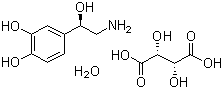
L-Norepinephrine bitartrate, CAS 108341-18-0, is the bitartrate monohydrate salt of norepinephrine, a principal endogenous catecholamine neurotransmitter and hormone. USP distinguishes this hydrated identity from anhydrous norepinephrine bitartrate. Norepinephrine strongly activates alpha-adrenergic receptors and also beta1 receptors. Intravenous norepinephrine is a foundational vasopressor for severe acute hypotension, including septic shock, because alpha-mediated vasoconstriction raises vascular tone. The salt form supports pharmaceutical formulation, while norepinephrine is the active species after dissolution. Its catechol ring is oxidation-sensitive, making formulation and storage chemistry important.
The exact registry identity matters because related free forms, salts, hydrates, stereoisomers, process intermediates and finished medicines can have separate CAS numbers even when their names share a familiar stem. In pharmaceutical and fine-chemical work this distinction is practical: composition changes formula weight and can alter solubility, crystallization, analytical standards, manufacturing specifications and interpretation of physical-property data.
The molecule also illustrates how chemists use functional groups as deliberate handles. Aromatic rings and heterocycles establish shape and electronic character, while amines, alcohols, carbonyl groups, carboxylic acids, esters or ionic centers control reactivity and intermolecular interactions. In a multistep route, an intermediate may be valuable precisely because one group can be transformed selectively while another survives for a later operation.
Modern development is equally an analytical problem. Chemists must demonstrate identity and purity, control stereochemistry or salt composition where relevant, follow process-related impurities and establish reproducible specifications. Reference materials and isolated intermediates therefore have scientific importance even when they are never administered to a patient or sold as the final commercial product.
A careful Chemical Story must distinguish documented use from structural possibility. A familiar scaffold can suggest a biological hypothesis, but resemblance is not evidence that the exact CAS substance has been tested, approved or commercially adopted for that purpose. The account therefore emphasizes verified identity, development history and supported applications, and deliberately leaves unsupported claims out.
Seen more broadly, the compound shows that useful molecular design rarely depends on one functional group in isolation. Performance emerges from the whole structure, stereochemistry and physical form, the route used to make it, and the environment in which it operates. Connecting those molecular details to a real manufacturing, analytical or therapeutic role turns a technical registry entry into a meaningful chemical story.
The exact registry identity matters because related free forms, salts, hydrates, stereoisomers, process intermediates and finished medicines can have separate CAS numbers even when their names share a familiar stem. In pharmaceutical and fine-chemical work this distinction is practical: composition changes formula weight and can alter solubility, crystallization, analytical standards, manufacturing specifications and interpretation of physical-property data.
The molecule also illustrates how chemists use functional groups as deliberate handles. Aromatic rings and heterocycles establish shape and electronic character, while amines, alcohols, carbonyl groups, carboxylic acids, esters or ionic centers control reactivity and intermolecular interactions. In a multistep route, an intermediate may be valuable precisely because one group can be transformed selectively while another survives for a later operation.
Modern development is equally an analytical problem. Chemists must demonstrate identity and purity, control stereochemistry or salt composition where relevant, follow process-related impurities and establish reproducible specifications. Reference materials and isolated intermediates therefore have scientific importance even when they are never administered to a patient or sold as the final commercial product.
References:
1. USP-NF. Norepinephrine Bitartrate monograph.
2. PubChem. Norepinephrine Bitartrate.
3. Surviving Sepsis Campaign Guidelines, 2021.
|




 GHS06 Danger Details
 chemBlink Chemical Story