
Online Database of Chemicals from Around the World
| BOC Sciences | USA | |||
|---|---|---|---|---|
 | www.bocsci.com | |||
 | +1 (631) 485-4226 | |||
 | +1 (631) 614-7828 | |||
 | info@bocsci.com | |||
| Chemical manufacturer | ||||
| chemBlink Standard supplier since 2010 | ||||
| Suzhou Myland Pharm & Nutrition Inc. | China | |||
|---|---|---|---|---|
| www.mylandpharm.com | |||
| +86 (512) 6615-0687 | |||
| +86 (512) 6615-7101 | |||
| info@mylandpharm.com | |||
 | QQ Chat | |||
| Chemical manufacturer since 2013 | ||||
| chemBlink Standard supplier since 2014 | ||||
| Shanghai Angewchem Co., Ltd. | China | |||
|---|---|---|---|---|
| www.angewchem.com | |||
| +86 18917157435 | |||
| dylan@angewchem.com | |||
| Chemical manufacturer since 2015 | ||||
| chemBlink Standard supplier since 2016 | ||||
| Zhengzhou Xlinebio Technology Co., Ltd. | China | |||
|---|---|---|---|---|
| www.xlinebio.com | |||
| +86 (371) 6131-8675 | |||
| +86 (371) 6131-8675 | |||
| sales@xlinebio.com | |||
| Chemical manufacturer since 2017 | ||||
| chemBlink Standard supplier since 2018 | ||||
| Xi'an Yinherb Bio-tech Co., Ltd | China | |||
|---|---|---|---|---|
| yinherb.ecer.com | |||
| +86 (29) 6333-2330 | |||
| sales@yinherb-nutraceuticals.com | |||
| QQ Chat | |||
| Chemical manufacturer since 2009 | ||||
| chemBlink Standard supplier since 2021 | ||||
| Demeikai (hongkong) biotechnology Co., Ltd. | China | |||
|---|---|---|---|---|
| www.hkdmk.com | |||
| +86 18942921723 | |||
| wzh@dmksw.xin | |||
 | Skype Chat | |||
| Chemical distributor since 2017 | ||||
| chemBlink Standard supplier since 2021 | ||||
| Classification | API >> Other chemicals |
|---|---|
| Name | Fasoracetam |
| Synonyms | (R)-1-[(5-Oxo-2-pyrrolidinyl)carbonyl]piperidine; NS 105; NS 105 (pharmaceutical); (5R)-5-(piperidine-1-carbonyl)pyrrolidin-2-one |
| Molecular Structure | 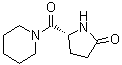 |
| Molecular Formula | C10H16N2O2 |
| Molecular Weight | 196.25 |
| Protein Sequence | X |
| CAS Registry Number | 110958-19-5 |
| SMILES | C1CCN(CC1)C(=O)[C@H]2CCC(=O)N2 |
| Solubility | Sparingly soluble (14 g/L) (25 °C), Calc.* |
|---|---|
| Density | 1.181±0.06 g/cm3 (20 °C 760 Torr), Calc.* |
| Boiling point | 456.8±38.0 °C 760 mmHg (Calc.)* |
| Flash point | 230.1±26.8 °C (Calc.)* |
| Index of refraction | 1.528 (Calc.)* |
| * | Calculated using Advanced Chemistry Development (ACD/Labs) Software. |
 chemBlink Chemical Story
|
Fasoracetam is a synthetic compound belonging to the racetam class of nootropic agents, structurally characterized by a pyrrolidone (2-oxopyrrolidine) core common to this family of molecules. It was originally developed in Japan during research into cognitive function and neurological modulation, particularly in the context of age-related cognitive decline and memory impairment models. The molecular structure of fasoracetam contains three main components: a cyclic pyrrolidone ring, a morpholine moiety, and an acetamide-related substituent. The pyrrolidone ring is a defining feature of racetams and contributes to the compound’s polarity and hydrogen-bonding capacity. This structural motif is chemically stable and is believed to play a role in interactions with neural systems, although the exact molecular binding targets of racetams are not fully established in the literature. The morpholine ring introduces additional heteroatoms (oxygen and nitrogen), increasing polarity and enabling potential hydrogen-bonding interactions. Morpholine-containing structures are relatively common in medicinal chemistry due to their balance of hydrophilicity and lipophilicity, which can influence membrane permeability and pharmacokinetic behavior. Fasoracetam has been investigated in preclinical and clinical contexts for its effects on neurotransmitter systems, particularly those involving glutamate and gamma-aminobutyric acid (GABA). Experimental studies have suggested that it may modulate metabotropic glutamate receptors (mGluRs) and influence cyclic AMP signaling pathways. These effects have been studied in relation to cognition, memory formation, and attention-related processes. However, the precise molecular mechanism of action remains not fully defined. In terms of physicochemical properties, fasoracetam is a relatively polar organic compound due to its multiple heteroatoms and carbonyl functionality. The presence of amide and lactam groups allows for hydrogen bonding with aqueous environments, which contributes to its solubility characteristics. At the same time, the cyclic structures provide sufficient hydrophobic character to allow membrane permeability. Like other racetam compounds, fasoracetam does not contain strongly basic or acidic functional groups under physiological conditions, which generally results in a neutral charge state at biological pH. This neutrality can influence its distribution and transport across biological membranes. From a historical perspective, fasoracetam was part of a broader class of racetam derivatives developed after the introduction of piracetam, the first compound in this chemical family. Subsequent research explored structural modifications intended to alter potency, receptor interactions, and pharmacokinetic profiles. Fasoracetam represents one such derivative with a distinct heterocyclic substitution pattern. The compound has been studied in research settings related to neurodevelopmental conditions and cognitive function, but the strength and consistency of evidence regarding its clinical efficacy remain limited in peer-reviewed literature. Its pharmacological profile is still considered under investigation, particularly in terms of receptor specificity and long-term effects. Overall, fasoracetam is a synthetic racetam-class compound characterized by a pyrrolidone-based core and additional heterocyclic functionality. Its significance lies in its role as a research molecule in neuropharmacology, particularly in studies exploring glutamatergic and cyclic nucleotide signaling systems, although its precise mechanism of action has not been fully established in definitive biochemical terms. References 2025. Psychotropic Activity of 4-Substituted Pyroglutamic Acids and Their Amides and Peptides. Pharmaceutical Chemistry Journal. DOI: 10.1007/s11094-026-03480-x 2025. Neural excitation/inhibition imbalance and neurodevelopmental pathology in human copy number variant syndromes: a systematic review. Journal of Neurodevelopmental Disorders. DOI: https://www.ncbi.nlm.nih.gov/pmc/articles/PMC12147258 2024. Farnesyltransferase inhibitor lonafarnib suppresses respiratory syncytial virus infection by blocking conformational change of fusion glycoprotein. Signal Transduction and Targeted Therapy. DOI: https://www.ncbi.nlm.nih.gov/pmc/articles/PMC11163014 |
| Market Analysis Reports |