Online Database of Chemicals from Around the World

Metformin hydrochloride
[CAS# 1115-70-4]

List of Suppliers
Simagchem Corporation China Inquire
www.simagchem.com
+86 13806087780
+86 (592) 268-0237
sale@simagchem.com
Chemical manufacturer since 2002
chemBlink Standard supplier since 2008
Hefei TNJ Chemical Industry Co., Ltd. China Inquire
www.tnjchem.com
+86 (551) 6541-8684
+86 (551) 6541-8697
sales@tnjchem.com
Chemical manufacturer since 2001
chemBlink Standard supplier since 2010
SL Drugs and Pharmaceuticals Pvt. Ltd. India Inquire
www.sldrugs.com
+91 (40) 6661-1133
+91 (40) 2375-1130
enquiry@sldrugs.com
Chemical distributor since 1999
chemBlink Standard supplier since 2010
BOC Sciences USA Inquire
www.bocsci.com
+1 (631) 485-4226
+1 (631) 614-7828
info@bocsci.com
Chemical manufacturer
chemBlink Standard supplier since 2010
Creative Peptides USA Inquire
www.creative-peptides.com
+1 (631) 624-4882
+1 (631) 614-7828
info@creative-peptides.com
Chemical manufacturer
chemBlink Standard supplier since 2010
Beckmann-Kenko GmbH Germany Inquire
www.beckmann-kenko.com
+49 (4241) 930-888
+49 (4241) 930-889
info@beckmann-kenko.com
Chemical distributor
chemBlink Standard supplier since 2011
Alfa Chemistry USA Inquire
www.alfa-chemistry.com
+1 (201) 478-8534
+1 (516) 927-0118
inquiry@alfa-chemistry.com
Chemical distributor since 2012
chemBlink Standard supplier since 2012
Golden Promise Industry Int'l Co., Ltd. China Inquire
www.goldenpromiseindustry.com
+86 15065329263
goldenpromise@163.com
Chemical manufacturer since 2003
chemBlink Standard supplier since 2013
Hangzhou Leap Chem Co., Ltd. China Inquire
www.leapchem.com
+86 (571) 8771-1850
market19@leapchem.com
QQ Chat
Chemical manufacturer since 2006
chemBlink Standard supplier since 2015
Amadis Chemical Co., Ltd. China Inquire
www.amadischem.com
+86 (571) 8992-5085
+86 (571) 8992-5065
sales@amadischem.com
Chemical manufacturer since 2010
chemBlink Standard supplier since 2015
Chengdu Biopurify Phytochemicals Ltd. China Inquire
www.phytopurify.com
+86 (28) 8263-3860
8263-3987
+86 (28) 8263-3165
sales@biopurify.com
biopurify@gmail.com
QQ Chat
Skype Chat
Chemical manufacturer
chemBlink Standard supplier since 2017
Hongkong Solun Co., Limited China Inquire
www.solun.hk
+86 13486804800
hugo@solun.hk
Chemical distributor since 2016
chemBlink Standard supplier since 2017
Shanghai Medfine Bio-pharmaceutical Ltd. China Inquire
www.bio-medfine.com
+86 13013810076
tina.lv@bio-medfine.com
WeChat: 13013810076
Chemical distributor since 2023
chemBlink Standard supplier since 2023
Turtle Pharma Private Limited India Inquire
www.turtlepharma.com
+91 9850998504
info@turtlepharma.com
Chemical manufacturer since 2015
chemBlink Standard supplier since 2024
AK Scientific, Inc USA Inquire
www.aksci.com
+1 (510) 429-8835
+1 (510) 429-8836
sales@aksci.com
Chemical manufacturer
Shanghai Univic International Trading Corporation China Inquire
www.sh-univic.com
+86 (21) 5836-0151
5836-0152
+86 (21) 5836-0153
info@sh-univic.com
Chemical distributor
Kemprotec Limited UK Inquire
www.kemprotec.com
+44 (1642) 591-764
+44 (1845) 550-001
sales@kemprotec.co.uk
Chemical distributor since 1998
VDM Biochemicals USA Inquire
www.vdmbio.com
+1 (330) 252-8181
+1 (330) 252-8171
sales@vdmbio.com
info@vdmbio.com
Chemical manufacturer
Jintan Tianyuan Institute Of Pharmaceuitcal Chemicals China Inquire
www.tianyuan-pharm.com
+86 (519) 8255-2658
8228-2658
+86 (519) 8255-8658
zly@tianyuan-pharm.com
Chemical manufacturer
Ivy Fine Chemicals USA Inquire
www.ivychem.com
+1 (856) 465-8550
+1 (856) 616-1161
sales@ivychem.com
Chemical manufacturer

Identification
ClassificationAPI >> Hormone and endocrine-regulating drugs >> Pancreatic hormones and other blood sugar regulating drugs
NameMetformin hydrochloride
Synonyms1,1-Dimethylbiguanide hydrochloride
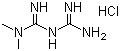
Molecular StructureCAS # 1115-70-4, Metformin hydrochloride
Molecular FormulaC4H11N5.HCl
Molecular Weight165.62
CAS Registry Number1115-70-4 (15537-72-1)
EC Number214-230-6
SMILESCN(C)C(=N)N=C(N)N.Cl
Properties
Solubility50mg/mL (DMSO)
Melting point223-226 °C
Safety Data
Hazard Symbolssymbol   GHS07 Warning  Details
Risk StatementsH302-H315-H319-H335-H412  Details
Safety StatementsP261-P264-P270-P271-P273-P280-P301+P312-P302+P352-P304+P340-P305+P351+P338-P312-P330-P332+P313-P337+P313-P362-P403+P233-P405-P501  Details
Hazard Classification
up    Details
HazardClassCategory CodeHazard Statement
Acute toxicityAcute Tox.4H302
Eye irritationEye Irrit.2H319
Skin irritationSkin Irrit.2H315
Chronic hazardous to the aquatic environmentAquatic Chronic3H412
Specific target organ toxicity - single exposureSTOT SE3H335
Acute toxicityAcute Tox.4H312
Acute toxicityAcute Tox.4H332
Reproductive toxicityLact.-H362
Reproductive toxicityRepr.2H361
Specific target organ toxicity - repeated exposureSTOT RE1H372
Acute toxicityAcute Tox.2H312
Chronic hazardous to the aquatic environmentAquatic Chronic4H412
SDSAvailable
up Discovery and Applications
Metformin hydrochloride is a widely used oral medication primarily prescribed for the treatment of type 2 diabetes mellitus. It is known for its effectiveness in controlling blood glucose levels and its role in managing insulin resistance. The discovery and development of metformin marked a significant advancement in diabetes care, offering a safer and more effective treatment option compared to earlier drugs.

The roots of metformin’s discovery can be traced back to the use of a plant called *Galega officinalis* (goat's rue or French lilac), which had been traditionally used in folk medicine for centuries. In the early 20th century, researchers identified a compound called guanidine in this plant, which had blood sugar-lowering properties. However, guanidine itself was found to be too toxic for therapeutic use. This led to the synthesis and testing of related compounds, one of which was metformin, first described in the scientific literature in the 1920s.

Metformin was initially overshadowed by the introduction of insulin and other antidiabetic agents, and it wasn't until the 1950s that its potential was recognized. The French physician Jean Sterne conducted clinical trials that demonstrated metformin’s ability to lower blood sugar without causing severe side effects. Following these successful trials, metformin was introduced in Europe in the 1950s and later in the United States in 1995.

Metformin hydrochloride works by reducing the amount of glucose produced by the liver, increasing the sensitivity of muscle cells to insulin, and slowing the absorption of glucose from the intestines. Unlike some other antidiabetic medications, metformin does not cause significant weight gain or hypoglycemia, making it a preferred first-line treatment for type 2 diabetes. Its efficacy in reducing HbA1c levels, a marker of long-term blood glucose control, has been well-documented, contributing to its widespread use.

Beyond its primary role in diabetes management, metformin hydrochloride has also been explored for its potential benefits in other areas of health. Studies have suggested that metformin may have a protective effect against cardiovascular diseases, which are a common complication of diabetes. Additionally, there is growing interest in its possible role in cancer prevention, particularly for certain types of cancer such as breast and colorectal cancer, although more research is needed to confirm these effects.

Another area of active research is the potential use of metformin in delaying the onset of type 2 diabetes in individuals with prediabetes. Clinical trials have shown that metformin can significantly reduce the risk of developing diabetes in high-risk individuals, which has led to its consideration as a preventive treatment in certain populations.

Metformin’s relatively low cost, safety profile, and effectiveness have made it one of the most prescribed medications worldwide. It is typically taken in tablet form, with immediate-release and extended-release versions available to suit different patient needs. Despite its widespread use, metformin is not without side effects. The most common side effects include gastrointestinal issues such as nausea, diarrhea, and abdominal discomfort. Rarely, metformin can cause a serious condition called lactic acidosis, particularly in individuals with kidney or liver impairment, which is why proper patient selection and monitoring are essential.

In recent years, metformin has also been studied in the context of aging and longevity. Some research suggests that metformin may have anti-aging properties and could potentially extend lifespan by mimicking some of the effects of calorie restriction, a known intervention for increasing lifespan in various organisms. This has led to ongoing studies to evaluate metformin’s potential as a geroprotective drug, although it is not currently approved for this purpose.

In summary, metformin hydrochloride is a cornerstone in the treatment of type 2 diabetes, with a history rooted in traditional medicine and decades of clinical research. Its applications continue to expand beyond diabetes, highlighting its potential as a multifaceted therapeutic agent.

References

2024. Formulation Optimization of Metformin-Loaded Propyl Moringa Gum Beads. Journal of Pharmaceutical Innovation.
DOI: 10.1007/s12247-024-09897-9

1998. Efficacy and Metabolic Effects of Metformin and Troglitazone in Type II Diabetes Mellitus. The New England Journal of Medicine.
DOI: 10.1056/nejm199803263381303

1998. Therapeutic effects of metformin on insulin resistance and hyperandrogenism in polycystic ovary syndrome. European Journal of Endocrinology.
DOI: 10.1530/eje.0.1380269
Market Analysis Reports
List of Reports Available for Metformin hydrochloride
Related Products
Met-Enkephalina...  Met-Enkephalin-...  Met-Enkephalin-...  Metenolone  Metergotamine  Metescufylline  Metesculetol  Metethoheptazin...  Metformin  Metformin-d6, H...  H-Met-Gln-OH  Methabenzthiazu...  Methacholine br...  Methacholine Ch...  Methacrifos  trans-Methacrif...  Methacrolein-13...  Methacrolein  Methacrolein-2,...  Methacrylamide