
Online Database of Chemicals from Around the World
| Tianjin Zhongxin Chem-tech Co., Ltd. | China | |||
|---|---|---|---|---|
 | www.tjzxchem.com | |||
 | +86 (22) 6688-0623 | |||
 | +86 (22) 8988-0739 ex 8030 | |||
 | sales@tjzxchem.com | |||
| Chemical manufacturer since 2007 | ||||
| chemBlink Standard supplier since 2009 | ||||
| Anhui Royal Chemical Co., Ltd. | China | |||
|---|---|---|---|---|
| www.royal-chem.com | |||
| +86 (25) 8663-9253 | |||
| +86 (25) 5227-9193 | |||
| zoey.zhao@royal-chem.com | |||
| Chemical manufacturer since 2008 | ||||
| chemBlink Standard supplier since 2019 | ||||
| Wuxi Anbao Dyes and Chemicals Co., Ltd. | China | |||
|---|---|---|---|---|
| www.anbaochem.com | |||
| +86 (510) 8580-6868 8586-8628 | |||
| +86 (510) 8586-7207 | |||
| james_wang1@yahoo.com | |||
| Chemical manufacturer since 1992 | ||||
| Classification | Chemical reagent >> Organic reagent >> Imide |
|---|---|
| Name | N-Butylaniline |
| Synonyms | N-Phenyl-n-butylamine |
| Molecular Structure | 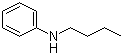 |
| Molecular Formula | C10H15N |
| Molecular Weight | 149.23 |
| CAS Registry Number | 1126-78-9 |
| EC Number | 214-425-6 |
| SMILES | CCCCNC1=CC=CC=C1 |
| Density | 0.93 |
|---|---|
| Melting point | -12 °C |
| Boiling point | 241 °C |
| Refractive index | 1.5325-1.5345 |
| Flash point | 107 °C |
| Water solubility | insoluble |
| Hazard Symbols |   GHS07;GHS08 Danger Details GHS07;GHS08 Danger Details | ||||||||||||||||||||||||||||||||
|---|---|---|---|---|---|---|---|---|---|---|---|---|---|---|---|---|---|---|---|---|---|---|---|---|---|---|---|---|---|---|---|---|---|
| Risk Statements | H302-H315-H319-H335-H370-H372 Details | ||||||||||||||||||||||||||||||||
| Safety Statements | P260-P261-P264-P264+P265-P270-P271-P280-P301+P317-P302+P352-P304+P340-P305+P351+P338-P308+P316-P319-P321-P330-P332+P317-P337+P317-P362+P364-P403+P233-P405-P501 Details | ||||||||||||||||||||||||||||||||
| Hazard Classification | |||||||||||||||||||||||||||||||||
| |||||||||||||||||||||||||||||||||
| SDS | Available | ||||||||||||||||||||||||||||||||
 chemBlink Chemical Story
|
N-Butylaniline is an organic compound that belongs to the class of secondary amines, characterized by the presence of a butyl group attached to the nitrogen atom of the aniline molecule. Its chemical formula is C10H15N, and it is commonly used in various industrial applications. N-Butylaniline was first synthesized in the late 19th century as chemists explored the properties and potential uses of aniline derivatives. The compound was isolated through the reaction of aniline with butyl bromide, providing a means to modify the functional properties of aniline for various applications. One of the primary applications of N-butylaniline is as a chemical intermediate in the production of dyes and pigments. Its ability to participate in various chemical reactions, such as alkylation and acylation, makes it a valuable building block for synthesizing a range of colorants used in textiles, plastics, and other materials. The compound’s unique structure contributes to the stability and vibrancy of the dyes produced, enhancing their commercial viability. In addition to its role in dye production, N-butylaniline is utilized in the formulation of rubber and plastics. It serves as a stabilizer and vulcanization agent, enhancing the performance and durability of rubber products. By improving the thermal and oxidative stability of rubber compounds, N-butylaniline contributes to the longevity and reliability of various rubber applications, including tires, seals, and gaskets. N-butylaniline is also employed in the synthesis of pharmaceutical compounds. Its amine functional group allows it to participate in the formation of more complex organic molecules, making it a useful intermediate in drug development. Research into the medicinal properties of N-butylaniline and its derivatives has indicated potential applications in treating various health conditions, although further studies are needed to fully understand its efficacy and safety in pharmaceutical formulations. Despite its usefulness, N-butylaniline poses certain health and environmental concerns. It is classified as a hazardous substance, with potential toxic effects on human health and the environment. Prolonged exposure to N-butylaniline can result in respiratory irritation, skin sensitization, and other adverse effects. Consequently, regulatory agencies have established guidelines for the safe handling and use of this compound in industrial settings to mitigate potential risks. Efforts are underway to develop safer alternatives to N-butylaniline in various applications, particularly in the dye and pigment industries. Researchers are exploring bio-based and less toxic compounds that can provide similar functional properties without the associated health risks. As industries increasingly prioritize sustainability and safety, the search for alternatives to traditional chemical intermediates like N-butylaniline is gaining momentum. In summary, N-butylaniline is an important organic compound with diverse applications in the dye, rubber, and pharmaceutical industries. Its discovery in the late 19th century opened the door for innovative uses of aniline derivatives, contributing to advancements in various fields. While its utility is significant, the associated health and environmental concerns necessitate careful management and ongoing research to find safer alternatives for industrial applications. References 2017. Arenesulfonylation of N-alkylanilines: reaction kinetics and mechanism. Russian Chemical Bulletin. DOI: 10.1007/s11172-017-1846-0 2017. Mutagenicities of 4-butylaniline and N-butylaniline determined by a bacterial reverse mutation (Ames) assay. Toxicology and Environmental Health Sciences. DOI: 10.1007/s13530-017-0309-1 2019. Colloidal and Nanosized Catalysts in Organic Synthesis: XXIII. Reductive Amination of Carbonyl Compounds Catalyzed by Nickel Nanoparticles in a Plug-Flow Reactor. Russian Journal of General Chemistry. DOI: 10.1134/s1070363219120016 |
| Market Analysis Reports |