
Online Database of Chemicals from Around the World
| Cn Chemunion Co., Ltd. | China | |||
|---|---|---|---|---|
 | www.cnchemunion.com | |||
 | +86 17366116869 | |||
 | david@cnchemunion.com | |||
 | QQ Chat | |||
 | WeChat: +86 15250069576 | |||
 | WhatsApp:+86 17366116869 | |||
| Chemical manufacturer since 2019 | ||||
| chemBlink Standard supplier since 2024 | ||||
| Classification | API >> Antineoplastic agents |
|---|---|
| Name | Quizartinib Dihydrochloride |
| Synonyms | 1-(5-tert-butyl-1,2-oxazol-3-yl)-3-[4-[6-(2-morpholin-4-ylethoxy)imidazo[2,1-b][1,3]benzothiazol-2-yl]phenyl]urea;dihydrochloride |
| Molecular Structure | 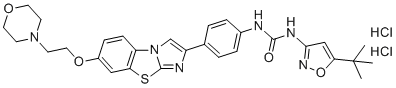 |
| Molecular Formula | C29H34Cl2N6O4S |
| Molecular Weight | 633.59 |
| CAS Registry Number | 1132827-21-4 |
| SMILES | CC(C)(C)C1=CC(=NO1)NC(=O)NC2=CC=C(C=C2)C3=CN4C5=C(C=C(C=C5)OCCN6CCOCC6)SC4=N3.Cl.Cl |
| Solubility | Soluble (DMSO) |
|---|---|
| SDS | Available |
|---|---|
 chemBlink Chemical Story
|
Quizartinib dihydrochloride is a potent small-molecule inhibitor primarily targeting the FMS-like tyrosine kinase 3 (FLT3) receptor, a class III receptor tyrosine kinase commonly mutated in various hematological malignancies, particularly acute myeloid leukemia (AML). The discovery of quizartinib was driven by the need for selective inhibitors capable of addressing FLT3 mutations, particularly the FLT3-internal tandem duplication (FLT3-ITD) mutation, which is found in approximately 30% of AML patients and is associated with a poor prognosis due to increased relapse rates and resistance to standard chemotherapy treatments. Quizartinib’s development focused on creating a compound that could overcome the constitutive activation of FLT3-ITD, leading to the proliferation of leukemic cells. Preclinical studies demonstrated its ability to selectively inhibit FLT3 signaling pathways, leading to apoptosis and reduced proliferation of leukemia cells in vitro and in animal models. Quizartinib dihydrochloride exhibited high specificity, reducing the likelihood of off-target effects and improving therapeutic outcomes compared to other kinase inhibitors. Its pharmacokinetic properties, including oral bioavailability and prolonged plasma half-life, made it a viable candidate for clinical development. The therapeutic potential of quizartinib was first evaluated in patients with relapsed or refractory FLT3-ITD-positive AML. Early-phase clinical trials revealed promising efficacy, with significant reductions in blast counts and complete remission in some patients. The compound’s ability to induce responses in patients with limited treatment options established it as a critical advancement in targeted cancer therapy. Quizartinib dihydrochloride was later evaluated in combination with other chemotherapeutic agents, further enhancing its application in AML treatment regimens. Despite its success, quizartinib’s clinical development faced challenges, particularly concerning drug resistance. Secondary mutations within the FLT3 kinase domain, particularly at the D835 residue, led to resistance in some patients, prompting research into combination therapies and next-generation inhibitors to overcome this limitation. Nevertheless, quizartinib dihydrochloride remains an important tool in managing FLT3-ITD-positive AML and has paved the way for more advanced treatments targeting specific genetic mutations in cancer. References 2019. A drug-drug interaction study to assess the potential effect of acid-reducing agent, lansoprazole, on quizartinib pharmacokinetics. Cancer Chemotherapy and Pharmacology. DOI: 10.1007/s00280-019-03915-1 2021. Concentration-QTc analysis of quizartinib in patients with relapsed/refractory acute myeloid leukemia. Cancer Chemotherapy and Pharmacology. DOI: 10.1007/s00280-020-04204-y 2018. Safety and tolerability of quizartinib, a FLT3 inhibitor, in advanced solid tumors: a phase 1 dose-escalation trial. BMC Cancer. DOI: 10.1186/s12885-018-4692-z |
| Market Analysis Reports |