Online Database of Chemicals from Around the World

Baclofen
[CAS# 1134-47-0]

List of Suppliers
Discovery Fine Chemicals Ltd. UK Inquire
www.discofinechem.com
+44 (1202) 874-517
+44 (845) 094-4385
pjc@discofinechem.com
Chemical manufacturer
chemBlink Standard supplier since 2009
Xiamen Taimai Chemical Limited China Inquire
www.timeschem.com
+86 (592) 766-2921
+86 (592) 766-4736
luoqiao@hotmail.com
Chemical manufacturer
chemBlink Standard supplier since 2010
Hefei TNJ Chemical Industry Co., Ltd. China Inquire
www.tnjchem.com
+86 (551) 6541-8684
+86 (551) 6541-8697
sales@tnjchem.com
Chemical manufacturer since 2001
chemBlink Standard supplier since 2010
BOC Sciences USA Inquire
www.bocsci.com
+1 (631) 485-4226
+1 (631) 614-7828
info@bocsci.com
Chemical manufacturer
chemBlink Standard supplier since 2010
Zhejiang Unipharma-Chem Co., Ltd. China Inquire
www.unipharma-chem.com
+86 (571) 8580-3833
+86 (571) 8580-3855
info@unipharma-chem.com
chenlinfang@hotmail.com
Chemical manufacturer
chemBlink Standard supplier since 2012
Joyochem Co., Ltd. China Inquire
www.joyochem.com
+86 13290333633
sales@joyochem.com
QQ Chat
WeChat: 13290333633
Chemical manufacturer since 2010
chemBlink Standard supplier since 2012
Hangzhou Leap Chem Co., Ltd. China Inquire
www.leapchem.com
+86 (571) 8771-1850
market19@leapchem.com
QQ Chat
Chemical manufacturer since 2006
chemBlink Standard supplier since 2015
Shanghai Yingrui Biopharm Co., Ltd. China Inquire
www.shyrchem.com
+86 (21) 3358-5366
3466-6753
+86 13311639313
+86 (21) 3497-9012
sales02@shyrchem.com
QQ Chat
Skype Chat
Chemical manufacturer since 2009
chemBlink Standard supplier since 2017
LKT Laboratories, Inc. USA Inquire
www.lktlabs.com
+1 (888) 558-5227
+1 (651) 644-8357
peacerli@mbolin-lktlabs.com
Chemical manufacturer
Santa Cruz Biotechnology, Inc. USA Inquire
www.scbt.com
+1 (831) 457-3800
+1 (831) 457-3801
scbt@scbt.com
Chemical manufacturer
Jiaojiang Xinyou Chemical Factory China Inquire
www.xinyouchem.com
+86 (576) 8851-7139
+86 (576) 8851-7152
sales@xinyouchem.com
ztt@xinyouchem.com
Chemical manufacturer since 1995
Toronto Research Chemicals Inc. Canada Inquire
www.trc-canada.com
+1 (416) 665-9696
+1 (416) 665-4439
info@trc-canada.com
Chemical manufacturer since 1982

Identification
ClassificationAPI >> Anesthetic agents >> Skeletal muscle relaxant
NameBaclofen
Synonymsbeta-(Aminomethyl)-4-chlorobenzenepropanoic acid; Lioresal
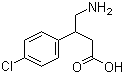
Molecular StructureCAS # 1134-47-0, Baclofen
Molecular FormulaC10H12ClNO2
Molecular Weight213.66
CAS Registry Number1134-47-0
EC Number214-486-9
SMILESC1=CC(=CC=C1C(CC(=O)O)CN)Cl
Properties
Density1.3±0.1 g/cm3 Calc.*
Melting point208 °C (Expl.)
Boiling point364.3±32.0 °C 760 mmHg (Calc.)*
Flash point174.1±25.1 °C (Calc.)*
Solubility100 mM (NaOH, aq), 10 mM(water), $lessThan$7.8 mg/mL (DMSO) (Expl.)
Index of refraction1.577 (Calc.)*
*Calculated using Advanced Chemistry Development (ACD/Labs) Software.
Safety Data
Hazard Symbolssymbol symbol symbol   GHS06;GHS07;GHS08 Danger  Details
Risk StatementsH301-H315-H317-H319-H334-H335-H336-H360-H361  Details
Safety StatementsP203-P233-P260-P261-P264-P264+P265-P270-P271-P272-P280-P284-P301+P316-P302+P352-P304+P340-P305+P351+P338-P318-P319-P321-P330-P332+P317-P333+P317-P337+P317-P342+P316-P362+P364-P403-P403+P233-P405-P501  Details
Hazard Classification
up    Details
HazardClassCategory CodeHazard Statement
Acute toxicityAcute Tox.3H301
Skin irritationSkin Irrit.2H315
Eye irritationEye Irrit.2H319
Skin sensitizationSkin Sens.1H317
Respiratory sensitizationResp. Sens.1H334
Specific target organ toxicity - single exposureSTOT SE3H335
Reproductive toxicityRepr.1BH360
Reproductive toxicityRepr.2H361
Specific target organ toxicity - single exposureSTOT SE3H336
Acute toxicityAcute Tox.4H302
Acute toxicityAcute Tox.3H311
Acute toxicityAcute Tox.3H331
Transport InformationUN 2811
SDSAvailable
up Discovery and Applications
Baclofen is a centrally acting muscle relaxant and antispastic agent that has been widely used in clinical practice since its development in the 1960s. It is a derivative of γ-aminobutyric acid (GABA) and functions as a selective agonist at GABAB receptors. The discovery of baclofen was closely tied to efforts aimed at finding GABA analogues that could cross the blood–brain barrier and exert therapeutic effects in neurological disorders characterized by excessive muscle tone and spasticity.

Baclofen was first synthesized by Swiss researchers at Ciba-Geigy in 1962. The initial aim was to develop a potential antiepileptic drug based on the structural modification of GABA. However, clinical trials revealed that baclofen had limited anticonvulsant activity but exhibited significant efficacy in reducing spasticity associated with neurological conditions. This redirected its therapeutic development toward the management of spasticity rather than epilepsy, and in 1977 baclofen was approved for medical use in Europe, followed by other regions.

The primary mechanism of action of baclofen involves activation of GABAB receptors located in the spinal cord and brain. This receptor activation results in hyperpolarization of neurons by increasing potassium conductance and inhibiting calcium influx. The net effect is the suppression of excitatory neurotransmitter release, leading to a reduction in muscle tone and spastic reflex activity. This unique pharmacological profile distinguishes baclofen from other muscle relaxants, such as benzodiazepines, which act primarily on GABAA receptors.

Clinically, baclofen has found widespread application in the treatment of spasticity resulting from conditions such as multiple sclerosis, spinal cord injury, cerebral palsy, and stroke. Oral baclofen is commonly prescribed, but one limitation is that therapeutic doses are often associated with systemic side effects, including sedation, dizziness, and muscle weakness. To overcome these issues, intrathecal administration of baclofen via implanted pumps was developed in the 1980s. This method allows for direct delivery of the drug to the cerebrospinal fluid, enabling lower doses to achieve therapeutic effects while minimizing systemic exposure. Intrathecal baclofen therapy has since become a major advance for patients with severe, refractory spasticity.

Beyond its established role in spasticity management, baclofen has been investigated for several other medical applications. Research has explored its potential in the treatment of alcohol use disorder, as GABAB receptor modulation may reduce alcohol craving and consumption. While clinical trial results have been mixed, some studies suggest benefit, particularly in patients with severe alcohol dependence. Baclofen has also been studied as a possible therapeutic option in gastroesophageal reflux disease (GERD), as it can reduce transient lower esophageal sphincter relaxations and thus decrease reflux episodes.

Despite its therapeutic advantages, baclofen is not without risks. Sudden discontinuation, especially in patients receiving intrathecal therapy, can result in serious withdrawal symptoms, including hyperthermia, hallucinations, seizures, and rebound spasticity, which may be life-threatening if untreated. Careful monitoring and gradual tapering are therefore essential in managing baclofen therapy.

The development and clinical use of baclofen marked a significant advance in the pharmacological management of spasticity. Its discovery highlighted the therapeutic potential of targeting GABAB receptors, and its applications have expanded from oral therapy to intrathecal administration, providing options for a wide range of patients. Continued research into baclofen’s mechanisms and therapeutic potential underscores its importance in both neurology and psychiatry.
Market Analysis Reports
List of Reports Available for Baclofen
Related Products
Bacillus coagul...  Bacillus lichen...  Bacillus megate...  Bacillus subtil...  Bacillus thurin...  Bacilysin  Bacitracin  Bacitracin  Bacitracin B1a  Bacitracin F  (R)-Baclofen  Baclofen-d4  S(-)-Baclofen H...  (R)-Baclofen la...  Bacmecillinam  Bacopa monnieri...  (-)-Bacopasapon...  Bacopaside I  Bacopaside II  Bacopaside V