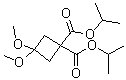
Diisopropyl 3,3-Dimethoxycyclobutane-1,1-dicarboxylate is an organic compound that finds application primarily in synthetic chemistry, particularly in the development of biologically active molecules and complex organic compounds. Its structural features, which include a cyclobutane ring with two methoxy groups and two ester groups, make it useful as an intermediate in various chemical reactions. The compound’s discovery can be traced to advancements in organic synthesis methodologies aimed at creating cyclobutane derivatives with functional diversity.
The cyclobutane ring structure is relatively rare in nature and poses a synthetic challenge due to its inherent ring strain. The inclusion of dimethoxy and diisopropyl ester groups in Diisopropyl 3,3-Dimethoxycyclobutane-1,1-dicarboxylate reduces this strain while making the compound versatile for further transformations. The methoxy groups serve as electron-donating groups, which can be modified or eliminated during subsequent reactions, while the ester groups provide reactive sites for hydrolysis or transesterification reactions. This dual functionalization makes the compound attractive for chemists working on multi-step synthetic routes, especially in medicinal chemistry where such modifications can help in tuning biological activity.
One of the main applications of Diisopropyl 3,3-Dimethoxycyclobutane-1,1-dicarboxylate is as a building block in the synthesis of pharmaceutical compounds. Cyclobutane derivatives are often incorporated into drug molecules to improve the pharmacokinetic properties, such as increasing lipophilicity or altering metabolic stability. The compact, rigid nature of the cyclobutane ring can help in achieving more selective binding to biological targets, which is a crucial aspect of drug design. Diisopropyl 3,3-Dimethoxycyclobutane-1,1-dicarboxylate, with its easily modifiable ester groups, is therefore frequently used as an intermediate in the preparation of these advanced pharmaceutical compounds.
In addition to its role in drug synthesis, this compound is also useful in the development of materials with unique properties. Cyclobutane-containing molecules have been explored in polymer science, where the ring structure contributes to increased rigidity and thermal stability in polymer backbones. Diisopropyl 3,3-Dimethoxycyclobutane-1,1-dicarboxylate can be incorporated into polymer precursors to create materials with enhanced mechanical strength and durability, which are desirable traits in specialized coatings, adhesives, and other high-performance materials.
Moreover, the compound’s diester groups enable its use in organocatalytic reactions, where the ester functionality can participate in nucleophilic attack or provide leaving groups in elimination reactions. This has been particularly valuable in the context of developing green chemistry processes, as the compound can be used to create more environmentally benign reaction conditions by enabling milder reaction pathways. Researchers are continually exploring its potential to serve as a safer alternative to more hazardous reagents traditionally used in esterification or carbon-carbon bond-forming reactions.
The compound’s stability and relatively straightforward synthesis have contributed to its widespread use in laboratory research and industrial processes. However, it is also important to note that while the compound is generally regarded as safe for laboratory use, standard safety precautions must be followed when handling it. This includes using appropriate personal protective equipment, as with most organic chemicals, to avoid skin or eye contact and inhalation of vapors.
The discovery and utilization of Diisopropyl 3,3-Dimethoxycyclobutane-1,1-dicarboxylate highlight the ongoing innovation in organic synthesis, where structural versatility and functional adaptability play critical roles in driving the development of new compounds. As more research continues into cyclobutane derivatives and their potential applications, this compound will likely remain a valuable intermediate in various fields, including drug discovery, materials science, and catalysis.
|




 GHS07 Warning Details
 chemBlink Chemical Story