
Online Database of Chemicals from Around the World
| AAT Bioquest, Inc. | USA | |||
|---|---|---|---|---|
 | www.aatbio.com | |||
 | +1 (408) 733-1055 | |||
 | +1 (408) 733-1304 | |||
 | jack@aatbio.com | |||
| Chemical manufacturer since 2005 | ||||
| chemBlink Standard supplier since 2010 | ||||
| BOC Sciences | USA | |||
|---|---|---|---|---|
| www.bocsci.com | |||
| +1 (631) 485-4226 | |||
| +1 (631) 614-7828 | |||
| info@bocsci.com | |||
| Chemical manufacturer | ||||
| chemBlink Standard supplier since 2010 | ||||
| Suzhou SciYoung BioMedicine Technology Co., Ltd. | China | |||
|---|---|---|---|---|
| www.sciyoung.com | |||
| +86 (512) 6295-6159 +86 18913577383 | |||
| +86 (512) 6295-6159 | |||
| sales@sciyoung.com | |||
 | QQ Chat | |||
| Chemical manufacturer since 2010 | ||||
| chemBlink Standard supplier since 2013 | ||||
| Carbosynth China Ltd. | China | |||
|---|---|---|---|---|
| www.carbosynth.cn | |||
| +86 (512) 6260-5585 | |||
| +86 (512) 6260-5576 | |||
| sales@carbosynth.com | |||
| QQ Chat | |||
| Chemical manufacturer since 2006 | ||||
| chemBlink Standard supplier since 2016 | ||||
| Zhangshu Hongyuan Biomedical Technology Co., Ltd. | China | |||
|---|---|---|---|---|
| www.zsshysw.cn | |||
| +86 19195036662 | |||
| 335864138@qq.com | |||
| QQ Chat | |||
| Chemical manufacturer since 2022 | ||||
| chemBlink Standard supplier since 2022 | ||||
| Targetmol Chemicals Inc. | USA | |||
|---|---|---|---|---|
| www.targetmol.com | |||
| +1 (781) 999-5354 | |||
| +1 (781) 281-9145 | |||
| sales@targetmol.com | |||
| Chemical manufacturer since 2013 | ||||
| chemBlink Standard supplier since 2025 | ||||
| Hubei Innerse Biotechnology Co., Ltd. | China | |||
|---|---|---|---|---|
| www.innersebio.com | |||
| +86 (027) 8818-9299 | |||
| sales@innersebio.com | |||
| QQ Chat | |||
| Chemical manufacturer since 2020 | ||||
| chemBlink Standard supplier since 2025 | ||||
| ChemPur GmbH | Germany | |||
|---|---|---|---|---|
| www.chempur.de | |||
| +49 (721) 933-840 | |||
| +49 (721) 47-2001 | |||
| info@chempur.de | |||
| Chemical manufacturer | ||||
| Santa Cruz Biotechnology, Inc. | USA | |||
|---|---|---|---|---|
| www.scbt.com | |||
| +1 (831) 457-3800 | |||
| +1 (831) 457-3801 | |||
| scbt@scbt.com | |||
| Chemical manufacturer | ||||
| LKT Laboratories, Inc. | USA | |||
|---|---|---|---|---|
| www.lktlabs.com | |||
| +1 (888) 558-5227 | |||
| +1 (651) 644-8357 | |||
| peacerli@mbolin-lktlabs.com | |||
| Chemical manufacturer | ||||
| Classification | Flavors and spices >> Synthetic spice >> Lactone and oxygen-containing heterocyclic compound >> Thiazole, thiophene and pyridine |
|---|---|
| Name | D-Luciferin potassium salt |
| Synonyms | (S)-4,5-Dihydro-2-(6-hydroxybenzothiazol-2-yl)thiazole-4-carboxylic acid potassium salt |
| Molecular Structure | 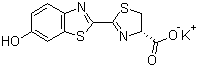 |
| Molecular Formula | C11H7KN2O3S2 |
| Molecular Weight | 318.41 |
| CAS Registry Number | 115144-35-9 |
| SMILES | C1[C@@H](N=C(S1)C2=NC3=C(S2)C=C(C=C3)O)C(=O)[O-].[K+] |
| Hazard Symbols |  GHS07 Warning Details GHS07 Warning Details |
|---|---|
| Risk Statements | H302-H315-H319-H335 Details |
| Safety Statements | P261-P305+P351+P338 Details |
| SDS | Available |
 chemBlink Chemical Story
|
D-Luciferin potassium salt is a bioluminescent substrate widely used in biological and biomedical research, particularly in the field of in vivo imaging. It is the potassium salt form of D-luciferin, a compound that emits light when oxidized in the presence of the enzyme luciferase, oxygen, and ATP. This chemical reaction, which naturally occurs in fireflies, produces visible light and serves as the basis for many bioimaging and reporter gene assays. The discovery of D-luciferin dates back to early biochemical studies of firefly luminescence in the 20th century. Researchers identified the compound as the substrate responsible for the characteristic yellow-green glow of fireflies. The bioluminescent reaction was later replicated in laboratory settings, leading to the synthesis of D-luciferin and its derivatives, including the potassium salt form, which is more water-soluble and therefore more suitable for biological applications. D-Luciferin potassium salt is primarily used in conjunction with luciferase-expressing cells or organisms. When administered to an organism that expresses luciferase, D-luciferin is taken up by cells and oxidized by the enzyme, producing light that can be detected using specialized imaging equipment. This allows researchers to noninvasively monitor gene expression, track cell migration, or assess the growth of tumors in live animals over time. The method is especially valuable in small animal models for preclinical studies. In molecular biology and genetic engineering, D-luciferin-based assays are used to quantify the activity of luciferase reporter genes. These assays can be highly sensitive and quantitative, making them a preferred choice for studying promoter activity, signal transduction pathways, and the efficacy of gene delivery systems. The light output generated by the luciferase-luciferin reaction provides a direct readout of the biological process under investigation. One of the key advantages of using D-luciferin potassium salt is its low background signal in mammalian tissues, resulting in high sensitivity for imaging applications. In addition, the reaction is rapid and does not require external light excitation, avoiding problems associated with autofluorescence and phototoxicity. The compound is typically administered by intraperitoneal or intravenous injection in animal models and is generally well tolerated at research concentrations. Over time, the versatility and reliability of D-luciferin potassium salt have made it a standard reagent in life science research. It is routinely used in studies involving cancer biology, stem cell tracking, infectious diseases, and gene therapy. Its application has extended to high-throughput screening assays in drug discovery and toxicology studies, where rapid and accurate measurement of gene expression or cellular viability is required. In summary, D-luciferin potassium salt represents a critical tool in modern biological research, enabling real-time, noninvasive observation of dynamic biological processes. Its role in bioluminescence imaging and gene expression analysis continues to expand, supporting advances across a wide spectrum of scientific disciplines. References 2009. The effective role of positive charge saturation in bioluminescence color and thermostability of firefly luciferase. Photochemical & Photobiological Sciences, 8(6). DOI: 10.1039/b901938c 2018. IL-8-induced O-GlcNAc modification via GLUT3 and GFAT regulates cancer stem cell-like properties in colon and lung cancer cells. Oncogene, 37(50). DOI: 10.1038/s41388-018-0533-4 2024. A bispecific nanosystem activates endogenous natural killer cells in the bone marrow for haematologic malignancies therapy. Nature Nanotechnology, 19(10). DOI: 10.1038/s41565-024-01736-9 |
| Market Analysis Reports |