
Online Database of Chemicals from Around the World
| Chengdu Herbpurify Co., Ltd. | China | |||
|---|---|---|---|---|
 | www.scstandards.com | |||
 | +86 028 8265-1368 | |||
 | 2851037747@qq.com | |||
 | QQ Chat | |||
 | WeChat: 18981950076 | |||
| Chemical manufacturer since 2019 | ||||
| chemBlink Standard supplier since 2026 | ||||
| Classification | Organic raw materials >> Ketone compound |
|---|---|
| Name | Lucidone A |
| Synonyms | (3S,5R,7S,10S,13R,14R,17S)-17-acetyl-3,7-dihydroxy-4,4,10,13,14-pentamethyl-2,3,5,6,7,12,16,17-octahydro-1H-cyclopenta[a]phenanthrene-11,15-dione |
| Molecular Structure | 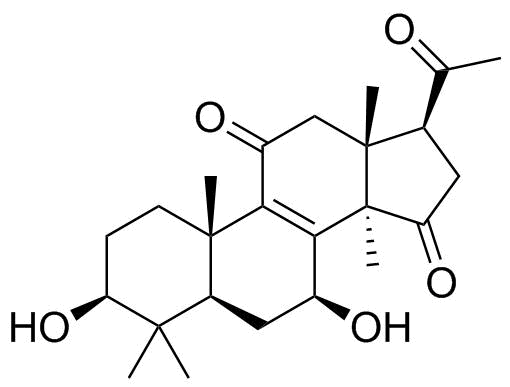 |
| Molecular Formula | C24H34O5 |
| Molecular Weight | 402.52 |
| CAS Registry Number | 97653-92-4 |
| SMILES | CC(=O)[C@H]1CC(=O)[C@@]2([C@@]1(CC(=O)C3=C2[C@H](C[C@@H]4[C@@]3(CC[C@@H](C4(C)C)O)C)O)C)C |
| Density | 1.2±0.1 g/cm3 Calc.* |
|---|---|
| Boiling point | 570.8±50.0 °C 760 mmHg (Calc.)* |
| Flash point | 313.1±26.6 °C (Calc.)* |
| Index of refraction | 1.568 (Calc.)* |
| * | Calculated using Advanced Chemistry Development (ACD/Labs) Software. |
| Hazard Symbols |  GHS07 Warning Details GHS07 Warning Details |
|---|---|
| Risk Statements | H302-H315-H319-H335 Details |
| Safety Statements | P280-P305+P351+P338 Details |
| SDS | Available |
 chemBlink Chemical Story
|
Lucidone A is a naturally occurring diterpenoid compound first isolated from species of the fungus Ganoderma, particularly Ganoderma lucidum, which has long been used in traditional medicinal systems in East Asia. It belongs to the class of highly oxygenated lanostane- or rearranged lanostane-type triterpenoids, which are characteristic secondary metabolites produced by Ganoderma species. These compounds are structurally diverse and are known for their complex polycyclic skeletons and extensive oxidation patterns. The discovery of lucidone A is part of broader phytochemical and mycological investigations into Ganoderma metabolites that began in the twentieth century. Systematic isolation and characterization of triterpenoids from Ganoderma species were driven by interest in their chemical diversity and potential biological activities. As chromatographic and spectroscopic techniques advanced, individual constituents such as lucidone A were identified and structurally elucidated from complex fungal extracts. Structurally, lucidone A features a multi-ring triterpenoid framework derived from the cyclization of squalene via lanosterol biosynthesis. In fungi, this pathway produces lanosterol as a key intermediate, which is then enzymatically modified through oxidation, rearrangement, and side-chain transformations to yield a wide range of lanostane derivatives. Lucidone A represents one of these oxidatively modified products, characterized by multiple oxygen-containing functional groups integrated into its rigid tetracyclic core. The structural complexity of lucidone A reflects the enzymatic diversity present in Ganoderma species, which are capable of producing numerous oxidized triterpenes. These transformations include hydroxylation, ketone formation, and double-bond rearrangements, resulting in compounds with varied polarity and biological properties. Such modifications significantly influence the chemical behavior of these molecules compared with their hydrocarbon precursors. Ganoderma-derived triterpenoids, including lucidone A, are of considerable interest in natural product chemistry due to their reported bioactivities in experimental systems. While specific pharmacological effects vary across individual compounds, this class of molecules has been studied for potential anti-inflammatory, antioxidant, and cytotoxic activities. These investigations are part of ongoing research into fungal metabolites as sources of structurally unique bioactive compounds. From a physicochemical standpoint, lucidone A is expected to exhibit relatively low water solubility due to its large hydrophobic polycyclic framework, combined with moderate polarity arising from oxygenated functional groups. The presence of multiple hydroxyl and carbonyl functionalities enables hydrogen bonding interactions, which can influence both solubility in organic solvents and solid-state packing behavior. The isolation of lucidone A typically involves solvent extraction of fungal biomass followed by chromatographic separation techniques such as column chromatography and high-performance liquid chromatography. Structural elucidation is performed using spectroscopic methods including nuclear magnetic resonance spectroscopy and mass spectrometry, which allow determination of the carbon skeleton and functional group distribution. The study of lucidone A contributes to the broader understanding of fungal triterpenoid biosynthesis and the chemical diversity of Ganoderma metabolites. These compounds serve as chemotaxonomic markers and provide insight into the enzymatic pathways responsible for secondary metabolite production in basidiomycete fungi. Overall, lucidone A is a highly oxygenated triterpenoid natural product derived from Ganoderma species. Its significance lies in its structural complexity, biosynthetic origin from lanosterol-derived pathways, and its role as part of the chemically diverse suite of fungal secondary metabolites that continue to be studied in natural product chemistry and biological research. References 2026. The LOTUS Initiative for Open Natural Products Research: frozen dataset union wikidata (with metadata). . DOI: 10.5281/zenodo.5794106 2018. Hepatoprotective natural triterpenoids. European Journal of Medicinal Chemistry. DOI: 10.1016/j.ejmech.2018.01.011 2012. Lanostanoids from Fungi: A Group of Potential Anticancer Compounds. Journal of Natural Products. DOI: 10.1021/np300412h |
| Market Analysis Reports |