
Online Database of Chemicals from Around the World
| wuhan chemi Pharmacy Chemical Technology Co., Ltd. | China | |||
|---|---|---|---|---|
 | www.chemipharm.com.cn | |||
 | +86 13971619949 | |||
 | gmn424@chemipharm.com.cn | |||
 | QQ Chat | |||
 | WeChat: 13971619949 | |||
| Chemical manufacturer since 2014 | ||||
| chemBlink Standard supplier since 2026 | ||||
| Classification | Pharmaceutical intermediate >> Heterocyclic compound intermediate >> Pyridine compound |
|---|---|
| Name | 4-Chloro(1,3)thiazolo(5,4-c)pyridine |
| Molecular Structure | 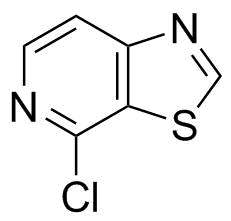 |
| Molecular Formula | C6H3ClN2S |
| Molecular Weight | 170.62 |
| CAS Registry Number | 1159828-95-1 |
| EC Number | 894-515-5 |
| SMILES | C1=CN=C(C2=C1N=CS2)Cl |
| Density | 1.5±0.1 g/cm3 Calc.* |
|---|---|
| Boiling point | 305.7±22.0 °C 760 mmHg (Calc.)* |
| Flash point | 138.7±22.3 °C (Calc.)* |
| Index of refraction | 1.71 (Calc.)* |
| * | Calculated using Advanced Chemistry Development (ACD/Labs) Software. |
| Hazard Symbols |  GHS07 Warning Details GHS07 Warning Details |
|---|---|
| Risk Statements | H302-H315-H319-H335 Details |
| Safety Statements | P261-P264-P264+P265-P270-P271-P280-P301+P317-P302+P352-P304+P340-P305+P351+P338-P319-P321-P330-P332+P317-P337+P317-P362+P364-P403+P233-P405-P501 Details |
| SDS | Available |
 chemBlink Chemical Story
|
4-Chloro(1,3)thiazolo(5,4-c)pyridine is a fused heteroaromatic compound that belongs to the thiazolopyridine family. The molecule combines a thiazole ring and a pyridine ring within a condensed bicyclic framework and contains a chlorine substituent at the 4-position. Compounds based on fused nitrogen- and sulfur-containing heterocycles have attracted substantial interest in synthetic and medicinal chemistry because such ring systems are frequently used as core structures in the preparation of biologically active molecules. The importance of 4-chloro(1,3)thiazolo(5,4-c)pyridine is primarily associated with its role as a synthetic intermediate and building block in heterocyclic chemistry. The development of thiazolopyridine chemistry emerged from broader efforts during the twentieth century to explore fused heteroaromatic systems. Researchers recognized that combining multiple heteroatoms within rigid aromatic frameworks could produce compounds with useful electronic and structural properties. As methods for constructing fused heterocyclic rings improved, numerous thiazolopyridine isomers were synthesized and characterized. These studies established practical routes to chlorinated thiazolopyridines, including 4-chloro(1,3)thiazolo(5,4-c)pyridine, which could subsequently be transformed into a wide variety of substituted derivatives. The discovery and characterization of compounds such as 4-chloro(1,3)thiazolo(5,4-c)pyridine were facilitated by advances in heterocyclic synthesis and analytical chemistry. The structure of the fused ring system can be confirmed through established spectroscopic techniques, including nuclear magnetic resonance spectroscopy, mass spectrometry, and elemental analysis. The availability of reliable synthetic routes enabled researchers to investigate the chemical behavior of the chlorinated heterocycle and to evaluate its usefulness as a precursor for further transformations. One of the most important applications of 4-chloro(1,3)thiazolo(5,4-c)pyridine is as an intermediate in medicinal chemistry research. The chlorine substituent is a useful functional handle because it can undergo nucleophilic aromatic substitution reactions with a variety of nitrogen-, oxygen-, and sulfur-containing nucleophiles. Through these reactions, chemists can prepare libraries of substituted thiazolopyridine derivatives for biological evaluation. The chlorinated precursor therefore serves as a versatile starting material in the synthesis of more complex heterocyclic compounds. The compound has appeared in patent and research literature describing the preparation of candidate pharmaceutical molecules. In such work, the fused thiazolopyridine scaffold is retained while the chlorine atom is replaced by other functional groups designed to modify the physicochemical and biological properties of the resulting molecules. The use of 4-chloro(1,3)thiazolo(5,4-c)pyridine in these synthetic sequences reflects the value of the compound as a strategically functionalized heterocyclic intermediate. Another documented application is in structure-activity relationship studies. Medicinal chemistry programs often require the synthesis of closely related analogs in order to determine how structural changes affect biological performance. Because the chlorine substituent can be replaced by a wide range of groups, 4-chloro(1,3)thiazolo(5,4-c)pyridine provides a convenient platform for generating analog series based on a common heterocyclic core. This capability has supported research directed toward the optimization of heteroaromatic lead compounds. The compound has also been used in general heterocyclic synthesis. Fused nitrogen- and sulfur-containing ring systems are valuable motifs in organic chemistry, and chlorinated derivatives frequently serve as intermediates for the preparation of more elaborate structures. The reactivity of the carbon-chlorine bond within the aromatic framework allows introduction of diverse substituents while preserving the integrity of the bicyclic ring system. As a result, the compound has utility beyond pharmaceutical research and contributes to broader investigations of heterocyclic chemistry. The significance of 4-chloro(1,3)thiazolo(5,4-c)pyridine lies in its established role as a synthetic building block. Published chemical and patent literature demonstrates its use in the preparation of substituted thiazolopyridines and related heterocyclic compounds. Through its application in medicinal chemistry, structure-activity relationship studies, and heterocyclic synthesis, the compound has contributed to the continued development of fused-ring chemistry and the discovery of new classes of functional organic molecules. |
| Market Analysis Reports |