
Online Database of Chemicals from Around the World
| Zhengzhou Kingorgchem Chemical Technology Co., Ltd. | China | |||
|---|---|---|---|---|
 | www.kingorgchem.com | |||
 | +86 (371) 6551-1006 | |||
 | +86 (371) 6575-6965 | |||
 | sales@kingorgchem.com | |||
 | QQ Chat | |||
 | WeChat: 18625597674 | |||
| Chemical manufacturer since 2015 | ||||
| chemBlink Standard supplier since 2016 | ||||
| Classification | Chemical reagent >> Organic reagent >> Phosphine ligand |
|---|---|
| Name | Bis(3-bromophenyl)phenylphosphine oxide |
| Synonyms | 1-bromo-3-[(3-bromophenyl)-phenylphosphoryl]benzene |
| Molecular Structure | 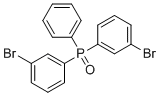 |
| Molecular Formula | C18H13Br2OP |
| Molecular Weight | 436.08 |
| CAS Registry Number | 1163698-32-5 |
| EC Number | 835-956-5 |
| SMILES | C1=CC=C(C=C1)P(=O)(C2=CC(=CC=C2)Br)C3=CC(=CC=C3)Br |
| Hazard Symbols |  GHS07 Warning Details GHS07 Warning Details | ||||||||||||
|---|---|---|---|---|---|---|---|---|---|---|---|---|---|
| Risk Statements | H315-H319 Details | ||||||||||||
| Safety Statements | P264-P264+P265-P280-P302+P352-P305+P351+P338-P321-P332+P317-P337+P317-P362+P364 Details | ||||||||||||
| Hazard Classification | |||||||||||||
| |||||||||||||
| SDS | Available | ||||||||||||
 chemBlink Chemical Story
|
Bis(3-bromophenyl)phenylphosphine oxide is an organophosphorus compound that has gained attention in the field of materials science and organic synthesis. This compound features a phosphine oxide core with two 3-bromophenyl groups and one phenyl group attached, resulting in a structure that is both electronically rich and sterically demanding. The unique properties of this molecule make it valuable in various applications, particularly in the design of advanced materials and as a ligand in catalytic processes. The discovery of bis(3-bromophenyl)phenylphosphine oxide was driven by the need for new organophosphorus compounds that could serve as building blocks in organic synthesis and materials chemistry. The incorporation of bromine atoms in the 3-position of the phenyl rings introduces potential sites for further functionalization, enabling the synthesis of more complex molecules. Additionally, the phosphine oxide functionality is known for its strong electron-withdrawing properties, which can influence the reactivity and coordination behavior of the molecule. One of the primary applications of bis(3-bromophenyl)phenylphosphine oxide is in the field of flame retardancy. Phosphorus-based flame retardants are widely used in the production of polymers and textiles to enhance their fire resistance. The presence of bromine and phosphorus in bis(3-bromophenyl)phenylphosphine oxide makes it particularly effective in this role, as these elements work synergistically to promote char formation and inhibit the release of flammable gases during combustion. This makes it a valuable additive in the development of safer, flame-resistant materials for various industries. In addition to its use in flame retardancy, bis(3-bromophenyl)phenylphosphine oxide has also found applications as a ligand in transition metal catalysis. The electron-withdrawing nature of the phosphine oxide group, combined with the steric bulk provided by the phenyl and bromophenyl groups, allows for the stabilization of metal complexes and enhances their catalytic activity. This has been particularly useful in processes such as cross-coupling reactions, where the ligand’s properties can significantly influence the efficiency and selectivity of the reaction. Moreover, the compound’s potential for further functionalization through the bromine atoms offers opportunities for creating customized ligands and materials tailored to specific applications. This versatility makes bis(3-bromophenyl)phenylphosphine oxide an important tool in both research and industrial contexts. In summary, bis(3-bromophenyl)phenylphosphine oxide is a multifaceted compound with applications ranging from flame retardancy to catalysis. Its unique structure, featuring bromine-substituted phenyl groups and a phosphine oxide core, provides a foundation for further innovation in materials science and organic synthesis. References 2017. Triphenyl phosphine oxide and carbazole-based polymer host materials for green phosphorescent organic light-emitting diodes. Chinese Journal of Polymer Science. DOI: 10.1007/s10118-017-1926-5 |
| Market Analysis Reports |