
Online Database of Chemicals from Around the World
| wuhan chemi Pharmacy Chemical Technology Co., Ltd. | China | |||
|---|---|---|---|---|
 | www.chemipharm.com.cn | |||
 | +86 13971619949 | |||
 | gmn424@chemipharm.com.cn | |||
 | QQ Chat | |||
 | WeChat: 13971619949 | |||
| Chemical manufacturer since 2014 | ||||
| chemBlink Standard supplier since 2026 | ||||
| Classification | Organic raw materials >> Carboxylic compounds and derivatives |
|---|---|
| Name | 1-(difluoromethyl)-1H-pyrazole-4-carboxylic acid |
| Molecular Structure | 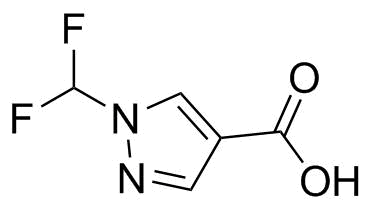 |
| Molecular Formula | C5H4F2N2O2 |
| Molecular Weight | 162.09 |
| CAS Registry Number | 1174305-81-7 |
| EC Number | 838-317-9 |
| SMILES | C1=C(C=NN1C(F)F)C(=O)O |
| Density | 1.6±0.1 g/cm3 Calc.* |
|---|---|
| Boiling point | 273.7±40.0 °C 760 mmHg (Calc.)* |
| Flash point | 119.4±27.3 °C (Calc.)* |
| Index of refraction | 1.54 (Calc.)* |
| * | Calculated using Advanced Chemistry Development (ACD/Labs) Software. |
| Hazard Symbols |  GHS07 Warning Details GHS07 Warning Details | ||||||||||||||||
|---|---|---|---|---|---|---|---|---|---|---|---|---|---|---|---|---|---|
| Risk Statements | H315-H319-H335 Details | ||||||||||||||||
| Safety Statements | P261-P264-P264+P265-P271-P280-P302+P352-P304+P340-P305+P351+P338-P319-P321-P332+P317-P337+P317-P362+P364-P403+P233-P405-P501 Details | ||||||||||||||||
| Hazard Classification | |||||||||||||||||
| |||||||||||||||||
| SDS | Available | ||||||||||||||||
 chemBlink Chemical Story
|
1-(Difluoromethyl)-1H-pyrazole-4-carboxylic acid is a fluorinated heterocyclic compound belonging to the pyrazole family. The molecule contains a pyrazole ring substituted with a difluoromethyl group and a carboxylic acid functionality. Compounds incorporating fluorinated pyrazole motifs have become important intermediates in modern synthetic chemistry because fluorine-containing substituents can significantly influence the physical, chemical, and biological properties of organic molecules. The significance of 1-(difluoromethyl)-1H-pyrazole-4-carboxylic acid is primarily associated with its use as a synthetic building block in the preparation of more complex compounds, particularly in agrochemical and pharmaceutical research. The development of this compound is linked to broader advances in fluorine chemistry and heterocyclic synthesis during the latter part of the twentieth century. As researchers increasingly recognized the value of fluorinated functional groups in the design of biologically active molecules, considerable effort was directed toward the preparation of fluorinated heterocycles. Among the structures investigated, pyrazole derivatives attracted particular attention because the pyrazole ring is present in numerous compounds of practical importance. The introduction of difluoromethyl substituents provided a means of modifying lipophilicity, metabolic behavior, and intermolecular interactions while retaining the desirable characteristics of the heterocyclic framework. The identification and preparation of 1-(difluoromethyl)-1H-pyrazole-4-carboxylic acid emerged from research aimed at developing versatile fluorinated intermediates. Synthetic methods reported in the chemical literature enabled the construction of pyrazole rings bearing both fluorinated substituents and functional groups suitable for further transformation. The presence of a carboxylic acid group is particularly valuable because it can be converted into a variety of derivatives, including esters, amides, and other functionalized products. As a result, the compound became useful as a starting material for the synthesis of structurally diverse molecules. One of the most important documented applications of 1-(difluoromethyl)-1H-pyrazole-4-carboxylic acid is in agrochemical research. Patent and scientific literature describe the use of fluorinated pyrazole carboxylic acid derivatives as intermediates in the preparation of crop-protection agents. In such syntheses, the carboxylic acid functionality serves as a convenient site for chemical modification, allowing the pyrazole core to be incorporated into more elaborate molecular frameworks. The compound has therefore contributed to the development of synthetic routes employed in agrochemical discovery programs. The compound has also been utilized in medicinal chemistry research. Fluorinated heterocycles are widely investigated because fluorine substitution can influence molecular properties that are important in drug design. Researchers have employed pyrazole-containing intermediates to generate libraries of compounds for biological evaluation. In these efforts, 1-(difluoromethyl)-1H-pyrazole-4-carboxylic acid has functioned as a precursor that enables the systematic preparation of analogs possessing a common fluorinated heterocyclic core. Another documented application is in structure-activity relationship studies. Such studies require the preparation of related compounds that differ in specific structural features. The availability of a pyrazole building block bearing both a difluoromethyl substituent and a reactive carboxylic acid group makes it possible to generate numerous derivatives while maintaining the same central heterocyclic scaffold. This capability has supported investigations into the effects of molecular modification on chemical and biological properties. The compound has further served as a useful intermediate in heterocyclic chemistry. Carboxylic acid derivatives of pyrazoles are valuable synthetic precursors because they can undergo a variety of well-established transformations. Through reactions involving the carboxyl group, researchers can access amides, esters, and other functionalized products that may be difficult to prepare directly. Consequently, 1-(difluoromethyl)-1H-pyrazole-4-carboxylic acid has contributed to the broader development of fluorinated heterocyclic synthesis. The importance of 1-(difluoromethyl)-1H-pyrazole-4-carboxylic acid lies in its established role as a fluorinated pyrazole intermediate. Published chemical and patent literature document its use in agrochemical research, medicinal chemistry, structure-activity relationship investigations, and synthetic methodology development. Through these applications, the compound has become part of the expanding field of fluorinated heterocyclic chemistry and has supported the preparation of numerous more complex organic molecules. |
| Market Analysis Reports |