
Online Database of Chemicals from Around the World
| Hubei Tianmeng Chemical Co., Ltd. | China | |||
|---|---|---|---|---|
 | www.tianmengchem.com | |||
 | +86 (713) 362-3096 | |||
 | +86 (713) 275-5084 | |||
 | 112560868@qq.com | |||
| Chemical manufacturer since 1993 | ||||
| chemBlink Standard supplier since 2007 | ||||
| Extrasynthese Chemical S.A.S. | France | |||
|---|---|---|---|---|
| www.extrasynthese.com | |||
| +33 (47) 898-2034 | |||
| +33 (47) 898-1945 | |||
| info@extrasynthese.com | |||
| Chemical manufacturer | ||||
| chemBlink Standard supplier since 2009 | ||||
| Hefei TNJ Chemical Industry Co., Ltd. | China | |||
|---|---|---|---|---|
| www.tnjchem.com | |||
| +86 (551) 6541-8684 | |||
| +86 (551) 6541-8697 | |||
| sales@tnjchem.com | |||
| Chemical manufacturer since 2001 | ||||
| chemBlink Standard supplier since 2010 | ||||
| Medilink Pharmachem | India | |||
|---|---|---|---|---|
| www.medilinkpharma.com | |||
| +91 (79) 3007-0133 | |||
| +91 (79) 4007-4175 | |||
| exports@medilinkpharma.com | |||
| Chemical distributor since 1996 | ||||
| chemBlink Standard supplier since 2014 | ||||
| Changzhou Jintan ChengEn Chemical Co., Ltd. | China | |||
|---|---|---|---|---|
| www.chengenchem.com | |||
| +86 (519) 8019-0155 +86 13961176135 +86 13775159780 | |||
| +86 (519) 8019-0155 | |||
| sales@chengenchem.com | |||
 | QQ Chat | |||
| Chemical manufacturer since 2014 | ||||
| chemBlink Standard supplier since 2016 | ||||
| Chengdu Biopurify Phytochemicals Ltd. | China | |||
|---|---|---|---|---|
| www.phytopurify.com | |||
| +86 (28) 8263-3860 8263-3987 | |||
| +86 (28) 8263-3165 | |||
| sales@biopurify.com biopurify@gmail.com | |||
| QQ Chat | |||
 | Skype Chat | |||
| Chemical manufacturer | ||||
| chemBlink Standard supplier since 2017 | ||||
| Clinivex Enterprises Inc | Canada | |||
|---|---|---|---|---|
| theclinivex.com | |||
| +1 (877) 861-1996 | |||
| info@theclinivex.com | |||
| Chemical distributor since 2018 | ||||
| chemBlink Standard supplier since 2021 | ||||
| Jiangxi Alpha Hi-Tech Pharmaceutical Co., Ltd | China | |||
|---|---|---|---|---|
| en.alphahi-tech.com | |||
| +86 (510) 8501-0237 | |||
| overseamarketing@alphahi-tech.com 2881931019@qq.com | |||
| Chemical manufacturer since 2009 | ||||
| chemBlink Standard supplier since 2021 | ||||
| Santa Cruz Biotechnology, Inc. | USA | |||
|---|---|---|---|---|
| www.scbt.com | |||
| +1 (831) 457-3800 | |||
| +1 (831) 457-3801 | |||
| scbt@scbt.com | |||
| Chemical manufacturer | ||||
| Archimica Inc. | USA | |||
|---|---|---|---|---|
| www.archimica.com | |||
| +1 (302) 994-3043 | |||
| +1 (302) 994-3475 | |||
| contact@archimica.com | |||
| Chemical manufacturer since 1946 | ||||
| Avonchem/Chromos Express Ltd. | UK | |||
|---|---|---|---|---|
| www.avonchem.co.uk | |||
| +44 (1625) 434-300 | |||
| +44 (1625) 869-777 | |||
| info@avonchem.co.uk | |||
| Chemical manufacturer | ||||
| Classification | API >> Synthetic anti-infective drugs >> Disinfectant antiseptic |
|---|---|
| Name | Ethyl salicylate |
| Synonyms | Ethyl 2-hydroxybenzoate |
| Molecular Structure | 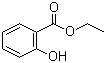 |
| Molecular Formula | C9H10O3 |
| Molecular Weight | 166.18 |
| CAS Registry Number | 118-61-6 |
| EC Number | 204-265-5 |
| FEMA | 2458 |
| SMILES | CCOC(=O)C1=CC=CC=C1O |
| Density | 1.128 g/mL |
|---|---|
| Melting point | 2-3 °C |
| Boiling point | 234 °C |
| Refractive index | 1.521-1.525 |
| Flash point | 107 °C |
| Water solubility | slightly soluble |
| Hazard Symbols |  GHS07 Warning Details GHS07 Warning Details | ||||||||||||||||
|---|---|---|---|---|---|---|---|---|---|---|---|---|---|---|---|---|---|
| Risk Statements | H302 Details | ||||||||||||||||
| Safety Statements | P264-P270-P301+P317-P330-P501 Details | ||||||||||||||||
| Hazard Classification | |||||||||||||||||
| |||||||||||||||||
| SDS | Available | ||||||||||||||||
 chemBlink Chemical Story
|
Ethyl salicylate is an organic ester formed from the esterification of salicylic acid and ethanol. It is a clear, colorless to pale yellow liquid with a characteristic sweet, wintergreen-like odor. This compound is naturally present in several plants, notably in the essential oil of wintergreen (Gaultheria procumbens) and some other species where it contributes to their aroma. It has been known to science and industry for over a century and has found various uses based on its fragrance, mild antiseptic properties, and chemical reactivity. The discovery and early recognition of ethyl salicylate's fragrance properties can be traced back to the broader study of salicylic acid derivatives in the 19th century. As interest in aromatic compounds and essential oils grew in perfumery and medicinal chemistry, researchers identified ethyl salicylate as one of the pleasant-smelling esters derived from salicylic acid. It was characterized by its relatively low volatility and persistent odor, which made it particularly suitable for use in perfumery. Ethyl salicylate is produced via a Fischer esterification process, in which salicylic acid reacts with ethanol in the presence of an acid catalyst such as sulfuric acid. The reaction proceeds with the elimination of water, and the product is typically purified through distillation. This synthetic method is straightforward and efficient, making the compound readily available for commercial and industrial applications. One of the primary uses of ethyl salicylate is in the flavor and fragrance industry. Due to its strong, sweet, and slightly minty aroma, it is employed as a flavoring agent in candies, chewing gums, toothpaste, and pharmaceuticals. It serves as a fragrance component in perfumes and colognes, particularly in formulations intended to emulate natural or herbal scents. Its olfactory characteristics are valued for evoking a sense of freshness and cleanliness. In pharmaceuticals, ethyl salicylate has been used in topical preparations where its mild anti-inflammatory and analgesic properties can offer relief for minor muscle or joint pain. These properties stem from its relationship to salicylic acid, a known anti-inflammatory agent. However, its use in this context has declined in favor of more potent and better-studied non-steroidal anti-inflammatory drugs (NSAIDs). Ethyl salicylate also functions as an intermediate in organic synthesis. Its reactive ester group and aromatic hydroxyl moiety make it a useful starting material in the preparation of more complex molecules. It can be involved in hydrolysis, transesterification, and other transformations that exploit its ester functionality. In laboratory settings, it may also serve as a model compound for studying ester hydrolysis or for demonstrating organic reactions in educational contexts. Although generally considered to be of low toxicity, ethyl salicylate should be handled with care, particularly in industrial settings where prolonged exposure to vapors can occur. As with other salicylate esters, ingestion in significant quantities can lead to salicylate toxicity, with symptoms such as nausea, dizziness, and metabolic disturbances. Appropriate personal protective equipment and ventilation are standard measures in environments where the substance is handled in bulk. Ethyl salicylate is a stable compound under normal storage conditions and is compatible with a wide range of cosmetic, flavor, and fragrance formulations. It blends well with essential oils and other aromatic esters, which enhances its versatility in product design. Today, ethyl salicylate continues to be used in industries that require safe, effective, and pleasant-smelling compounds. Its synthesis, properties, and safety profile are well documented in the literature, ensuring that its applications are based on established chemical principles and industrial standards. References 2021. Characterization of odor-active volatile compounds of jambolan [Syzgium cumini (L.) Skeels] wine. Journal of Food Science and Technology, 59(3). DOI: 10.1007/s13197-021-05163-9 2023. Antibacterial, antifungal activities and toxicity of new synthetic fatty acid salicylate esters. Medicinal Chemistry Research, 32(4). DOI: 10.1007/s00044-023-03034-w 2024. Volatile metabolomics and metagenomics reveal the effects of lactic acid bacteria on alfalfa silage quality, microbial communities, and volatile organic compounds. Communications Biology, 7(1). DOI: 10.1038/s42003-024-07083-8 |
| Market Analysis Reports |