
Online Database of Chemicals from Around the World
| Tianjin ComoraTechnology Co., Ltd. | China | |||
|---|---|---|---|---|
 | comoratj.com | |||
 | +86 15908635794 | |||
 | sales@comoratj.com | |||
 | WhatsApp:+86 15908635794 | |||
| Chemical manufacturer since 2026 | ||||
| chemBlink Standard supplier since 2026 | ||||
| Classification | Organic raw materials >> Carboxylic compounds and derivatives |
|---|---|
| Name | (S)-2-((tert-butoxycarbonyl)amino)-2-((1r,4S)-4-methylcyclohexyl)acetic acid |
| Synonyms | (2S)-2-(4-methylcyclohexyl)-2-[(2-methylpropan-2-yl)oxycarbonylamino]acetic acid |
| Molecular Structure | 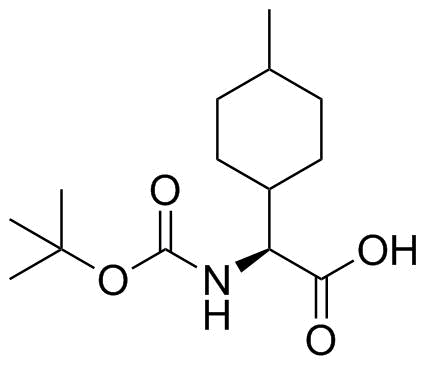 |
| Molecular Formula | C14H25NO4 |
| Molecular Weight | 271.35 |
| CAS Registry Number | 1187224-06-1 |
| SMILES | CC1CCC(CC1)[C@@H](C(=O)O)NC(=O)OC(C)(C)C |
| Density | 1.1±0.1 g/cm3 Calc.* |
|---|---|
| Boiling point | 413.1±28.0 °C 760 mmHg (Calc.)* |
| Flash point | 203.6±24.0 °C (Calc.)* |
| Index of refraction | 1.482 (Calc.)* |
| * | Calculated using Advanced Chemistry Development (ACD/Labs) Software. |
| Hazard Symbols |  GHS07 Warning Details |
|---|---|
| Risk Statements | H315-H319-H335 Details |
| Safety Statements | P261-P264-P271-P280-P302+P352-P304+P340-P305+P351+P338-P312-P362-P403+P233-P501 Details |
| SDS | Available |
 chemBlink Chemical Story
|
The long name of CAS 1187224-06-1 describes a protected, nonproteinogenic amino acid rather than a finished pharmaceutical. Its amino-bearing carbon has the S configuration and is attached directly to a trans-4-methylcyclohexyl group. A tert-butoxycarbonyl group, usually abbreviated Boc, protects the nitrogen, while the carboxylic acid remains unprotected. This arrangement lets a chemist use the acid to connect the fragment to an amine without simultaneously exposing a free amino group. There is a documented research use beyond a catalog classification. Patent publication US20230286943A1, concerning IL-17A modulators, explicitly identifies this starting material by CAS number in the preparation of several intermediates. The disclosed chemistry couples its carboxylic acid with different aromatic or heteroaromatic amines. The result is a series of amides that retain the protected amino-acid fragment for subsequent elaboration. This supports describing the compound as a synthetic building block used in a medicinal-chemistry program; it does not make the starting acid an IL-17A inhibitor. The structure also illustrates why stereochemical details matter in a reagent list. The S label at the amino-acid center and the trans relationship on the cyclohexyl portion describe different aspects of the molecule. Neither should be discarded when matching a supply item to a published experiment. The cyclohexyl ring may change conformation without changing the specified configuration. Conversely, a cis-substituted ring or an opposite configuration at the amino-acid carbon represents a different stereochemical material. The documented examples show a practical way of making a series rather than one isolated target. Different amine partners are attached to the same protected acid fragment, so a portion of the molecular structure is held constant while another portion changes. This is a common experimental strategy for investigating structure-activity relationships: the chemist prepares comparable molecules, then asks which changes alter the measured behavior. The starting material contributes a reproducible structural element to that comparison. Amide formation changes the carboxylic acid into a new connection, but the Boc-protected nitrogen remains a separate site for later elaboration. The two nitrogens in an eventual amide-containing intermediate need not have the same origin or function: one may come from the incoming amine, while the original amino-acid nitrogen remains protected. Following atom connectivity through the sequence is therefore more informative than treating every occurrence of the word amino as an equivalent reactive group. The cyclohexyl portion supplies a saturated carbon framework, while its methyl substituent and trans relationship specify how that framework is substituted. It is reasonable to examine such a fragment when varying molecular shape, but neither a chair-shaped ring nor a defined stereocenter predicts a successful drug. The experimental opportunity is narrower and more useful: a chemist can introduce the same specified fragment into several structures and compare the resulting compounds under controlled assays. That is a concrete contribution to discovery even when the starting reagent has no established therapeutic activity of its own. Boc protection is a temporary synthetic device. In the protected compound, the nitrogen forms part of a carbamate, so its behavior differs from that of a free primary amine. Once the desired acid coupling has been accomplished, the nitrogen can be made available for further construction by a suitable deprotection step. The value of the reagent is therefore organizational: it carries a defined three-dimensional hydrocarbon fragment and two differentiated nitrogen/acid functions into a larger molecule. Biological activity, selectivity, and therapeutic potential must be established for the actual final products, not inferred from the precursor or from a patent's title. References: 1. AChemBlock. CAS 1187224-06-1, AD262299: identity and structure. https://www.achemblock.com/s-2-tert-butoxycarbonylamino-2-1r-4s-4-methylcyclohexylacetic-acid.html 2. US20230286943A1. IL-17A modulators; preparations of protected amino-acid-derived amides. https://patents.google.com/patent/US20230286943A1/en |
| Market Analysis Reports |