
Online Database of Chemicals from Around the World
| Wuhan Kemi-works Chemical Co., Ltd. | China | |||
|---|---|---|---|---|
 | www.kemiworks.net | |||
 | +86 (27) 8573-6489 | |||
 | +86 (27) 8573-6485 | |||
 | info@kemiworks.net sales@kemiworks.com | |||
| Chemical manufacturer | ||||
| chemBlink Premium supplier since 2011 | ||||
| Classification | Natural product >> Natural phenols |
|---|---|
| Name | 2,2'-Methylenebis(6-tert-butyl-4-methylphenol) |
| Synonyms | 2,2'-Methylene-bis(6-tert-butyl-para-cresol); 2,2'-Methylenebis(4-methyl-6-tert-butylphenol); 6,6'-Di-tert-butyl-2,2'-methylenedi-p-cresol; Antioxidant 2246 |
| Molecular Structure | 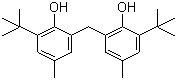 |
| Molecular Formula | C23H32O2 |
| Molecular Weight | 340.50 |
| CAS Registry Number | 119-47-1 |
| EC Number | 204-327-1 |
| SMILES | CC1=CC(=C(C(=C1)C(C)(C)C)O)CC2=C(C(=CC(=C2)C)C(C)(C)C)O |
| Density | 1.0±0.1 g/cm3, Calc.* |
|---|---|
| Melting point | 123-133 °C |
| Index of Refraction | 1.551, Calc.* |
| Boiling Point | 428.6±40.0 °C (760 mmHg), Calc.* |
| Flash Point | 181.2±21.9 °C, Calc.* |
| * | Calculated using Advanced Chemistry Development (ACD/Labs) Software. |
| Hazard Symbols |  GHS08 Danger Details GHS08 Danger Details | ||||||||||||||||||||||||||||||||||||||||||||||||||||
|---|---|---|---|---|---|---|---|---|---|---|---|---|---|---|---|---|---|---|---|---|---|---|---|---|---|---|---|---|---|---|---|---|---|---|---|---|---|---|---|---|---|---|---|---|---|---|---|---|---|---|---|---|---|
| Risk Statements | H360F Details | ||||||||||||||||||||||||||||||||||||||||||||||||||||
| Safety Statements | P280-P305+P351+P338 Details | ||||||||||||||||||||||||||||||||||||||||||||||||||||
| Hazard Classification | |||||||||||||||||||||||||||||||||||||||||||||||||||||
| |||||||||||||||||||||||||||||||||||||||||||||||||||||
| SDS | Available | ||||||||||||||||||||||||||||||||||||||||||||||||||||
 chemBlink Chemical Story
|
2,2'-Methylenebis(6-tert-butyl-4-methylphenol), commonly referred to as MBP or antioxidant 1010, is a significant chemical compound primarily recognized for its application as a stabilizer and antioxidant in various industrial materials. Its chemical formula is C22H30O2, and it falls under the category of hindered phenolic antioxidants. The compound was first synthesized in the mid-20th century during a time when the need for effective stabilizers in polymer and plastic formulations was becoming increasingly important. The development of MBP was driven by the demand for materials that could withstand the detrimental effects of heat, light, and oxygen. The discovery of 2,2'-methylenebis(6-tert-butyl-4-methylphenol) provided the industry with a powerful tool to prevent oxidative degradation in a variety of applications. This compound exhibits exceptional thermal stability and effectiveness in scavenging free radicals, making it a crucial additive in the production of plastics, rubber, and coatings. Its ability to protect materials from oxidative stress helps extend their lifespan and maintain their physical properties over time. MBP is commonly utilized in the formulation of polyolefins, polyamides, and polyurethanes. In these applications, it plays a vital role in preventing discoloration, loss of mechanical strength, and degradation of performance characteristics caused by oxidative processes. The compound is particularly effective in applications involving high temperatures, such as in automotive and industrial settings, where materials are subjected to extreme conditions. In addition to its primary function as an antioxidant, 2,2'-methylenebis(6-tert-butyl-4-methylphenol) also serves as a stabilizer in other materials, including adhesives, sealants, and coatings. Its versatility makes it a valuable component in a wide range of industries, including automotive, construction, and consumer goods. The presence of MBP in these products ensures enhanced durability and performance, which is critical for meeting industry standards and consumer expectations. Despite its widespread use, the safety profile of MBP has been a subject of research and regulatory scrutiny. Studies have indicated that, while it is effective in preventing degradation in materials, concerns exist regarding potential environmental and health impacts. Regulatory bodies, such as the European Chemicals Agency (ECHA) and the U.S. Environmental Protection Agency (EPA), have established guidelines for the use of such chemical additives, emphasizing the importance of safety assessments in industrial applications. As the demand for more sustainable and environmentally friendly materials grows, the industry is increasingly exploring alternative antioxidants and stabilizers. However, 2,2'-methylenebis(6-tert-butyl-4-methylphenol) remains a popular choice due to its proven efficacy and stability under various conditions. Ongoing research seeks to develop formulations that incorporate MBP while minimizing potential environmental impacts, ensuring that its benefits can continue to be realized in a responsible manner. In summary, 2,2'-methylenebis(6-tert-butyl-4-methylphenol) is a vital chemical compound used as an antioxidant and stabilizer in various industrial materials. Its discovery in the mid-20th century has significantly contributed to advancements in material science, offering enhanced durability and protection against oxidative degradation. As the industry moves towards more sustainable practices, ongoing research into the safety and effectiveness of this compound will be essential to ensure its responsible use. References 1972. Development of an oxidation reaction in a nonuniformly inhibited polymer. Bulletin of the Academy of Sciences of the USSR, Division of chemical science. DOI: 10.1007/bf00849830 2019. Generating the Blood Exposome Database Using a Comprehensive Text Mining and Database Fusion Approach. Environmental Health Perspectives. DOI: 10.1289/ehp4713 2023. Identification of phenol 2,2-methylene bis, 6 [1,1-D] as breath biomarker of hepatocellular carcinoma (HCC) patients and its electrochemical sensing: E-nose biosensor for HCC. Analytica Chimica Acta. DOI: 10.1016/j.aca.2022.340752 |
| Market Analysis Reports |