
Online Database of Chemicals from Around the World
| Beijing Eagle Sky Pharmatech Co., Ltd. | China | |||
|---|---|---|---|---|
 | www.eagleskypharmatech.com | |||
 | +86 (10) 5979-9429 8875-5821 | |||
 | +86 (10) 5804-3698 | |||
 | sophia_818@126.com contact@eagleskypharmatech.com | |||
 | QQ Chat | |||
| Chemical manufacturer since 2009 | ||||
| chemBlink Premium supplier since 2010 | ||||
| Classification | Organic raw materials >> Carboxylic compounds and derivatives >> Carboxylic esters and their derivatives |
|---|---|
| Name | 3-(Methylsulfonyl)-L-phenylalanine phenylmethyl ester hydrochloride (1:1) |
| Synonyms | benzyl (2S)-2-amino-3-(3-methylsulfonylphenyl)propanoate;hydrochloride |
| Molecular Structure | 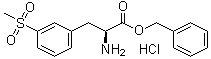 |
| Molecular Formula | C17H19NO4S.HCl |
| Molecular Weight | 369.86 |
| CAS Registry Number | 1194550-59-8 |
| EC Number | 811-561-3 |
| SMILES | CS(=O)(=O)C1=CC=CC(=C1)C[C@@H](C(=O)OCC2=CC=CC=C2)N.Cl |
| Hazard Symbols |   GHS07;GHS09 Warning Details GHS07;GHS09 Warning Details | ||||||||||||||||||||||||||||||||
|---|---|---|---|---|---|---|---|---|---|---|---|---|---|---|---|---|---|---|---|---|---|---|---|---|---|---|---|---|---|---|---|---|---|
| Risk Statements | H302+H312+H332-H302-H312-H315-H319-H332-H335-H411 Details | ||||||||||||||||||||||||||||||||
| Safety Statements | P261-P264-P264+P265-P270-P271-P273-P280-P301+P317-P302+P352-P304+P340-P305+P351+P338-P317-P319-P321-P330-P332+P317-P337+P317-P362+P364-P391-P403+P233-P405-P501 Details | ||||||||||||||||||||||||||||||||
| Hazard Classification | |||||||||||||||||||||||||||||||||
| |||||||||||||||||||||||||||||||||
| SDS | Available | ||||||||||||||||||||||||||||||||
 chemBlink Chemical Story
|
3-(Methylsulfonyl)-L-phenylalanine phenylmethyl ester hydrochloride (1:1) is a chemical compound that has gained attention in the field of medicinal chemistry due to its unique structure and potential applications. It is a derivative of L-phenylalanine, an essential amino acid, and features a methylsulfonyl group attached to the phenylalanine backbone. Additionally, the compound is formed as a phenylmethyl ester, which influences its solubility and biological activity. The hydrochloride salt form of this compound enhances its stability and facilitates handling and storage, making it useful in pharmaceutical research and development. The discovery of 3-(methylsulfonyl)-L-phenylalanine phenylmethyl ester hydrochloride (1:1) is part of ongoing efforts to explore modified amino acid derivatives with enhanced pharmacological properties. L-phenylalanine, a naturally occurring amino acid, serves as a building block for many biologically active compounds. By modifying its structure, such as the addition of a methylsulfonyl group and esterifying the carboxyl group, researchers can create derivatives with improved solubility, bioavailability, and bioactivity. The methylsulfonyl group, in particular, can impact the compound's reactivity, while the phenylmethyl ester can enhance its lipophilicity, allowing for better penetration of cellular membranes. The primary application of 3-(methylsulfonyl)-L-phenylalanine phenylmethyl ester hydrochloride (1:1) lies in its potential as a precursor or intermediate in the synthesis of more complex compounds. The compound’s structure makes it a valuable building block for the creation of pharmaceutical agents with diverse biological activities. Its unique combination of a methylsulfonyl group, phenylalanine backbone, and ester functionality may provide an advantage in the development of drugs aimed at a variety of therapeutic targets. One notable area where this compound could have applications is in the design of inhibitors for specific enzymes involved in metabolic disorders or diseases. The modification of amino acids, particularly with the introduction of functional groups like methylsulfonyl, can alter the interactions of these compounds with biological targets, such as enzymes or receptors. The ester functionality in the compound could influence its binding affinity and cellular uptake, making it a useful candidate for further exploration in drug development. Additionally, the ability to fine-tune the solubility and stability of these compounds through such modifications is important for optimizing their therapeutic potential. Furthermore, this compound could find applications in the synthesis of peptide-based drugs or as part of larger biomolecular structures. The presence of the phenylmethyl ester group could enable the compound to be incorporated into peptides with desirable pharmacological properties, such as enhanced stability or receptor specificity. As part of peptide drug discovery, derivatives like 3-(methylsulfonyl)-L-phenylalanine phenylmethyl ester hydrochloride (1:1) could play a role in the development of novel therapeutic agents for conditions like cancer, diabetes, or neurodegenerative diseases. In addition to its potential as a pharmaceutical intermediate, this compound may have value in academic and industrial research settings. It can be used in studies related to protein synthesis, enzyme inhibition, and metabolic pathway analysis. Researchers can explore the effects of various functional groups, such as the methylsulfonyl group, on the biological activity of the molecule, helping to better understand the mechanisms of action for similar compounds. In conclusion, 3-(methylsulfonyl)-L-phenylalanine phenylmethyl ester hydrochloride (1:1) is a promising compound with potential applications in pharmaceutical development, particularly as an intermediate for the synthesis of more complex molecules. Its structure, featuring both a methylsulfonyl group and a phenylmethyl ester, positions it as an interesting candidate for the design of new drug molecules with improved bioactivity and solubility. Further research into its properties and applications could lead to the development of novel therapeutic agents targeting a variety of diseases. |
| Market Analysis Reports |