
Online Database of Chemicals from Around the World
| Xi'an Reapsource Biotechnology Co., Ltd. | China | |||
|---|---|---|---|---|
 | www.rpybiotech.com | |||
 | +86 18991103357 | |||
 | buyun.ping@rpybiotech.com | |||
 | QQ Chat | |||
 | WeChat: 18991103357 | |||
| Chemical manufacturer since 2024 | ||||
| chemBlink Standard supplier since 2026 | ||||
| Classification | Chemical reagent >> Deuterated reagent |
|---|---|
| Name | 1-Bromo-2,6-difluorobenzene-d3 |
| Molecular Structure | 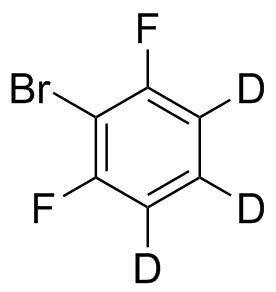 |
| Molecular Formula | C6D3BrF2 |
| Molecular Weight | 196.01 |
| CAS Registry Number | 1219803-73-2 |
| SMILES | [2H]C1=C(C(=C(C(=C1[2H])F)Br)F)[2H] |
| Density | 1.7±0.1 g/cm3 Calc.* |
|---|---|
| Boiling point | 149.8±20.0 °C 760 mmHg (Calc.)* |
| Flash point | 53.3 °C (Calc.)* |
| Index of refraction | 1.507 (Calc.)* |
| * | Calculated using Advanced Chemistry Development (ACD/Labs) Software. |
| Hazard Symbols |  GHS07 Warning Details GHS07 Warning Details |
|---|---|
| Risk Statements | H302-H315-H319-H335 Details |
| Safety Statements | P280-P305+P351+P338 Details |
| SDS | Available |
 chemBlink Chemical Story
|
1-Bromo-2,6-difluorobenzene-d3 is a stable isotope-labeled halogenated aromatic compound derived from 1-bromo-2,6-difluorobenzene in which three hydrogen atoms on the benzene ring are replaced with deuterium. The compound belongs to the broader class of halogenated benzenes and is primarily used as a reference material in analytical chemistry and research applications. Isotopically labeled aromatic halides such as this compound are important tools because they allow accurate detection and quantification of organic substances using mass spectrometric techniques while maintaining nearly identical chemical behavior to the unlabeled parent molecule. The development of deuterium-labeled aromatic compounds is closely associated with advances in isotope chemistry and instrumental analysis during the twentieth century. As gas chromatography and mass spectrometry became widely used in chemical and environmental analysis, the need for internal standards that closely mimic target analytes increased. Deuterium was adopted as a labeling isotope because it produces a predictable mass shift while preserving the overall chemical structure and reactivity of the molecule. This makes deuterated aromatic halides particularly suitable for quantitative analytical applications. 1-Bromo-2,6-difluorobenzene itself is a substituted benzene containing both bromine and fluorine atoms. The presence of halogens significantly alters the electronic properties of the aromatic ring by withdrawing electron density through inductive effects. Fluorine atoms exert strong electron-withdrawing effects while also influencing bond polarization, whereas bromine contributes both inductive withdrawal and characteristic isotopic patterns in mass spectrometry. The combination of these substituents results in a relatively deactivated aromatic system compared with unsubstituted benzene. In the deuterated analog, selected hydrogen atoms on the aromatic ring are replaced by deuterium. This substitution does not significantly alter the chemical reactivity of the compound under most conditions, but it does create a measurable difference in mass. This isotopic distinction is the basis for its primary use as an internal standard in analytical workflows. The compound can be distinguished from non-deuterated analytes during mass spectrometric detection, allowing precise quantification. One of the most important applications of 1-bromo-2,6-difluorobenzene-d3 is in gas chromatography–mass spectrometry (GC–MS) analysis. Internal standards are routinely used in this technique to correct for variations in sample preparation, injection volume, and instrument response. Because isotopically labeled compounds behave almost identically to their unlabeled counterparts during chromatographic separation and ionization, they provide a reliable basis for quantitative comparison. This makes deuterated halogenated benzenes valuable in analytical chemistry laboratories. The compound is also used in method development and validation studies. Analytical methods designed to detect halogenated aromatic compounds require calibration and performance verification. Isotopically labeled analogs such as 1-bromo-2,6-difluorobenzene-d3 serve as reference materials for evaluating extraction efficiency, recovery rates, and detection limits. These applications are particularly important in environmental analysis, where halogenated aromatic compounds may be present at trace levels in complex matrices. Another application of deuterated aromatic halides is in the study of mass spectrometric fragmentation patterns. The presence of both bromine and fluorine atoms in the molecule produces characteristic isotope distributions, while deuterium substitution provides additional mass resolution. These features are useful in interpreting spectral data and improving the identification of structurally related compounds. Although the compound is primarily used in analytical contexts, it is also relevant in fundamental studies of isotopic effects. Deuterium substitution can provide insight into reaction mechanisms and molecular behavior, particularly in cases where subtle kinetic isotope effects are being investigated. However, for aromatic halides such as this compound, such effects are generally small and the main utility remains analytical rather than mechanistic. From a physicochemical perspective, 1-bromo-2,6-difluorobenzene-d3 is expected to closely resemble the non-deuterated parent compound in terms of polarity, volatility, and solubility. The primary distinction lies in its increased molecular mass and altered vibrational properties due to deuterium substitution. These differences are sufficient for analytical discrimination but do not significantly affect chromatographic behavior. Overall, 1-bromo-2,6-difluorobenzene-d3 is a stable isotope-labeled aromatic halide used mainly as an internal standard and analytical reference compound. Its value lies in its ability to support accurate quantitative analysis, method validation, and spectral interpretation in gas chromatography–mass spectrometry applications involving halogenated aromatic compounds. |
| Market Analysis Reports |