
Online Database of Chemicals from Around the World
| Colourise Industries | India | |||
|---|---|---|---|---|
 | www.colourise.in | |||
 | +91 (79) 2685-3684 2685-7684 | |||
 | +91 (79) 2685-7684 | |||
 | info@colourise.in | |||
| Chemical manufacturer since 1978 | ||||
| chemBlink Standard supplier since 2010 | ||||
| BOC Sciences | USA | |||
|---|---|---|---|---|
| www.bocsci.com | |||
| +1 (631) 485-4226 | |||
| +1 (631) 614-7828 | |||
| info@bocsci.com | |||
| Chemical manufacturer | ||||
| chemBlink Standard supplier since 2010 | ||||
| Alfa Chemistry | USA | |||
|---|---|---|---|---|
| www.alfa-chemistry.com | |||
| +1 (516) 734-6573 | |||
| +1 (516) 927-0118 | |||
| support@alfa-chemistry.com | |||
| Chemical manufacturer since 2005 | ||||
| chemBlink Standard supplier since 2012 | ||||
| Hangzhou Leap Chem Co., Ltd. | China | |||
|---|---|---|---|---|
| www.leapchem.com | |||
| +86 (571) 8771-1850 | |||
| market19@leapchem.com | |||
 | QQ Chat | |||
| Chemical manufacturer since 2006 | ||||
| chemBlink Standard supplier since 2015 | ||||
| Shen Zhen Reagent Biotechnology Co., Ltd. | China | |||
|---|---|---|---|---|
| www.haoreagent.com | |||
| +86 (755) 8945-9231 | |||
| sales@haoreagent.com | |||
| Chemical distributor since 2016 | ||||
| chemBlink Standard supplier since 2024 | ||||
| Classification | Dyes and pigments >> Dyes >> Reactive dye (reactive dye) |
|---|---|
| Name | Reactive Violet 5 |
| Synonyms | Remazol Brilliant Violet 5R; 5-(Acetylamino)-4-hydroxy-3-[[2-hydroxy-4-[[2-(sulfooxy)ethyl]sulfonyl]phenyl]azo]-2,7-naphthalenedisulfonic acid trisodium salt |
| Molecular Structure | 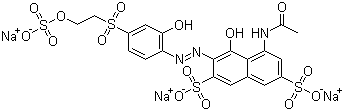 |
| Molecular Formula | C20H16N3O15S4.3Na |
| Molecular Weight | 735.58 |
| CAS Registry Number | 12226-38-9 |
| EC Number | 235-434-1 |
| SMILES | CC(=O)NC1=C2C(=CC(=C1)S(=O)(=O)[O-])C=C(C(=C2O)N=NC3=C(C=CC(=C3)S(=O)(=O)CCOS(=O)(=O)[O-])O)S(=O)(=O)[O-].[Na+].[Na+].[Na+] |
| Hazard Symbols |  GHS07 Warning Details GHS07 Warning Details | ||||||||||||
|---|---|---|---|---|---|---|---|---|---|---|---|---|---|
| Risk Statements | H302-H315-H319-H335 Details | ||||||||||||
| Safety Statements | P261-P305+P351+P338 Details | ||||||||||||
| Hazard Classification | |||||||||||||
| |||||||||||||
| SDS | Available | ||||||||||||
 chemBlink Chemical Story
|
Reactive Violet 5 is a synthetic dye belonging to the class of reactive dyes, known for their vivid coloration and ability to chemically bond with fibers. It was first developed in the mid-20th century as part of a broader effort to create dyes with superior performance characteristics, including better colorfastness and ease of application. Reactive Violet 5 features a reactive group that allows it to form covalent bonds with textile fibers, resulting in vibrant and long-lasting colors. One of the primary applications of Reactive Violet 5 is in the textile industry. It is widely used for dyeing natural fibers such as cotton and wool, as well as synthetic fibers like nylon and polyester. The dye’s reactive properties enable it to form strong chemical bonds with the fiber molecules, resulting in a high degree of colorfastness. This makes Reactive Violet 5 particularly valuable for applications where durability and resistance to washing and light exposure are important. It is commonly used in the production of clothing, home textiles, and industrial fabrics. In addition to textiles, Reactive Violet 5 is utilized in the paper and packaging industries. It is employed to impart vivid violet hues to paper products and packaging materials, enhancing their visual appeal and marketability. The dye’s excellent colorfastness and stability under various conditions make it suitable for use in products that require consistent and reliable coloration. The versatility of Reactive Violet 5 extends to applications in cosmetics and personal care products. It is used in formulations such as shampoos, lotions, and makeup to provide bright and attractive colors. The dye’s stability in these formulations ensures that the color remains vibrant throughout the product's shelf life, contributing to its aesthetic appeal. While Reactive Violet 5 offers numerous benefits in terms of color and performance, its use is subject to regulatory scrutiny due to concerns about potential environmental and health impacts. Studies are ongoing to assess the safety and environmental effects of synthetic dyes, including Reactive Violet 5, and to develop safer alternatives where possible. References 2014. Isolation and Characterization of Paracoccus sp. GSM2 Capable of Degrading Textile Azo Dye Reactive Violet 5. The Scientific World Journal. DOI: 10.1155/2014/410704 2016. Microaerophilic Symmetric Reductive Cleavage of Reactive Azo Dye—Remazole Brilliant Violet 5R by Consortium VIE6: Community Synergism. Applied Biochemistry and Biotechnology. DOI: 10.1007/s12010-016-2150-4 2020. Laccase isoform diversity on basal medium in Cyathus bulleri and role in decolorization/detoxification of textile dyes and effluent. World Journal of Microbiology and Biotechnology. DOI: 10.1007/s11274-020-02939-7 |
| Market Analysis Reports |