
Online Database of Chemicals from Around the World
| Watec Laboratories, Inc. | China | |||
|---|---|---|---|---|
 | www.wateclaboratories.com | |||
 | +86 (519) 8692-1516 +86 18602586511 | |||
 | +86 (519) 8526-7382 | |||
 | info@wateclaboratories.com | |||
 | QQ Chat | |||
| Chemical manufacturer since 2014 | ||||
| chemBlink Standard supplier since 2012 | ||||
| Classification | API >> Water, electrolyte and acid-base balance regulator >> Glucose drug |
|---|---|
| Name | Ethyl vanillin glucoside |
| Synonyms | 3-ethoxy-4-[(2S,3R,4S,5S,6R)-3,4,5-trihydroxy-6-(hydroxymethyl)oxan-2-yl]oxybenzaldehyde |
| Molecular Structure | 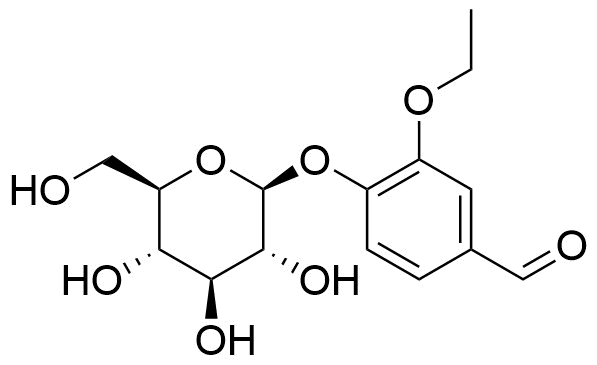 |
| Molecular Formula | C15H20O8 |
| Molecular Weight | 328.31 |
| CAS Registry Number | 122397-96-0 |
| EC Number | 602-769-3 |
| SMILES | CCOC1=C(C=CC(=C1)C=O)O[C@H]2[C@@H]([C@H]([C@@H]([C@H](O2)CO)O)O)O |
| Density | 1.4±0.1 g/cm3 Calc.* |
|---|---|
| Boiling point | 578.1±50.0 °C 760 mmHg (Calc.)* |
| Flash point | 214.5±23.6 °C (Calc.)* |
| Index of refraction | 1.617 (Calc.)* |
| * | Calculated using Advanced Chemistry Development (ACD/Labs) Software. |
| Hazard Symbols |  GHS07 Warning Details GHS07 Warning Details |
|---|---|
| Risk Statements | H302-H315-H319 Details |
| Safety Statements | P501-P270-P264-P280-P302+P352-P337+P313-P305+P351+P338-P362+P364-P332+P313-P301+P312+P330 Details |
| SDS | Available |
 chemBlink Chemical Story
|
Ethyl vanillin glucoside is a glycosylated aromatic compound derived from ethyl vanillin, a synthetic flavoring agent structurally related to vanillin. It consists of an ethyl vanillin aglycone linked to a glucose unit through a glycosidic bond, forming a β-D-glucoside derivative. The molecular structure combines an aromatic aldehyde-derived core with a carbohydrate moiety, giving the molecule both hydrophobic and hydrophilic regions. The aglycone portion, ethyl vanillin, is a substituted benzaldehyde in which the aldehyde group is retained and the phenolic hydroxyl group is etherified with an ethoxy substituent. The aromatic ring contains electron-donating and electron-withdrawing substituents that influence its reactivity and stability. In ethyl vanillin glucoside, this aglycone is attached to a glucose residue, typically through the phenolic oxygen atom, forming an O-glycosidic linkage. The glucose moiety is a hexose sugar in its pyranose form, which provides multiple hydroxyl groups capable of hydrogen bonding. This significantly increases the polarity and water solubility of the molecule compared with ethyl vanillin itself. The glycosidic bond connects the anomeric carbon of glucose to the oxygen atom of the aromatic component, forming a stable acetal-type linkage under neutral conditions. Ethyl vanillin glucosides are commonly formed in biological systems as part of glycosylation reactions in plants or microbial metabolism. Glycosylation is a biochemical modification that enhances solubility, stability, and storage of phenolic compounds. In plants, such transformations are typically catalyzed by glycosyltransferase enzymes, which transfer activated sugar donors to small-molecule acceptors such as phenols and aldehydes. The glycosylation of aromatic compounds like ethyl vanillin serves several functional roles in nature. It reduces reactivity of the aglycone, increases water solubility, and allows compartmentalization within plant tissues. Glycosides can also act as storage or transport forms of volatile or bioactive phenolic compounds. From a chemical perspective, ethyl vanillin glucoside is more stable toward oxidation and volatilization than free ethyl vanillin. The aldehyde group in the aromatic moiety remains chemically intact, while the phenolic oxygen is blocked by glycosidic substitution. The glycosidic bond itself is stable under neutral and mildly basic conditions but can be hydrolyzed under acidic conditions or by enzymatic action, releasing ethyl vanillin and glucose. Hydrolysis of ethyl vanillin glucoside regenerates the free aglycone, which is responsible for the characteristic aroma and flavor properties associated with vanillin derivatives. This reversible transformation is important in both biological systems and food chemistry, where glycosides can act as flavor precursors. Physicochemically, the presence of the glucose unit greatly increases hydrophilicity and hydrogen bonding capacity. The compound is expected to be highly soluble in water due to multiple hydroxyl groups on the sugar moiety, while the aromatic portion contributes moderate hydrophobic character. In analytical chemistry, glycosylated phenolic compounds such as ethyl vanillin glucoside are often studied to understand plant metabolism, flavor precursor chemistry, and enzymatic transformation pathways. Detection and characterization typically involve chromatographic and spectrometric techniques that distinguish between glycosylated and free forms. Although ethyl vanillin itself is widely used as a synthetic flavoring agent in food and fragrance applications, its glycoside form is more relevant in natural product chemistry and biotransformation studies rather than direct industrial use. The glycoside represents a storage or transport form that can be enzymatically converted to the active flavor compound. Overall, ethyl vanillin glucoside is a glycosylated derivative of ethyl vanillin in which a glucose unit is linked to the aromatic aglycone through an O-glycosidic bond. Its structure combines a phenolic aldehyde derivative with a carbohydrate moiety, resulting in increased solubility, stability, and relevance in biochemical and plant metabolic processes. |
| Market Analysis Reports |