
Online Database of Chemicals from Around the World
| Tianjin ComoraTechnology Co., Ltd. | China | |||
|---|---|---|---|---|
 | comoratj.com | |||
 | +86 15908635794 | |||
 | sales@comoratj.com | |||
 | WhatsApp:+86 15908635794 | |||
| Chemical manufacturer since 2026 | ||||
| chemBlink Standard supplier since 2026 | ||||
| Classification | Chemical reagent >> Organic reagent >> Amine salt (ammonium salt) |
|---|---|
| Name | (1-Methylcyclobutyl)methanamine hydrochloride |
| Molecular Structure | 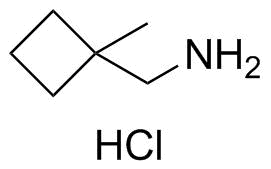 |
| Molecular Formula | C6H14ClN |
| Molecular Weight | 135.64 |
| CAS Registry Number | 1245647-53-3 |
| EC Number | 821-514-9 |
| SMILES | CC1(CCC1)CN.Cl |
| Hazard Symbols |  GHS07 Warning Details | ||||||||||||||||||||||||||||||||||||
|---|---|---|---|---|---|---|---|---|---|---|---|---|---|---|---|---|---|---|---|---|---|---|---|---|---|---|---|---|---|---|---|---|---|---|---|---|---|
| Risk Statements | H302-H312-H315-H319-H332-H335-H336 Details | ||||||||||||||||||||||||||||||||||||
| Safety Statements | P261-P264-P264+P265-P270-P271-P280-P301+P317-P302+P352-P304+P340-P305+P351+P338-P317-P319-P321-P330-P332+P317-P337+P317-P362+P364-P403+P233-P405-P501 Details | ||||||||||||||||||||||||||||||||||||
| Hazard Classification | |||||||||||||||||||||||||||||||||||||
| |||||||||||||||||||||||||||||||||||||
| SDS | Available | ||||||||||||||||||||||||||||||||||||
 chemBlink Chemical Story
|
(1-Methylcyclobutyl)methanamine hydrochloride is a small amine building block in which a four-membered carbon ring carries both a methyl group and an aminomethyl group at the same ring carbon. The nitrogen is separated from the ring by a methylene unit. This detail distinguishes it from 1-methylcyclobutan-1-amine, whose nitrogen is attached directly to the ring. The extra carbon changes the connectivity and should not disappear when names are shortened or translated. The hydrochloride is the acid-addition salt of the amine. Its chloride is a counterion, not a chlorine substituent on the carbon framework. Conversion between a salt and its corresponding free base changes protonation and handling properties while retaining the organic skeleton. In synthetic planning, the primary amino group is the main connection point: it can participate in amide formation or other nitrogen-based derivatization when appropriate reaction conditions make the amine available. A specific documentary connection appears in patent ES2602039T3, on bicyclic aza compounds investigated as muscarinic M1 receptor agonists. Its starting-material table lists (1-methylcyclobutyl)methanamine hydrochloride with CAS 1245647-53-3 as a commercially available reagent. The same table separately lists related cyclobutyl amines, illustrating the care needed to distinguish ring-bound amino groups from aminomethyl side chains. The table supports a research-reagent role in that synthetic program; it is not evidence that the isolated salt itself activates the M1 receptor. The compound's interest is therefore a matter of molecular construction rather than an established therapeutic effect. A compact saturated ring gives the fragment a different shape from a flat aromatic group, and the methylene spacer places the nitrogen outside that ring. Whether incorporating the fragment improves any final molecule depends on the complete structure and experimental measurements. Identity, salt form, and the position of the nitrogen are the reliable starting points for understanding this specialized reagent. References: 1. Apollo Scientific. (1-Methylcyclobutyl)methanamine hydrochloride, OR317109, typical certificate of analysis. https://store.apolloscientific.co.uk/storage/coas/OR317109_TypicalCofA.pdf 2. ES2602039T3. Bicyclic aza compounds as muscarinic M1 receptor agonists; starting-material table. https://patents.google.com/patent/ES2602039T3/en |
| Market Analysis Reports |