
Online Database of Chemicals from Around the World
| CAS: 125-33-7 Product: Primidone No suppliers available. |
| Classification | API >> Nervous system medication >> Antiepileptic and anticonvulsant |
|---|---|
| Name | Primidone |
| Synonyms | 2-Deoxyphenobarbital; 5-Phenyl-5-ethyl-hexahydropyrimidine-4,6-dione; 5-Ethyldihydro-5-phenyl-4,6(1H,5H)-pyrimidinedione |
| Molecular Structure | 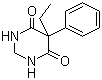 |
| Molecular Formula | C12H14N2O2 |
| Molecular Weight | 218.25 |
| CAS Registry Number | 125-33-7 |
| EC Number | 204-737-0 |
| SMILES | CCC1(C(=O)NCNC1=O)C2=CC=CC=C2 |
| Density | 1.2±0.1 g/cm3 Calc.* |
|---|---|
| Melting point | 281 °C (Expl.) |
| Boiling point | 442.9±55.0 °C 760 mmHg (Calc.)* |
| Flash point | 289.6±20.8 °C (Calc.)* |
| Solubility | DMSO 44 mg/mL, Water <1 mg/mL (Expl.) |
| Index of refraction | 1.603 (Calc.)* |
| * | Calculated using Advanced Chemistry Development (ACD/Labs) Software. |
| Hazard Symbols |   GHS07;GHS08 Danger Details GHS07;GHS08 Danger Details | ||||||||||||||||||||||||||||||||||||||||||||
|---|---|---|---|---|---|---|---|---|---|---|---|---|---|---|---|---|---|---|---|---|---|---|---|---|---|---|---|---|---|---|---|---|---|---|---|---|---|---|---|---|---|---|---|---|---|
| Risk Statements | H302-H351-H360 Details | ||||||||||||||||||||||||||||||||||||||||||||
| Safety Statements | P203-P264-P270-P280-P301+P317-P318-P330-P405-P501 Details | ||||||||||||||||||||||||||||||||||||||||||||
| Hazard Classification | |||||||||||||||||||||||||||||||||||||||||||||
| |||||||||||||||||||||||||||||||||||||||||||||
| SDS | Available | ||||||||||||||||||||||||||||||||||||||||||||
 chemBlink Chemical Story
|
Primidone is a barbiturate derivative with the chemical formula C12H14N2O2. It was first synthesized and introduced in the 1950s as an anticonvulsant medication. Structurally, primidone is a pyrimidine derivative closely related to barbiturates, and it functions primarily as an anticonvulsant and antiepileptic agent. The discovery of primidone was motivated by the search for effective treatments for epilepsy. It was developed as a less sedating alternative to earlier barbiturates used in seizure control. Primidone itself is pharmacologically active but is also metabolized in the body to phenobarbital and phenylethylmalonamide, both of which contribute to its anticonvulsant effects. The conversion to phenobarbital is a significant pathway that enhances seizure control. Primidone is used clinically to manage various types of seizures, including generalized tonic-clonic seizures and partial seizures. It is also sometimes prescribed for essential tremor, where it helps reduce involuntary shaking. The drug acts by enhancing gamma-aminobutyric acid (GABA) neurotransmission in the central nervous system, leading to increased inhibitory effects on neuronal excitability, thereby stabilizing electrical activity in the brain. The medication is typically administered orally and absorbed efficiently in the gastrointestinal tract. It has a relatively long half-life, allowing for sustained anticonvulsant action. Dose adjustment and monitoring are important due to the potential for side effects and interactions with other medications. Primidone’s use has been widely studied and established in clinical practice. It is included in treatment guidelines for epilepsy and remains an important option, especially in cases where other anticonvulsants are insufficient or unsuitable. However, its side effect profile includes sedation, dizziness, and possible hematologic effects, requiring careful patient management. In summary, primidone is a well-established anticonvulsant drug discovered in the mid-20th century and used primarily to treat epilepsy and essential tremor. Its therapeutic effects arise from both the parent compound and its active metabolites, with a mechanism involving enhancement of GABAergic inhibition in the brain. References 1987. Essential tremor variants: effect of treatment. Clinical Neuropharmacology, 10(4). DOI: 10.1097/00002826-198708000-00004 1984. Primidone therapy in refractory neonatal seizures. The Journal of Pediatrics, 105(4). DOI: 10.1016/s0022-3476(84)80442-4 1979. Single‐dose pharmacokinetics and anticonvulsant efficacy of primidone in mice. Annals of Neurology, 5(5). DOI: 10.1002/ana.410050512 |
| Market Analysis Reports |