
Online Database of Chemicals from Around the World
| INA Pharmaceuticals Pvt. Ltd. | India | |||
|---|---|---|---|---|
 | inapharma.in | |||
 | +91 7815933367 | |||
 | rd@inapharma.in | |||
| Chemical manufacturer since 2018 | ||||
| chemBlink Standard supplier since 2026 | ||||
| Classification | Organic raw materials >> Carboxylic compounds and derivatives >> Carboxylic esters and their derivatives |
|---|---|
| Name | (2-Cyano-4-(methoxycarbonyl)phenyl)boronic acid pinacol ester |
| Synonyms | methyl 3-cyano-4-(4,4,5,5-tetramethyl-1,3,2-dioxaborolan-2-yl)benzoate |
| Molecular Structure | 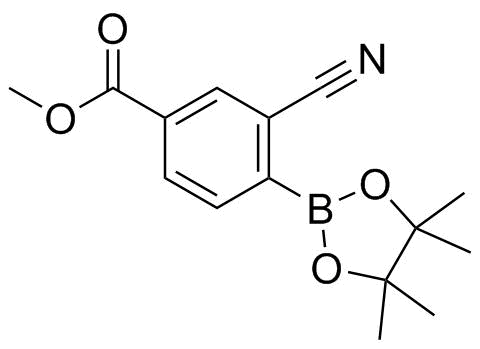 |
| Molecular Formula | C15H18BNO4 |
| Molecular Weight | 287.12 |
| CAS Registry Number | 1258963-20-0 |
| EC Number | 892-854-3 |
| SMILES | B1(OC(C(O1)(C)C)(C)C)C2=C(C=C(C=C2)C(=O)OC)C#N |
| Density | 1.1±0.1 g/cm3 Calc.* |
|---|---|
| Boiling point | 421.7±40.0 °C 760 mmHg (Calc.)* |
| Flash point | 208.8±27.3 °C (Calc.)* |
| Index of refraction | 1.513 (Calc.)* |
| * | Calculated using Advanced Chemistry Development (ACD/Labs) Software. |
| Hazard Symbols |  GHS07 Warning Details GHS07 Warning Details |
|---|---|
| Risk Statements | H302-H315-H319-H335 Details |
| Safety Statements | P261-P264-P264+P265-P270-P271-P280-P301+P317-P302+P352-P304+P340-P305+P351+P338-P319-P321-P330-P332+P317-P337+P317-P362+P364-P403+P233-P405-P501 Details |
| SDS | Available |
 chemBlink Chemical Story
|
(2-Cyano-4-(methoxycarbonyl)phenyl)boronic acid pinacol ester, CAS 1258963-20-0, is a specialized aromatic boronic ester used primarily as a synthetic building block in organic and medicinal chemistry research. It is also known as methyl 3-cyano-4-(4,4,5,5-tetramethyl-1,3,2-dioxaborolan-2-yl)benzoate. With the molecular formula C15H18BNO4, the molecule combines three synthetically useful features on one benzene ring: a pinacol boronate ester, a nitrile group, and a methyl carboxylate ester. Its significance is best understood through the development of organoboron chemistry. Carbon-boron bonds occupy an unusual position in synthetic chemistry. They can often be prepared and handled as relatively stable compounds, yet under appropriate reaction conditions the carbon group attached to boron can be transferred to another carbon atom. This combination of practical stability and controlled reactivity has made arylboronic acids and their esters extraordinarily useful intermediates. The best-known application is the Suzuki-Miyaura cross-coupling reaction. Developed through the work of Akira Suzuki and Norio Miyaura and their collaborators, this palladium-catalyzed chemistry allows an organoboron compound to be coupled with an organic halide or related electrophile, creating a new carbon-carbon bond. Its broad functional-group tolerance and the availability of many different boron-containing building blocks helped make Suzuki-Miyaura coupling one of the fundamental tools of modern organic synthesis. Pinacol boronic esters, often abbreviated BPin compounds, have become particularly convenient versions of these reagents. Conversion of a boronic acid into its cyclic pinacol ester can provide a readily handled form that is often useful for storage, purification, and multistep synthesis. The characteristic 4,4,5,5-tetramethyl-1,3,2-dioxaborolane ring therefore appears repeatedly in catalogs of modern pharmaceutical and fine-chemical building blocks. CAS 1258963-20-0 adds another layer of synthetic utility because the aromatic ring is already decorated with two additional functional groups. The nitrile group provides a compact, strongly polar carbon-nitrogen functionality that is widely encountered in medicinal and agrochemical chemistry. It can also serve as a synthetic handle for subsequent transformations. The methyl ester provides another independently useful site that can be retained, hydrolyzed, converted into amides, or otherwise manipulated depending on the synthetic objective. This means the compound is not usually interesting because of a final biological or material property of its own. Its value lies in what chemists can build from it. In a Suzuki-Miyaura reaction, the boronate-bearing carbon can become the point at which another aromatic or heteroaromatic fragment is attached. The nitrile and ester groups can remain in the product, providing functionality for later stages of synthesis. One purchased building block can therefore introduce several carefully positioned structural features at once. This strategy has become increasingly important in medicinal chemistry. Drug discovery frequently requires the preparation of dozens or hundreds of closely related molecules in which one portion of a molecular scaffold is systematically changed. A collection of substituted boronic esters allows chemists to assemble such analogues efficiently through modular cross-coupling chemistry. Instead of constructing every candidate from the beginning, researchers can prepare common intermediates and attach different molecular fragments at selected positions. The molecule also illustrates why the commercial chemical industry now supplies enormous libraries of compounds that may never become products themselves. Modern synthesis depends on an infrastructure of intermediates: protected groups, coupling partners, chiral fragments, heterocycles, and functionalized aromatic building blocks. CAS 1258963-20-0 is commercially supplied specifically as an R&D chemical, consistent with this role. Its three functional elements also demonstrate an important principle of synthetic planning known as chemoselectivity. A useful synthetic sequence should modify the desired functional group while leaving others available for later steps. Modern coupling conditions often allow organoboron functionality to participate in carbon-carbon bond construction while nitrile and ester groups remain intact. Subsequent reactions can then address those groups independently. (2-Cyano-4-(methoxycarbonyl)phenyl)boronic acid pinacol ester therefore represents a different side of chemistry from familiar medicines, pigments, polymers, or industrial commodities. It is molecular construction material. Its purpose is not necessarily to appear in a finished product, but to give chemists a strategically prepared piece from which more complex molecules can be assembled. Modern organic synthesis increasingly resembles modular engineering. Chemists prepare molecular fragments with carefully chosen connection points, then join those fragments through reliable reactions. Boronic esters became some of the most useful connectors in that molecular toolkit. CAS 1258963-20-0 is one small example of how a seemingly obscure research chemical can participate in a much larger transformation: turning molecular synthesis from a strictly linear craft into a flexible system of chemical assembly. References 1. Miyaura, N.; Suzuki, A. (1995). "Palladium-Catalyzed Cross-Coupling Reactions of Organoboron Compounds." Chemical Reviews, 95, 2457-2483. 2. Lennox, A. J. J.; Lloyd-Jones, G. C. (2014). "Selection of boron reagents for Suzuki-Miyaura coupling." Chemical Society Reviews, 43, 412-443. https://doi.org/10.1039/C3CS60197H 3. Hall, D. G. (ed.) (2011). Boronic Acids: Preparation and Applications in Organic Synthesis, Medicine and Materials, 2nd ed. Wiley-VCH. 4. Accela ChemBio. 2-Cyano-4-(methoxycarbonyl)phenylboronic Acid Pinacol Ester, CAS 1258963-20-0. Product information. |
| Market Analysis Reports |