
Online Database of Chemicals from Around the World
| Nanjing Finetech Chemical Co., Ltd. | China | |||
|---|---|---|---|---|
 | www.fine-chemtech.com | |||
 | +86 (25) 5207-8417 +86 17714198479 | |||
 | +86 (25) 5207-8417 | |||
 | sales@fine-chemtech.com | |||
 | QQ Chat | |||
| Chemical manufacturer since 2007 | ||||
| chemBlink Standard supplier since 2007 | ||||
| Abosyn Chemicals Inc. | USA | |||
|---|---|---|---|---|
| www.abosyn.com | |||
| +1 (203) 683-8328 | |||
| info@abosyn.com | |||
| Chemical manufacturer since 2014 | ||||
| chemBlink Standard supplier since 2025 | ||||
| Classification | Organic raw materials >> Carboxylic compounds and derivatives >> Carboxylic esters and their derivatives |
|---|---|
| Name | (3S)-3-(2-Hydroxyethyl)-1-piperazinecarboxylic acid 1,1-dimethylethyl ester |
| Synonyms | tert-butyl (3S)-3-(2-hydroxyethyl)piperazine-1-carboxylate |
| Molecular Structure | 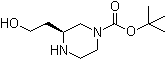 |
| Molecular Formula | C11H22N2O3 |
| Molecular Weight | 230.30 |
| CAS Registry Number | 1273577-11-9 |
| SMILES | CC(C)(C)OC(=O)N1CCN[C@H](C1)CCO |
| Solubility | Soluble (53 g/L) (25 °C), Calc.* |
|---|---|
| Density | 1.067±0.06 g/cm3 (20 °C 760 Torr), Calc.* |
| Index of Refraction | 1.478, Calc.* |
| Boiling Point | 352.2±22.0 °C (760 mmHg), Calc.* |
| Flash Point | 166.8±22.3 °C, Calc.* |
| * | Calculated using Advanced Chemistry Development (ACD/Labs) Software. |
| Hazard Symbols |  GHS07 Warning Details GHS07 Warning Details |
|---|---|
| Risk Statements | H302-H315-H319-H335 Details |
| Safety Statements | P261-P305+P351+P338 Details |
| SDS | Available |
 chemBlink Chemical Story
|
(3S)-3-(2-Hydroxyethyl)-1-piperazinecarboxylic acid 1,1-dimethylethyl ester is a chemical compound that belongs to the family of piperazine derivatives. This substance features a piperazine ring, which is a six-membered heterocyclic structure containing two nitrogen atoms. The compound also contains a hydroxyethyl group and a tert-butyl ester group, both of which contribute to its chemical and physical properties. Its chemical formula is C9H18N2O3, and it is often synthesized for use in medicinal and pharmaceutical research. The compound was first synthesized as part of efforts in medicinal chemistry to create new bioactive molecules. Piperazine derivatives, including those with hydroxyethyl and ester groups, have been explored for a variety of applications due to their potential pharmacological properties. These compounds can exhibit a range of biological activities, such as antimicrobial, antiviral, and analgesic effects, which are linked to their ability to interact with biological systems. In terms of structure, the (3S)-configuration refers to the specific stereochemistry of the molecule, indicating the spatial arrangement of atoms around the chiral center at the 3-position of the piperazine ring. The presence of the hydroxyethyl group enhances the solubility of the compound in water and biological media, which is important for its potential as a drug-like molecule. The tert-butyl ester group, on the other hand, is often used to improve the stability and bioavailability of the compound, as it can influence the molecule’s interaction with enzymes and its absorption in the body. While specific applications of (3S)-3-(2-hydroxyethyl)-1-piperazinecarboxylic acid 1,1-dimethylethyl ester are not extensively documented in the literature, compounds with similar structural features have been studied for use in the development of therapeutic agents. For instance, derivatives of piperazine with hydroxyethyl and ester groups are often investigated for their role in drug design, particularly for targeting receptors or enzymes involved in various diseases. The modification of the piperazine ring through functional groups like hydroxyethyl and tert-butyl esters is known to affect the compound’s pharmacokinetic properties, which is an important factor in developing effective drugs. In conclusion, (3S)-3-(2-hydroxyethyl)-1-piperazinecarboxylic acid 1,1-dimethylethyl ester is a piperazine-based compound that holds potential for various applications in medicinal chemistry. It is part of a broader class of piperazine derivatives studied for their potential biological activities. Ongoing research into piperazine-based molecules continues to explore their pharmacological properties and their potential for use in treating a range of medical conditions. References Majid M. Heravi, Vahideh Zadsirjan. Prescribed drugs containing nitrogen heterocycles: an overview. RSC Advances, 2020, 10, 44311. DOI: 10.1039/D0RA09198G Sonja Seeberger, Roger J. Griffin, Ian R. Hardcastle, Bernard T. Golding. A new strategy for the synthesis of taurine derivatives using the 'safety-catch' principle for the protection of sulfonic acids. Organic & Biomolecular Chemistry, 2007, 5, 138. DOI: 10.1039/B614333D Jun-Bo Chen, Cheng Peng, Sheng-Suo Zhou, Yong Wang, Zheng Wang, Xing-Wang Wang. Chiral oxamide-phosphine-palladium catalyzed highly asymmetric allylic amination: carbonyl assistance for high regio- and enantiocontrols. Organic Chemistry Frontiers, 2022, 9, 3989. DOI: 10.1039/D2QO00458E |
| Market Analysis Reports |