
Online Database of Chemicals from Around the World
| Hangzhou TJM Chemical Co., Ltd. | China | |||
|---|---|---|---|---|
 | www.tjmchem.com | |||
 | +86 13388471767 | |||
 | +86 (571) 8822-3279 | |||
 | sales@tjmchem.com | |||
| Chemical manufacturer | ||||
| chemBlink Standard supplier since 2011 | ||||
| Biosynth AG. | Switzerland | |||
|---|---|---|---|---|
| www.biosynth.com | |||
| +41 (71) 858-2020 | |||
| +41 (71) 858-2030 | |||
| welcome@biosynth.ch | |||
| Chemical manufacturer | ||||
| chemBlink Standard supplier since 2014 | ||||
| Changchun BC&HC Pharmaceutical Technology Co., Ltd. | China | |||
|---|---|---|---|---|
| www.bchc-china.com | |||
| +86 (431) 8087-1788 8087-1588 +86 15804318207 | |||
| +86 (431) 8841-7879 | |||
| 3468242165@qq.com | |||
 | QQ Chat | |||
| Chemical manufacturer since 2014 | ||||
| chemBlink Standard supplier since 2016 | ||||
| Shenzhen Geneseqtools Bioscience & Technology Co. Ltd. | China | |||
|---|---|---|---|---|
| geneseqtools.com | |||
| +86 (0755) 2325-1735 | |||
| sales@geneseqtools.com | |||
| QQ Chat | |||
 | WeChat: 13302967066 | |||
| Chemical manufacturer since 2015 | ||||
| chemBlink Standard supplier since 2025 | ||||
| SynInnova Laboratories Inc. | USA | |||
|---|---|---|---|---|
| www.syninnova.com | |||
| +1 (780) 485-2962 | |||
| +1 (780) 485-2963 | |||
| sales@syninnova.com | |||
| Chemical manufacturer | ||||
| Apollo Scientific Ltd. | UK | |||
|---|---|---|---|---|
| www.apolloscientific.co.uk | |||
| +44 (161) 406-0505 | |||
| +44 (161) 406-0506 | |||
| sales@apolloscientific.co.uk | |||
| Chemical manufacturer | ||||
| Classification | Organic raw materials >> Heterocyclic compound >> Indoles |
|---|---|
| Name | Octanoic acid 5-bromo-4-chloro-1H-indol-3-yl ester |
| Synonyms | (5-bromo-4-chloro-1H-indol-3-yl) octanoate |
| Molecular Structure | 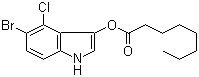 |
| Molecular Formula | C16H19BrClNO2 |
| Molecular Weight | 372.68 |
| CAS Registry Number | 129541-42-0 |
| EC Number | 806-317-8 |
| SMILES | CCCCCCCC(=O)OC1=CNC2=C1C(=C(C=C2)Br)Cl |
| Density | 1.4±0.1 g/cm3 Calc.* |
|---|---|
| Boiling point | 482.6±40.0 °C 760 mmHg (Calc.)* |
| Flash point | 245.7±27.3 °C (Calc.)* |
| Index of refraction | 1.592 (Calc.)* |
| * | Calculated using Advanced Chemistry Development (ACD/Labs) Software. |
| Hazard Symbols |  GHS07 Warning Details GHS07 Warning Details | ||||||||||||||||
|---|---|---|---|---|---|---|---|---|---|---|---|---|---|---|---|---|---|
| Risk Statements | H315-H319-H335 Details | ||||||||||||||||
| Safety Statements | P261-P264-P264+P265-P271-P280-P302+P352-P304+P340-P305+P351+P338-P319-P321-P332+P317-P337+P317-P362+P364-P403+P233-P405-P501 Details | ||||||||||||||||
| Hazard Classification | |||||||||||||||||
| |||||||||||||||||
| SDS | Available | ||||||||||||||||
 chemBlink Chemical Story
|
Octanoic acid 5-bromo-4-chloro-1H-indol-3-yl ester is a synthetic compound structurally characterized by the esterification of octanoic acid with a substituted indole ring bearing halogen atoms at positions 5 and 4. The indole core, a bicyclic structure formed by the fusion of a benzene ring with a pyrrole ring, is a widely explored scaffold in medicinal chemistry and is frequently modified to develop new bioactive molecules. In this molecule, the substitution pattern includes a bromine atom at position 5 and a chlorine atom at position 4 on the indole ring, enhancing its electron-withdrawing character and potentially altering its physicochemical and biological properties. This compound has been investigated for applications in both biochemical assays and pharmaceutical development due to the combined presence of lipophilic and aromatic functionalities. The indole ring system is known for its ability to interact with a variety of biological targets, including enzymes and receptors, through π-π stacking, hydrogen bonding, and hydrophobic interactions. Functionalizing the indole nucleus with halogens such as bromine and chlorine is often employed to modulate these interactions and improve metabolic stability. The octanoic acid moiety, a saturated eight-carbon fatty acid, contributes significant lipophilicity to the molecule, improving its membrane permeability and potentially enabling it to cross biological barriers more effectively. The ester linkage between the indole and the fatty acid also plays a key role in modulating the compound’s hydrolytic stability and can serve as a prodrug strategy, where enzymatic cleavage of the ester bond in vivo releases the active indole-based drug. Compounds like octanoic acid 5-bromo-4-chloro-1H-indol-3-yl ester have been evaluated for their use as chromogenic or fluorogenic enzyme substrates. In particular, esters of halogenated indoles are known to act as substrates for hydrolases such as esterases or lipases. Upon enzymatic cleavage, the indole moiety can undergo oxidative dimerization or other reactions that yield colored or fluorescent products, facilitating the detection and quantification of enzymatic activity in biochemical assays. In the field of microbiology and molecular biology, indole derivatives are also utilized as substrates for the identification of bacterial species that express specific hydrolases. The distinctive coloration or fluorescence that develops upon enzymatic hydrolysis provides a simple and rapid diagnostic tool. Although the specific use of octanoic acid 5-bromo-4-chloro-1H-indol-3-yl ester in commercial detection kits may be limited, its structural similarity to widely used compounds such as 5-bromo-4-chloro-3-indolyl derivatives suggests potential for similar applications. The synthesis of this compound typically involves esterification of 5-bromo-4-chloro-1H-indole-3-ol (a halogenated indole with a hydroxyl group at the 3-position) with octanoyl chloride under acidic or basic conditions, often using a catalyst or coupling agent to drive the reaction. This synthetic pathway allows for customization of the alkyl chain length or substitution pattern to tailor the compound’s properties for specific applications. Overall, octanoic acid 5-bromo-4-chloro-1H-indol-3-yl ester represents a specialized class of functionalized indole esters that combine halogen-substituted aromatic moieties with fatty acid-derived lipophilic groups. Its design illustrates the chemical strategies used to engineer small molecules for targeted biological interaction, enzyme detection, or as components of diagnostic assays. Further development and testing are needed to expand its utility and confirm its safety and effectiveness in practical applications. References 2008. Molecular cloning and characterization of a novel pyrethroid-hydrolyzing esterase originating from the Metagenome. Microbial Cell Factories, 7(38). DOI: 10.1186/1475-2859-7-38 2012. Identification and characterization of a novel thermostable pyrethroid-hydrolyzing enzyme isolated through metagenomic approach. Microbial Cell Factories, 11(33). DOI: 10.1186/1475-2859-11-33 2017. Directed evolution and secretory expression of a pyrethroid-hydrolyzing esterase with enhanced catalytic activity and thermostability. Microbial Cell Factories, 16(81). DOI: 10.1186/s12934-017-0698-5 |
| Market Analysis Reports |