
Online Database of Chemicals from Around the World
| Beijing Eagle Sky Pharmatech Co., Ltd. | China | |||
|---|---|---|---|---|
 | www.eagleskypharmatech.com | |||
 | +86 (10) 5979-9429 8875-5821 | |||
 | +86 (10) 5804-3698 | |||
 | sophia_818@126.com contact@eagleskypharmatech.com | |||
 | QQ Chat | |||
| Chemical manufacturer since 2009 | ||||
| chemBlink Premium supplier since 2010 | ||||
| Classification | API >> Other chemicals |
|---|---|
| Name | Selank |
| Synonyms | L-Threonyl-L-lysyl-L-prolyl-L-arginyl-L-prolylglycyl-L-proline; Selanc |
| Molecular Structure | 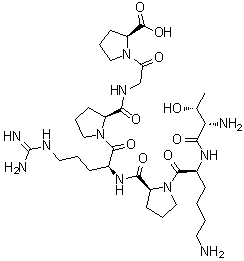 |
| Molecular Formula | C33H57N11O9 |
| Molecular Weight | 751.87 |
| Protein Sequence | TKPRPGP |
| CAS Registry Number | 129954-34-3 |
| SMILES | C[C@H]([C@@H](C(=O)N[C@@H](CCCCN)C(=O)N1CCC[C@H]1C(=O)N[C@@H](CCCN=C(N)N)C(=O)N2CCC[C@H]2C(=O)NCC(=O)N3CCC[C@H]3C(=O)O)N)O |
| Solubility | Sparingly soluble (18 g/L) (25 °C), Calc.* |
|---|---|
| Density | 1.53±0.1 g/cm3 (20 °C 760 Torr), Calc.* |
| Melting point | 134-136 °C** |
| Index of refraction | 1.686 (Calc.)* |
| * | Calculated using Advanced Chemistry Development (ACD/Labs) Software V11.02 (©1994-2018 ACD/Labs) |
| ** | Shevchenko, V. P. |
 chemBlink Chemical Story
|
Selank is a synthetic heptapeptide with the sequence Thr-Lys-Pro-Arg-Pro-Gly-Pro, derived from the naturally occurring tetrapeptide tuftsin, which is involved in immune modulation. It was developed by the Institute of Molecular Genetics of the Russian Academy of Sciences as a novel anxiolytic and nootropic agent. The goal of its development was to combine the immunomodulatory properties of tuftsin with enhanced neuropsychotropic activity to create a peptide suitable for managing anxiety, stress-related disorders, and cognitive impairment. Selank’s discovery was rooted in efforts to explore endogenous peptides with dual neuroimmune activities. Tuftsin, originally identified in the 1970s as a fragment of immunoglobulin G (IgG), was found to stimulate phagocytic activity in the immune system. Russian researchers modified tuftsin to improve its metabolic stability and expand its activity spectrum by adding specific amino acid residues, ultimately synthesizing Selank. The peptide exhibits a range of well-documented pharmacological effects, including anxiolytic, antidepressant, nootropic, and antiasthenic activities. Unlike many conventional anxiolytics such as benzodiazepines, Selank does not cause sedation, addiction, or withdrawal symptoms. These properties have been verified in various preclinical and clinical trials conducted primarily in Russia. Selank’s mechanism of action involves modulation of monoaminergic systems, particularly serotonin and dopamine, which are critical to mood regulation. It has been shown to influence the expression of genes associated with synaptic plasticity and neurotrophic factors. Moreover, Selank exhibits regulatory effects on the balance of pro- and anti-inflammatory cytokines, suggesting that it contributes to immunological homeostasis under stress conditions. In clinical studies, Selank has demonstrated efficacy in reducing symptoms of anxiety and improving cognitive performance in patients with generalized anxiety disorder, neurasthenia, and asthenic conditions. The peptide is typically administered intranasally, which facilitates direct access to the central nervous system by bypassing the blood-brain barrier. Pharmacokinetic studies confirm its rapid onset of action and favorable safety profile. Selank has also been evaluated for its effects on attention, memory, and learning. Evidence from human and animal studies supports its role in enhancing cognitive functions, especially under stress or fatigue. It has been tested as a possible adjunctive therapy in patients with depressive symptoms and those experiencing chronic fatigue or post-infectious asthenia. In Russia, Selank is approved as a medication and is available by prescription under the trade name "Selank" for the treatment of anxiety and related conditions. However, it has not been approved for clinical use outside Russia and has not undergone evaluation by regulatory agencies such as the U.S. Food and Drug Administration (FDA) or the European Medicines Agency (EMA). In non-Russian markets, it is typically sold for research purposes only. Despite its therapeutic potential, Selank remains limited in use internationally due to the lack of large-scale, multicenter clinical trials conforming to international regulatory standards. Nevertheless, its development represents a significant advancement in peptide-based neuropsychiatric therapy, particularly in the search for safe, non-sedating anxiolytics with added cognitive benefits. In conclusion, Selank is a synthetic peptide developed from tuftsin with verified anxiolytic, cognitive-enhancing, and immunomodulatory properties. It offers an alternative approach to managing stress and anxiety-related disorders without the adverse effects associated with many traditional medications. Its clinical use remains geographically limited, but it continues to be a subject of active research in the fields of neuroscience and psychopharmacology. References 2006. Selank-induced normalizing effects on the integrative brain activity and biogenic amine level disorders due to antenatal hypoxia. Rossiiskii fiziologicheskii zhurnal imeni I.M. Sechenova, 92(11). PMID: 17385425 2008. Use of Selank to correct measures of integrative brain activity and biogenic amine levels in adult rats resulting from Antenatal Hypoxia. Neuroscience and Behavioral Physiology, 38(2). DOI: 10.1007/s11055-008-0030-2 2008. A comparative analysis of distribution of glyprolines administered by various routes. Bioorganicheskaia khimiia, 34(4). DOI: 10.1134/s1068162008040043 |
| Market Analysis Reports |