
Online Database of Chemicals from Around the World
| Taizhou Crene Biotechnology Co., Ltd. | China | |||
|---|---|---|---|---|
 | www.pharm-intermediates.com | |||
 | +86 (576) 8881-3233 8820-5808 +86 13396860566 | |||
 | +86 (576) 8822-9589 | |||
 | sales@pharm-intermediates.com | |||
 | QQ Chat | |||
| Chemical manufacturer since 2011 | ||||
| chemBlink Standard supplier since 2009 | ||||
| BOC Sciences | USA | |||
|---|---|---|---|---|
| www.bocsci.com | |||
| +1 (631) 485-4226 | |||
| +1 (631) 614-7828 | |||
| info@bocsci.com | |||
| Chemical manufacturer | ||||
| chemBlink Standard supplier since 2010 | ||||
| Shanghai Hohance Chemical Co., Ltd. | China | |||
|---|---|---|---|---|
| www.hohance.com | |||
| +86 (21) 3111-5312 | |||
| +86 (21) 3111-5317 | |||
| info@hohance.com | |||
| Chemical manufacturer | ||||
| chemBlink Standard supplier since 2011 | ||||
| Shanghai Yingrui Biopharm Co., Ltd. | China | |||
|---|---|---|---|---|
| www.shyrchem.com | |||
| +86 (21) 3358-5366 3466-6753 +86 13311639313 | |||
| +86 (21) 3497-9012 | |||
| sales02@shyrchem.com | |||
| QQ Chat | |||
 | Skype Chat | |||
| Chemical manufacturer since 2009 | ||||
| chemBlink Standard supplier since 2017 | ||||
| Suzhou Biosyntech Co., Ltd. | China | |||
|---|---|---|---|---|
| www.biosyntech-suzhou.com | |||
| +86 13921151340 +86 (512) 6300-1269 | |||
| sales2@biosyntech-suzhou.com sales@biosyntech-suzhou.com | |||
| QQ Chat | |||
| Chemical distributor since 2019 | ||||
| chemBlink Standard supplier since 2020 | ||||
| Classification | API >> Other chemicals |
|---|---|
| Name | Selamectin |
| Synonyms | 25-Cyclohexyl-4'-O-de(2,6-dideoxy-3-O-methyl-alpha-L-arabino-hexopyranosyl)-5-demethoxy-25-de(1-methylpropyl)-22,23-dihydro-5-(hydroxyimino)avermectin A1a |
| Molecular Structure | 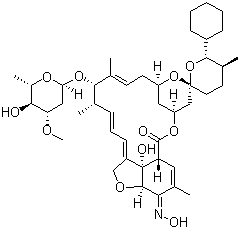 |
| Molecular Formula | C43H63NO11 |
| Molecular Weight | 769.96 |
| CAS Registry Number | 165108-07-6 |
| EC Number | 811-481-9 |
| SMILES | C[C@H]1CC[C@]2(C[C@@H]3C[C@H](O2)C/C=C(/[C@H]([C@H](/C=C/C=C/4CO[C@H]5[C@@]4([C@@H](C=C(/C5=N/O)C)C(=O)O3)O)C)O[C@H]6C[C@@H]([C@H]([C@@H](O6)C)O)OC)C)O[C@@H]1C7CCCCC7 |
| Density | 1.4±0.1 g/cm3 Calc.* |
|---|---|
| Boiling point | 917.0±65.0 °C 760 mmHg (Calc.)* |
| Flash point | 508.4±34.3 °C (Calc.)* |
| Index of refraction | 1.618 (Calc.)* |
| * | Calculated using Advanced Chemistry Development (ACD/Labs) Software. |
| Hazard Symbols |   GHS08;GHS09 Warning Details GHS08;GHS09 Warning Details | ||||||||||||
|---|---|---|---|---|---|---|---|---|---|---|---|---|---|
| Risk Statements | H361-H400 Details | ||||||||||||
| Safety Statements | P203-P273-P280-P318-P391-P405-P501 Details | ||||||||||||
| Hazard Classification | |||||||||||||
| |||||||||||||
 chemBlink Chemical Story
|
Selamectin is a semi-synthetic antiparasitic agent belonging to the avermectin class, structurally derived from doramectin, which itself is produced by the soil-dwelling actinomycete *Streptomyces avermitilis*. It is used primarily in veterinary medicine to protect cats and dogs against a range of internal and external parasites. Selamectin is marketed under trade names such as Revolution and Stronghold and is typically administered as a topical (spot-on) solution. The discovery of selamectin is part of the broader development of avermectin derivatives aimed at enhancing spectrum, safety, and pharmacokinetics for companion animal use. Avermectins, discovered in the 1970s, are macrocyclic lactones that exhibit potent anthelmintic and insecticidal properties. Selamectin was developed to address the need for a more targeted compound with improved safety in dogs and especially in cats, which can be more sensitive to certain macrocyclic lactones. Selamectin functions by binding with high affinity to glutamate-gated chloride channels found in the nerve and muscle cells of invertebrates. This binding increases the permeability of the cell membrane to chloride ions, leading to hyperpolarization, paralysis, and death of the parasite. These glutamate-gated chloride channels are specific to invertebrates and are not present in mammals, which contributes to selamectin's selective toxicity. At higher concentrations, selamectin may also interact with gamma-aminobutyric acid (GABA)-gated chloride channels, further affecting neuromuscular function in parasites. Selamectin is effective against a broad range of parasites. In cats, it provides protection against *Ctenocephalides felis* (fleas), *Toxocara cati* (intestinal roundworms), *Ancylostoma tubaeforme* (hookworms), *Dirofilaria immitis* (heartworms), and ear mites (*Otodectes cynotis*). In dogs, it treats and prevents flea infestations, heartworm disease, sarcoptic mange caused by *Sarcoptes scabiei*, and ear mite infestations. Selamectin also aids in the control of tick infestations in some regions, depending on the local regulatory approval. The formulation of selamectin as a topical solution is designed to maximize convenience and compliance for pet owners. After application to the skin, selamectin is absorbed into the bloodstream and distributed systemically, reaching tissue fluids, including those in the skin and gastrointestinal tract. This allows the compound to act on both ectoparasites (such as fleas and mites) and endoparasites (such as nematodes and heartworms). It has a long half-life in tissues, enabling monthly administration. Selamectin has demonstrated a high margin of safety in target animals when used as directed. It is generally well tolerated, although transient local irritation at the application site may occur in some cases. Its safety in breeding, pregnant, and lactating animals has also been established, contributing to its wide use in both individual treatment and population-level parasite control in shelters and breeding facilities. Its broad efficacy and ease of use make selamectin an important tool in integrated parasite management programs for companion animals. While resistance to macrocyclic lactones has emerged in some livestock parasites, reports of resistance to selamectin in dogs and cats remain rare. Nevertheless, continued monitoring of efficacy and adherence to best practices in parasite control are essential to maintain its effectiveness. Through its unique pharmacological profile, broad spectrum, and good safety margin, selamectin remains a widely used and trusted agent for the prevention and treatment of parasitic infections in dogs and cats. References 2000. Avermectins and flea control: structure-activity relationships and the selection of selamectin for development as an endectocide for companion animals. Bioorganic & Medicinal Chemistry, 8(8). DOI: 10.1016/s0968-0896(00)00120-6 2000. Safety of selamectin in dogs. Veterinary Parasitology, 91(3-4). DOI: 10.1016/s0304-4017(00)00306-x 2023. Correction to: First study of topical selamectin efficacy for treating cats naturally infected with Brugia malayi and Brugia pahangi under field conditions. Parasitology Research, 122(8). DOI: 10.1007/s00436-023-07914-3 |
| Market Analysis Reports |