
Online Database of Chemicals from Around the World
| Wuhan Kemi-works Chemical Co., Ltd. | China | |||
|---|---|---|---|---|
 | www.kemiworks.net | |||
 | +86 (27) 8573-6489 | |||
 | +86 (27) 8573-6485 | |||
 | info@kemiworks.net sales@kemiworks.com | |||
| Chemical manufacturer | ||||
| chemBlink Premium supplier since 2011 | ||||
| Classification | Organic raw materials >> Carboxylic compounds and derivatives >> Carboxylic esters and their derivatives |
|---|---|
| Name | Benzoic acid, C9-11-branched alkyl esters |
| Synonyms | Isodecyl benzoate |
| Molecular Structure | 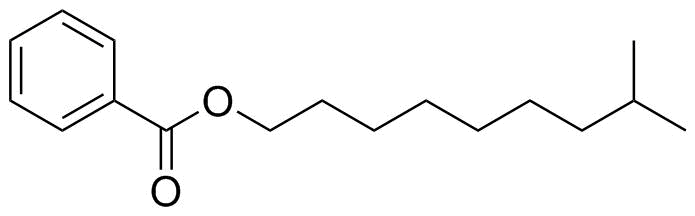 |
| Molecular Formula | C17H26O2 |
| Molecular Weight | 262.39 |
| CAS Registry Number | 131298-44-7 |
| EC Number | 421-090-1 |
| SMILES | CC(C)CCCCCCCOC(=O)c1ccccc1 |
| Density | 0.9±0.1 g/cm3 Calc.* |
|---|---|
| Boiling point | 345.9±10.0 °C 760 mmHg (Calc.)*, 361.9 °C (Expl.) |
| Flash point | 145.9±6.5 °C (Calc.)* |
| Index of refraction | 1.489 (Calc.)*, 1.49 (Expl.) |
| * | Calculated using Advanced Chemistry Development (ACD/Labs) Software. |
| Hazard Symbols |   GHS07;GHS09 Warning Details GHS07;GHS09 Warning Details | ||||||||
|---|---|---|---|---|---|---|---|---|---|
| Risk Statements | H315-H319-H332-H400-H410 Details | ||||||||
| Safety Statements | P261-P264-P264+P265-P271-P273-P280-P302+P352-P304+P340-P305+P351+P338-P317-P321-P332+P317-P337+P317-P362+P364-P391-P501 Details | ||||||||
| Hazard Classification | |||||||||
| |||||||||
| SDS | Available | ||||||||
 chemBlink Chemical Story
|
Benzoic acid, C9-11-branched alkyl esters are a group of aromatic ester compounds formed by the reaction of benzoic acid with branched alcohol mixtures containing nine to eleven carbon atoms. These substances are not single defined molecules but industrial mixtures, because the alcohol feedstocks used in their production are typically obtained from petrochemical oligomerization processes that yield multiple structural isomers. The resulting esters are therefore best understood as a family of closely related compounds sharing a common benzoate functional group and similar physicochemical behavior. Benzoic acid itself is one of the earliest known aromatic carboxylic acids to be isolated and characterized in organic chemistry. It was first obtained in the sixteenth century from natural sources such as gum benzoin, from which its name is derived. Over time, benzoic acid became an important intermediate in chemical synthesis due to its stable aromatic structure and reactive carboxylic acid group. The development of industrial oxidation processes for toluene in the nineteenth and twentieth centuries enabled large-scale production of benzoic acid, which in turn made benzoate esters commercially accessible. The alcohol components used to produce C9-11-branched alkyl esters of benzoic acid are typically generated through petrochemical processes such as oligomerization of propylene or ethylene followed by hydroformylation and hydrogenation. These processes produce mixtures of branched alcohols with varying chain structures, which are then reacted with benzoic acid or its derivatives under esterification conditions. The esterification reaction generally involves acid catalysis and removal of water to drive the equilibrium toward ester formation. The resulting ester mixture consists of molecules containing a benzene ring connected through an ester linkage to a branched aliphatic chain. The aromatic portion contributes rigidity and hydrophobic aromatic character, while the branched alkyl chain introduces flexibility and prevents close molecular packing. This structural combination leads to low crystallinity and favorable liquid-state behavior over a wide temperature range. These benzoate esters were developed primarily for industrial formulation purposes rather than as discrete chemical entities. Their primary applications emerged in fields where controlled viscosity, low volatility, and good compatibility with organic materials were required. As a result, they are widely used as emollients and solvent systems in personal care formulations. Their sensory properties, including a light and non-greasy feel, made them useful in cosmetic products such as skin creams, sunscreens, and hair care formulations. In addition to cosmetic applications, these esters are used in coatings, adhesives, and polymer systems. In such applications, they function as plasticizer components or co-solvents that improve processing behavior and modify mechanical properties of polymeric materials. The ability of benzoate esters to reduce intermolecular forces within polymer matrices contributes to increased flexibility and improved workability of materials such as polyvinyl chloride and related resins. The development of benzoate ester plasticizers reflects broader trends in industrial chemistry toward tailoring molecular structure to achieve specific performance characteristics. Compared with earlier plasticizers based on simpler aliphatic acids or phthalate structures, benzoate esters with branched alkyl groups offer improved volatility profiles and different compatibility characteristics with modern polymer systems. This has led to their adoption in applications where a balance of performance, stability, and regulatory considerations is required. From a chemical standpoint, these compounds are relatively stable under normal conditions of use. The ester linkage can undergo hydrolysis in strongly acidic or basic environments, yielding benzoic acid and the corresponding alcohols. However, under typical storage and application conditions, hydrolysis is minimal. The aromatic ring remains chemically inert in most formulation environments, contributing to long-term stability. The physical properties of C9-11-branched alkyl benzoates are strongly influenced by the branching of the alkyl chain. Branching reduces crystallization tendency and lowers melting points, resulting in liquids with low pour points and stable viscosity behavior. This is a key reason for their usefulness in formulations that must remain fluid across varying temperatures. In summary, benzoic acid, C9-11-branched alkyl esters are industrially important aromatic ester mixtures derived from benzoic acid and branched C9-11 alcohols. Their development is closely linked to advances in petrochemical alcohol synthesis and esterification technology. Their primary significance lies in their application as multifunctional formulation ingredients in cosmetics, coatings, and polymer systems, where their balance of hydrophobic aromatic structure and flexible branched alkyl chains provides desirable performance characteristics. |
| Market Analysis Reports |