
Online Database of Chemicals from Around the World
| Wuhan Kemi-works Chemical Co., Ltd. | China | |||
|---|---|---|---|---|
 | www.kemiworks.net | |||
 | +86 (27) 8573-6489 | |||
 | +86 (27) 8573-6485 | |||
 | info@kemiworks.net sales@kemiworks.com | |||
| Chemical manufacturer | ||||
| chemBlink Standard supplier since 2011 | ||||
| Hangzhou Leap Chem Co., Ltd. | China | |||
|---|---|---|---|---|
| www.leapchem.com | |||
| +86 (571) 8771-1850 | |||
| market19@leapchem.com | |||
 | QQ Chat | |||
| Chemical manufacturer since 2006 | ||||
| chemBlink Standard supplier since 2015 | ||||
| SynChem, Inc. | USA | |||
|---|---|---|---|---|
| www.synchem.com | |||
| +1 (847) 298-2436 ex 230 | |||
| +1 (847) 298-2439 | |||
| sales@synchem.com | |||
| Chemical manufacturer since 1997 | ||||
| Classification | Pharmaceutical intermediate >> Heterocyclic compound intermediate >> Pyridine compound >> Bromopyridine |
|---|---|
| Name | 4-Bromo-2-pyridinemethanol |
| Synonyms | 4-Bromopyridine-2-methanol |
| Molecular Structure | 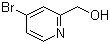 |
| Molecular Formula | C6H6BrNO |
| Molecular Weight | 188.02 |
| CAS Registry Number | 131747-45-0 |
| EC Number | 812-912-3 |
| SMILES | C1=CN=C(C=C1Br)CO |
| Density | 1.7±0.1 g/cm3, Calc.* |
|---|---|
| Index of Refraction | 1.599, Calc.* |
| Boiling Point | 284.3±25.0 °C (760 mmHg), Calc.* |
| Flash Point | 125.7±23.2 °C, Calc.* |
| * | Calculated using Advanced Chemistry Development (ACD/Labs) Software. |
| Hazard Symbols |   GHS05;GHS07 Danger Details GHS05;GHS07 Danger Details | ||||||||||||||||||||||||
|---|---|---|---|---|---|---|---|---|---|---|---|---|---|---|---|---|---|---|---|---|---|---|---|---|---|
| Risk Statements | H302-H315-H318-H319-H332-H335 Details | ||||||||||||||||||||||||
| Safety Statements | P261-P264-P264+P265-P270-P271-P280-P301+P317-P302+P352-P304+P340-P305+P351+P338-P305+P354+P338-P317-P319-P321-P330-P332+P317-P337+P317-P362+P364-P403+P233-P405-P501 Details | ||||||||||||||||||||||||
| Hazard Classification | |||||||||||||||||||||||||
| |||||||||||||||||||||||||
| SDS | Available | ||||||||||||||||||||||||
 chemBlink Chemical Story
|
4-Bromo-2-pyridinemethanol is an organic compound consisting of a pyridine ring substituted with a hydroxymethyl group (-CH2OH) and a bromine atom at the 4-position of the pyridine ring. It is of particular interest in organic chemistry due to its versatility as an intermediate in the synthesis of a wide range of bioactive molecules and functional materials. The compound has found applications in pharmaceutical research, material science, and as a reagent in organic synthesis. The discovery of 4-bromo-2-pyridinemethanol dates back to the early development of pyridine derivatives, which have been extensively studied for their biological and chemical properties. Pyridine, a heterocyclic aromatic compound, serves as a key building block for many synthetic pathways. The introduction of functional groups, such as the hydroxymethyl group and the bromine atom, significantly enhances the reactivity of the pyridine ring. This makes 4-bromo-2-pyridinemethanol a valuable intermediate for the synthesis of various organic compounds, particularly those with potential pharmacological activity. The synthesis of 4-bromo-2-pyridinemethanol typically involves a straightforward procedure starting from commercially available pyridine derivatives. Bromination reactions at the 4-position of the pyridine ring, followed by the introduction of a hydroxymethyl group, result in the desired product. Various synthetic approaches have been developed, including nucleophilic substitution and selective functionalization techniques, making it possible to obtain this compound in high yields with good purity. Its ability to undergo further chemical modifications, such as substitution or addition reactions, makes it highly adaptable for use in synthetic chemistry. One of the primary applications of 4-bromo-2-pyridinemethanol is in the field of medicinal chemistry. Due to the presence of the hydroxymethyl group, the compound has been investigated as a potential scaffold for the design of novel pharmaceuticals. It has shown promise as a precursor in the development of antimicrobial and anticancer agents, as well as in the synthesis of compounds with enzyme-inhibitory activity. The bromine atom in the structure provides a site for additional reactivity, allowing for the incorporation of various functional groups to tailor the biological activity of the resulting molecules. In material science, 4-bromo-2-pyridinemethanol is used as a precursor for the preparation of specialized polymers and organic materials with unique properties. The pyridine ring, along with the functional groups attached to it, allows for the creation of materials with tunable electronic, optical, and mechanical properties. These materials have potential applications in areas such as organic electronics, sensors, and optoelectronics. The compound's ability to serve as a building block for the synthesis of conjugated polymers and small organic molecules further extends its usefulness in the development of advanced materials. Another important application of 4-bromo-2-pyridinemethanol is as a reagent in organic synthesis. Its reactivity and functional groups make it a versatile tool for the construction of more complex molecules. The hydroxymethyl group, for example, can be easily modified to introduce a variety of other functional groups, while the bromine atom can undergo substitution reactions with different nucleophiles. This makes 4-bromo-2-pyridinemethanol useful in the synthesis of diverse compounds, ranging from small organic molecules to larger, more complex structures. Despite its usefulness, 4-bromo-2-pyridinemethanol also poses certain challenges, particularly in terms of environmental and health considerations. Like other halogenated organic compounds, the bromine atom in the molecule can contribute to toxicity and persistence in the environment. Therefore, careful handling and disposal are necessary to minimize its impact on human health and the environment. Ongoing research into the development of safer and more sustainable synthetic pathways for the production of 4-bromo-2-pyridinemethanol and its derivatives is important for addressing these concerns. In conclusion, 4-bromo-2-pyridinemethanol is a valuable chemical compound with broad applications in medicinal chemistry, materials science, and organic synthesis. Its unique combination of functional groups makes it a versatile intermediate for the creation of bioactive molecules and advanced materials. As research into its potential applications continues, this compound is likely to play an increasingly important role in the development of new drugs, materials, and chemical processes. References 2022. Mapping Ligand Interactions of Bromodomains BRD4 and ATAD2 with FragLites and PepLites─Halogenated Probes of Druglike and Peptide-like Molecular Interactions. Journal of Medicinal Chemistry, 65(22). DOI: 10.1021/acs.jmedchem.2c01357 |
| Market Analysis Reports |