
Online Database of Chemicals from Around the World
| E-fine Bio Technology Co., Ltd. | China | |||
|---|---|---|---|---|
 | www.efine-bio.com | |||
 | +86 15251778053 | |||
 | William.efine@hotmail.com | |||
| Chemical manufacturer since 2021 | ||||
| chemBlink Standard supplier since 2022 | ||||
| Sichuan Taienkang Pharmaceutical Co., Ltd. | China | |||
|---|---|---|---|---|
| www.taienkangpharma.com | |||
| +86 15102825326 | |||
| sales@taienkangpharma.com | |||
 | QQ Chat | |||
 | Skype Chat | |||
| Chemical manufacturer since 2020 | ||||
| chemBlink Standard supplier since 2024 | ||||
| Suzhou Jinghe Pharmaceutical Technology Co., Ltd. | China | |||
|---|---|---|---|---|
| suzhoujinghe.com | |||
| +86 15897565406 | |||
| yangshu5406@163.com | |||
| Chemical manufacturer since 2023 | ||||
| chemBlink Standard supplier since 2026 | ||||
| Classification | Biochemical >> Inhibitor >> Neuronal signaling |
|---|---|
| Name | Xanomeline |
| Synonyms | 3-hexoxy-4-(1-methyl-3,6-dihydro-2H-pyridin-5-yl)-1,2,5-thiadiazole |
| Molecular Structure | 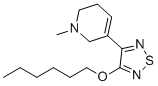 |
| Molecular Formula | C14H23N3OS |
| Molecular Weight | 281.42 |
| CAS Registry Number | 131986-45-3 |
| EC Number | 683-413-4 |
| SMILES | CCCCCCOC1=NSN=C1C2=CCCN(C2)C |
| Density | 1.1±0.1 g/cm3, Calc.* |
|---|---|
| Index of Refraction | 1.537, Calc.* |
| Boiling Point | 397.0±42.0 °C (760 mmHg), Calc.* |
| Flash Point | 193.9±27.9 °C, Calc.* |
| * | Calculated using Advanced Chemistry Development (ACD/Labs) Software. |
| Hazard Symbols |  GHS07 Warning Details GHS07 Warning Details | ||||||||
|---|---|---|---|---|---|---|---|---|---|
| Risk Statements | H302 Details | ||||||||
| Safety Statements | P264-P270-P301+P317-P330-P501 Details | ||||||||
| Hazard Classification | |||||||||
| |||||||||
| SDS | Available | ||||||||
 chemBlink Chemical Story
|
Xanomeline is a muscarinic receptor agonist that has been extensively studied for its potential therapeutic applications in the treatment of neurological disorders, particularly Alzheimer's disease and schizophrenia. The discovery of xanomeline was driven by the need to develop selective muscarinic receptor modulators that could improve cognitive function without causing significant side effects associated with non-selective cholinergic stimulation. The synthesis of xanomeline involves the derivatization of substituted benzene rings and cyclic amines, resulting in a compound that demonstrates high affinity for the M1 and M4 muscarinic receptor subtypes. This selective binding profile makes xanomeline an attractive candidate for drug development, as it can modulate neurotransmitter systems implicated in memory, learning, and psychosis. Xanomeline has shown promise in clinical trials for enhancing cognitive performance and reducing psychotic symptoms. Studies have demonstrated its ability to improve attention and working memory in patients with Alzheimer's disease. In the context of schizophrenia, xanomeline's mechanism of action offers a novel approach to address both positive and negative symptoms, representing a significant advancement in psychiatric treatment. Research continues to refine xanomeline analogs and delivery methods to optimize its pharmacokinetic properties and minimize adverse effects. The development of muscarinic receptor-targeting drugs highlights the importance of receptor subtype selectivity in achieving therapeutic efficacy and safety. References 2024. Efficacy and Safety of Xanomeline-Trospium Chloride in Schizophrenia: A Randomized Clinical Trial. JAMA Psychiatry. DOI: 10.1001/jamapsychiatry.2024.0785 2024. Muscarinic Receptor Activators as Novel Treatments for Schizophrenia. Biological Psychiatry. DOI: 10.1016/j.biopsych.2024.03.014 2024. Current Findings and Potential Mechanisms of KarXT (Xanomeline-Trospium) in Schizophrenia Treatment. Clinical Drug Investigation. DOI: 10.1007/s40261-024-01377-9 |
| Market Analysis Reports |