
Online Database of Chemicals from Around the World
| Tianjin ComoraTechnology Co., Ltd. | China | |||
|---|---|---|---|---|
 | comoratj.com | |||
 | +86 15908635794 | |||
 | sales@comoratj.com | |||
 | WhatsApp:+86 15908635794 | |||
| Chemical manufacturer since 2026 | ||||
| chemBlink Standard supplier since 2026 | ||||
| Classification | Organic raw materials >> Carboxylic compounds and derivatives |
|---|---|
| Name | 2-(Tert-butoxycarbonyl)-2-azaspiro[3.5]nonane-7-carboxylic acid |
| Synonyms | 2-[(2-methylpropan-2-yl)oxycarbonyl]-2-azaspiro[3.5]nonane-7-carboxylic acid |
| Molecular Structure | 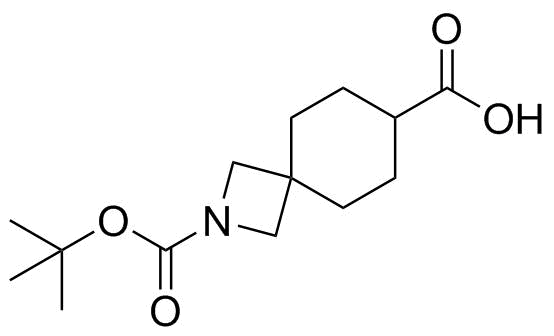 |
| Molecular Formula | C14H23NO4 |
| Molecular Weight | 269.34 |
| CAS Registry Number | 1363381-18-3 |
| EC Number | 885-382-4 |
| SMILES | CC(C)(C)OC(=O)N1CC2(C1)CCC(CC2)C(=O)O |
| Density | 1.2±0.1 g/cm3 Calc.* |
|---|---|
| Boiling point | 406.6±45.0 °C 760 mmHg (Calc.)* |
| Flash point | 199.7±28.7 °C (Calc.)* |
| Index of refraction | 1.528 (Calc.)* |
| * | Calculated using Advanced Chemistry Development (ACD/Labs) Software. |
| Hazard Symbols |  GHS07 Warning Details | ||||||||||||||||||||
|---|---|---|---|---|---|---|---|---|---|---|---|---|---|---|---|---|---|---|---|---|---|
| Risk Statements | H302-H315-H319-H335 Details | ||||||||||||||||||||
| Safety Statements | P261-P264-P264+P265-P270-P271-P280-P301+P317-P302+P352-P304+P340-P305+P351+P338-P319-P321-P330-P332+P317-P337+P317-P362+P364-P403+P233-P405-P501 Details | ||||||||||||||||||||
| Hazard Classification | |||||||||||||||||||||
| |||||||||||||||||||||
| SDS | Available | ||||||||||||||||||||
 chemBlink Chemical Story
|
2-(tert-Butoxycarbonyl)-2-azaspiro[3.5]nonane-7-carboxylic acid combines a protected nitrogen with a free carboxylic acid on a three-dimensional spirocyclic framework. The bracketed numbers describe the ring system: three and five atoms, respectively, belong to the two ring paths apart from the shared spiro atom. The actual rings therefore contain four and six atoms. They meet at one atom rather than sharing an edge, which distinguishes a spiro framework from a fused bicyclic system. The four-membered ring is an azetidine containing the nitrogen at position 2. Its Boc group is attached to nitrogen as a carbamate, while the carboxylic acid lies at position 7 on the six-membered carbon ring. This separation offers two chemically distinct handles. The acid can be modified while the ring nitrogen is protected; later, removal of the protecting group can expose the amine. These are features of a synthetic scaffold, not evidence of an inherent biological target. An experimentally described use appears in patent publication US20240131016A1, entitled IRAK degraders and uses thereof. In the preparation of Intermediate AUJ, the patent explicitly identifies the starting acid by CAS 1363381-18-3. The disclosed sequence converts the acid-derived functionality into a hydroxymethyl group and then elaborates it toward an aminomethyl substituent while retaining nitrogen protection. This gives a concrete example of using the molecule as a platform for changing the function at the six-membered ring. The patent context needs to be read carefully. Targeted protein degraders are larger constructs whose behavior depends on their component structures and their connections. A starting spiro acid used during preparation is not thereby an IRAK inhibitor or degrader. Nor does one disclosed sequence establish that the same transformations will work equally well for every related spiro compound. The verified contribution of this reagent is the provision of a defined ring arrangement and separately addressable nitrogen and acid functionality. The Intermediate AUJ sequence also separates a skeletal change from a functional-group change. Converting a carboxylic-acid-derived group into a hydroxymethyl group changes the outward-facing functionality while leaving the spiro junction and ring sizes intact. Further elaboration produces an aminomethyl group, creating another nitrogen connection point in addition to the protected ring nitrogen. A chemist can thus change what the scaffold connects to without abandoning the scaffold itself. This is useful in building molecules containing distinct modules. An amine on an external side chain and an amine embedded in a ring have different positions, and selective protection helps address them at different stages. The point is not that a spiro ring automatically improves biological performance. Rather, the framework supplies a defined set of positions from which different connections can be explored, and the protecting group keeps that exploration experimentally manageable. The bracket notation is a compact record of topology, not a measurement of rigidity or a guarantee of a particular solution conformation. Although the two rings share one atom, the six-membered ring still has conformational possibilities. Describing the compound as three-dimensional is therefore useful, but calling it completely motionless would be misleading. A good molecular design combines the known connectivity with an experimentally tested understanding of how the larger finished molecule behaves. Its chemical story is a useful reminder that three-dimensional shape and reaction planning are linked. A spiro junction constrains how the two rings are connected, while selective protection determines when each functional group can react. Together, these features let medicinal chemists change a fragment's connections without having to redesign its entire carbon skeleton at every step. References: 1. Bide Pharmatech via Sigma-Aldrich. CAS 1363381-18-3: structure and identity. https://www.sigmaaldrich.com/US/en/product/bidepharmatech/bdph9bccca3a 2. US20240131016A1. IRAK degraders and uses thereof; Intermediate AUJ. https://patents.google.com/patent/US20240131016A1/en |
| Market Analysis Reports |