
Online Database of Chemicals from Around the World
| Shandong Chenghui Shuangda Pharmaceutical Co., Ltd. | China | |||
|---|---|---|---|---|
 | www.chsdpharma.com | |||
 | +86-531-58897029 | |||
 | ericqiao@jnchsd.com | |||
 | QQ Chat | |||
 | WeChat: 15550412551 | |||
 | WhatsApp:15550412551 | |||
| Chemical manufacturer since 2014 | ||||
| chemBlink Standard supplier since 2025 | ||||
| Classification | API >> Antiparasitic drug |
|---|---|
| Name | Sarolaner |
| Synonyms | 1-[6-[(5S)-5-(3,5-dichloro-4-fluorophenyl)-5-(trifluoromethyl)-4H-1,2-oxazol-3-yl]spiro[1H-2-benzofuran-3,3'-azetidine]-1'-yl]-2-methylsulfonylethanone |
| Molecular Structure | 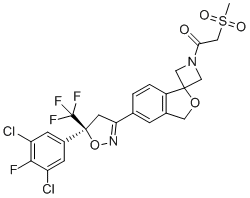 |
| Molecular Formula | C23H18Cl2F4N2O5S |
| Molecular Weight | 581.36 |
| CAS Registry Number | 1398609-39-6 |
| EC Number | 806-747-6 |
| SMILES | CS(=O)(=O)CC(=O)N1CC2(C1)C3=C(CO2)C=C(C=C3)C4=NO[C@@](C4)(C5=CC(=C(C(=C5)Cl)F)Cl)C(F)(F)F |
| Density | 1.7±0.1 g/cm3, Calc.* |
|---|---|
| Index of Refraction | 1.638, Calc.* |
| Boiling Point | 722.7±70.0 °C (760 mmHg), Calc.* |
| Flash Point | 390.9±35.7 °C, Calc.* |
| * | Calculated using Advanced Chemistry Development (ACD/Labs) Software. |
| Hazard Symbols |   GHS07;GHS09 Warning Details GHS07;GHS09 Warning Details | ||||||||||||||||
|---|---|---|---|---|---|---|---|---|---|---|---|---|---|---|---|---|---|
| Risk Statements | H302-H400-H410 Details | ||||||||||||||||
| Safety Statements | P264-P270-P273-P301+P317-P330-P391-P501 Details | ||||||||||||||||
| Hazard Classification | |||||||||||||||||
| |||||||||||||||||
| SDS | Available | ||||||||||||||||
 chemBlink Chemical Story
|
Sarolaner is a veterinary ectoparasiticide belonging to the isoxazoline class, developed for the control of fleas and ticks in companion animals. It functions by selectively inhibiting ligand-gated chloride channels in the nervous systems of arthropods, particularly those gated by gamma-aminobutyric acid (GABA) and L-glutamate. This inhibition leads to hyperexcitation of the parasite's nervous system, resulting in paralysis and death. Sarolaner exhibits a high degree of selectivity for insect and acarid receptors over mammalian ones, contributing to its safety profile in treated animals. The development of sarolaner was part of an effort to create new isoxazoline compounds with rapid onset of action, long duration, and broad-spectrum efficacy against key ectoparasites. It was discovered and developed by Zoetis and introduced to the veterinary market in the mid-2010s under the brand name Simparica. It was approved for use in dogs in the United States by the Food and Drug Administration (FDA) in 2016 and subsequently in other global markets. Sarolaner is administered orally in the form of a flavored chewable tablet. A single dose provides protection against fleas (Ctenocephalides felis) and a range of tick species (including Rhipicephalus sanguineus, Ixodes scapularis, Amblyomma americanum, and Dermacentor variabilis) for one month. The compound is rapidly absorbed after administration, with peak plasma concentrations typically reached within a few hours. Its pharmacokinetic properties support once-monthly dosing, with sustained systemic concentrations that ensure persistent efficacy over a 30-day period. In clinical studies, sarolaner has demonstrated high effectiveness in killing fleas and ticks within hours of administration. It begins acting on fleas as early as three hours post-treatment and eliminates over 95% of fleas within 8 hours. This rapid action not only provides relief from infestations but also helps prevent reproduction and re-infestation. Sarolaner has also been effective in treating and controlling sarcoptic mange and demodicosis, two conditions caused by mite infestations. In addition to its use as a monotherapy in Simparica, sarolaner is included in combination products that offer expanded protection. One such product is Simparica Trio, which contains sarolaner along with moxidectin (an antiparasitic for internal nematodes) and pyrantel (effective against intestinal worms). This combination allows for broad-spectrum internal and external parasite control with a single monthly chewable. Sarolaner is generally well tolerated in dogs. Reported adverse effects are rare and usually mild, including vomiting, diarrhea, lethargy, and anorexia. It is not approved for use in cats. The product is labeled for use in dogs from six weeks of age and over 1.3 kg in weight, although veterinarians may assess suitability based on individual animal health status. The safety profile of sarolaner has been evaluated in multiple laboratory and field studies. It has a wide margin of safety when administered at recommended dosages, even in susceptible breeds. However, as with all isoxazolines, regulatory agencies recommend caution in animals with a history of seizures or neurologic disorders, due to rare reports of adverse neurological effects. In summary, sarolaner is an oral isoxazoline ectoparasiticide used in dogs for the control of fleas and ticks. It acts by selectively inhibiting GABA- and glutamate-gated chloride channels in arthropods, leading to rapid and sustained killing of parasites. Its development has contributed significantly to effective and convenient parasite management in veterinary practice, with additional benefits in combination formulations that target a wider range of parasites. References 2016. Comparative speed of kill of sarolaner (Simparica™) and fluralaner (Bravecto®) against induced infestations of Ctenocephalides felis on dogs. Parasites & Vectors, 9(1). DOI: 10.1186/s13071-016-1372-1 2021. Effectiveness of sarolaner in the clinical management of furuncular myiasis in dogs naturally infested with Dermatobia hominis (Diptera: Cuterebridae). Parasites & Vectors, 14(1). DOI: 10.1186/s13071-021-04910-3 2023. Efficacy of a chewable tablet containing sarolaner, moxidectin, and pyrantel (Simparica Trio®) in the treatment of sarcoptic mange caused by Sarcoptes scabiei mite infestations in dogs. Parasites & Vectors, 16(1). DOI: 10.1186/s13071-023-06049-9 |
| Market Analysis Reports |