
Online Database of Chemicals from Around the World
| Simagchem Corporation | China | |||
|---|---|---|---|---|
 | www.simagchem.com | |||
 | +86 13806087780 | |||
 | +86 (592) 268-0237 | |||
 | sale@simagchem.com | |||
| Chemical manufacturer since 2002 | ||||
| chemBlink Standard supplier since 2008 | ||||
| Survival Technologies Pvt Ltd | India | |||
|---|---|---|---|---|
| www.survivaltechnologies.in | |||
| +91 (22) 4212-8221 | |||
| +91 (22) 4212-8226 | |||
| info@survivaltechnologies.in | |||
| Chemical manufacturer since 2006 | ||||
| chemBlink Standard supplier since 2009 | ||||
| Shanghai Hongsheng Industry Limited Company | China | |||
|---|---|---|---|---|
| www.shhschem.net | |||
| +86 (21) 5426-5267 +86 13901708303 | |||
| +86 (21) 5426-5268 | |||
| chshhsc@online.sh.cn zhgshhs@hotmail.com | |||
 | QQ Chat | |||
| Chemical manufacturer since 1998 | ||||
| chemBlink Standard supplier since 2012 | ||||
| Taizhou Tongxin Biopharmaceutical Technology Co., Ltd. | China | |||
|---|---|---|---|---|
| www.allyrise.com | |||
| +86 18652728585 | |||
| +86 (523) 8276-5215 | |||
| sales@allyrise.com | |||
| QQ Chat | |||
| Chemical manufacturer since 2013 | ||||
| chemBlink Standard supplier since 2013 | ||||
| Hangzhou Leap Chem Co., Ltd. | China | |||
|---|---|---|---|---|
| www.leapchem.com | |||
| +86 (571) 8771-1850 | |||
| market19@leapchem.com | |||
| QQ Chat | |||
| Chemical manufacturer since 2006 | ||||
| chemBlink Standard supplier since 2015 | ||||
| Shijiazhuang Yesheng Chemical Technology Co., Ltd. | China | |||
|---|---|---|---|---|
| www.chinasunchem.net | |||
| +86 (311) 6803-0586 | |||
| +86 (311) 6803-0587 | |||
| yeshengchemical@163.com | |||
| Chemical distributor since 2016 | ||||
| chemBlink Standard supplier since 2016 | ||||
| Frontier Scientific Services, Inc. | USA | |||
|---|---|---|---|---|
| www.frontierssi.com | |||
| +1 (302) 266-6891 (888) 577-2734 | |||
| +1 (302) 266-8296 | |||
| customerservice@frontierssi.com | |||
| Chemical manufacturer | ||||
| Classification | Chemical reagent >> Organic reagent >> Fatty acid |
|---|---|
| Name | 3-Cyclopentylpropionic acid |
| Synonyms | Cyclopentanepropionic acid |
| Molecular Structure | 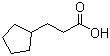 |
| Molecular Formula | C8H14O2 |
| Molecular Weight | 142.20 |
| CAS Registry Number | 140-77-2 |
| EC Number | 205-433-0 |
| SMILES | C1CCC(C1)CCC(=O)O |
| Density | 0.996 |
|---|---|
| Boiling point | 130-132 °C (12 mmHg) |
| Refractive index | 1.456-1.458 |
| Flash point | 46 °C |
| Water solubility | insoluble |
| Hazard Symbols |   GHS02;GHS07 Warning Details GHS02;GHS07 Warning Details | ||||||||||||||||||||||||
|---|---|---|---|---|---|---|---|---|---|---|---|---|---|---|---|---|---|---|---|---|---|---|---|---|---|
| Risk Statements | H226-H315-H319-H335 Details | ||||||||||||||||||||||||
| Safety Statements | P210-P233-P240-P241-P242-P243-P261-P264-P264+P265-P271-P280-P302+P352-P303+P361+P353-P304+P340-P305+P351+P338-P319-P321-P332+P317-P337+P317-P362+P364-P370+P378-P403+P233-P403+P235-P405-P501 Details | ||||||||||||||||||||||||
| Hazard Classification | |||||||||||||||||||||||||
| |||||||||||||||||||||||||
| Transport Information | UN 1993 | ||||||||||||||||||||||||
| SDS | Available | ||||||||||||||||||||||||
 chemBlink Chemical Story
|
3-Cyclopentylpropionic acid, commonly known as CPPA, was first synthesized and described in scientific literature in the mid-20th century. Its discovery emerged from the exploration of organic compounds with potential pharmaceutical applications. Researchers sought to develop molecules with diverse chemical structures to investigate their biological activities and therapeutic potentials. CPPA serves as a versatile intermediate in the synthesis of various pharmaceutical compounds. Its chemical reactivity and functional groups allow for the modification of its structure to create analogs with desired pharmacological properties. Pharmaceutical researchers utilize CPPA derivatives in the development of drugs targeting a wide range of therapeutic areas, including cardiovascular diseases, inflammation, and central nervous system disorders. CPPA and its derivatives exhibit anti-inflammatory properties, making them promising candidates for the treatment of inflammatory conditions such as arthritis and inflammatory bowel disease. By modulating inflammatory pathways and cytokine production, CPPA derivatives may alleviate symptoms and reduce tissue damage associated with chronic inflammation. CPPA derivatives demonstrate analgesic effects, offering potential applications in pain management. By targeting pain signaling pathways in the central nervous system, these compounds may provide relief from acute and chronic pain conditions. Some CPPA derivatives exhibit anticonvulsant properties, suggesting their potential use in the treatment of epilepsy and other seizure disorders. By modulating neuronal excitability and neurotransmitter release, these compounds may help control seizure activity. CPPA and its derivatives serve as valuable tools in scientific research aimed at understanding the structure-activity relationships of organic compounds and their interactions with biological targets. References 2011. Diverting non-haem iron catalysed aliphatic C-H hydroxylations towards desaturations. Nature Chemistry. Marinus A. Bigi, Sean A. Reed, M. Christina White. DOI: 10.1038/nchem.967 2009. The benefits and risks of testosterone replacement therapy: a review. Therapeutics and Clinical Risk Management. Nazem Bassil, Saad Alkaade, John E Morley. DOI: 10.2147/tcrm.s3025 2012. Eco-friendly approach using marine actinobacteria and its compounds to control ticks and mosquitoes. Parasitology Research. Mohankumar Thenmozhi, Jannu Vinay Gopal, Krishnan Kannabiran, Govindasamy Rajakumar, Kanayairam Velayutham, Abdul Abdul Rahuman. DOI: 10.1007/s00436-012-3192-3 |
| Market Analysis Reports |