Online Database of Chemicals from Around the World

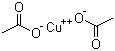
Cupric acetate
[CAS# 142-71-2]

List of Suppliers
Simagchem Corporation China Inquire
www.simagchem.com
+86 13806087780
+86 (592) 268-0237
sale@simagchem.com
Chemical manufacturer since 2002
chemBlink Standard supplier since 2008
Hefei TNJ Chemical Industry Co., Ltd. China Inquire
www.tnjchem.com
+86 (551) 6541-8684
+86 (551) 6541-8697
sales@tnjchem.com
Chemical manufacturer since 2001
chemBlink Standard supplier since 2010
BOC Sciences USA Inquire
www.bocsci.com
+1 (631) 485-4226
+1 (631) 614-7828
info@bocsci.com
Chemical manufacturer
chemBlink Standard supplier since 2010
Ereztech LLC USA Inquire
www.ereztech.com
+1 (888) 658-1221
sales@ereztech.com
Chemical distributor since 2010
chemBlink Standard supplier since 2011
Wuhan Kemi-works Chemical Co., Ltd. China Inquire
www.kemiworks.net
+86 (27) 8573-6489
+86 (27) 8573-6485
info@kemiworks.net
sales@kemiworks.com
Chemical manufacturer
chemBlink Standard supplier since 2011
Intatrade Chemicals GmbH Germany Inquire
www.intatrade.de
+49 (3493) 605-465
+49 (3493) 605-470
sales@intatrade.de
Chemical distributor
chemBlink Standard supplier since 2011
Hangzhou Leap Chem Co., Ltd. China Inquire
www.leapchem.com
+86 (571) 8771-1850
market19@leapchem.com
QQ Chat
Chemical manufacturer since 2006
chemBlink Standard supplier since 2015
West Bengal Chemical Industries Limited India Inquire
www.wbcil.com
08240399360
wbcilpvtltd@gmail.com
Chemical manufacturer since 1970
chemBlink Standard supplier since 2021
Dalchem Russia Inquire
www.dalchem.com
+7 (8312) 753-772
+7 (8312) 750-799
dregichy@dalchem.com
Chemical manufacturer since 1997
Anvia Chemicals, LLC USA Inquire
www.anviachem.com
+1 (414) 534-7845
+1 (414) 762-5539
sales@anviachem.com
Chemical manufacturer
City Chemical LLC USA Inquire
www.citychemical.com
+1 (203) 932-2489
+1 (203) 937-8400
sales@citychemical.com
Chemical distributor
Crescent Chemical Co. Inc. USA Inquire
www.crescentchemical.com
+1 (631) 348-0333
+1 (631) 348-0913
crescent@creschem.com
Chemical distributor
Acros Organics Belgium Inquire
www.acros.com
+86 (21) 5258-1100
+86 (21) 5258-0119
info@acros.com
Chemical manufacturer
Strem Chemicals, Inc. USA Inquire
www.strem.com
+1 (978) 499-1600
+1 (978) 465-3104
info@strem.com
Chemical manufacturer
Carbone Scientific Co., Ltd. UK Inquire
www.carbonesci.com
+44 (870) 486-8629
+44 (870) 288-7399
sales@carbonesci.com
Chemical distributor
Celtic Chemicals Ltd. UK Inquire
www.celticchemicals.co.uk
+44 (1656) 749-358
+44 (1656) 746-490
sales@celticchemicals.co.uk
Chemical manufacturer

Identification
ClassificationOrganic raw materials >> Carboxylic compounds and derivatives >> Salt of carboxylic acid ester and its derivatives
NameCupric acetate
SynonymsCopper(II) acetate
Molecular StructureCAS # 142-71-2, Cupric acetate
Molecular FormulaC4H6CuO4
Molecular Weight181.63
CAS Registry Number142-71-2
EC Number205-553-3
SMILESCC(=O)[O-].CC(=O)[O-].[Cu+2]
Properties
Melting point115 °C
Safety Data
Hazard Symbolssymbol symbol symbol symbol   GHS05;GHS06;GHS07;GHS09 Danger  Details
Risk StatementsH301-H302-H311-H314-H318-H400-H410-H411-H412  Details
Safety StatementsP260-P262-P264-P264+P265-P270-P273-P280-P301+P316-P301+P317-P301+P330+P331-P302+P352-P302+P361+P354-P304+P340-P305+P354+P338-P316-P317-P321-P330-P361+P364-P363-P391-P405-P501  Details
Hazard Classification
up    Details
HazardClassCategory CodeHazard Statement
Acute toxicityAcute Tox.4H302
Acute hazardous to the aquatic environmentAquatic Acute1H400
Serious eye damageEye Dam.1H318
Skin corrosionSkin Corr.1BH314
Chronic hazardous to the aquatic environmentAquatic Chronic2H411
Chronic hazardous to the aquatic environmentAquatic Chronic3H412
Acute toxicityAcute Tox.3H301
Chronic hazardous to the aquatic environmentAquatic Chronic1H410
Skin irritationSkin Irrit.2H315
Eye irritationEye Irrit.2H319
Specific target organ toxicity - single exposureSTOT SE3H335
Acute toxicityAcute Tox.4H312
Acute toxicityAcute Tox.4H332
Transport InformationUN 3077
SDSAvailable
up Discovery and Applications
Cupric acetate, also known as copper(II) acetate, is an inorganic compound with the formula Cu(CH3COO)2·H2O in its monohydrate form, although an anhydrous form also exists. It consists of divalent copper ions coordinated by acetate anions, usually forming a dimeric structure in the solid state, where two copper centers are bridged by four acetate groups. This arrangement, often called the paddlewheel structure, has been well studied in coordination chemistry as a model for metal–metal bonding interactions. The compound is typically blue-green in color and exhibits characteristic solubility in water and certain polar organic solvents.

Historically, cupric acetate has been known since at least the Renaissance period, when basic copper acetates, such as verdigris, were prepared by exposing copper or bronze to acetic acid vapors during the aging of wine or vinegar. The pure, well-defined salt, however, became more widely available through refined synthetic methods in the 18th and 19th centuries. Laboratory preparation is commonly achieved by reacting copper(II) oxide, hydroxide, or carbonate with acetic acid, followed by crystallization.

Cupric acetate has numerous applications in both laboratory research and industry. In organic synthesis, it serves as a catalyst or oxidizing agent in various reactions, including oxidative coupling of alkynes to form diynes, oxidative cyclization, and the Wacker-type oxidation of olefins. Its role in facilitating C–H activation processes has made it useful in modern synthetic methodologies. The compound has also been used in the preparation of other copper complexes by ligand exchange reactions.

In the field of polymer chemistry, cupric acetate is used as a catalyst in polycondensation reactions, particularly in the production of polyesters and other condensation polymers where controlled oxidation is beneficial. In analytical chemistry, it can function as a reagent for detecting certain functional groups or in gravimetric determinations involving copper.

Cupric acetate also finds application as a fungicide and pesticide, capitalizing on copper’s broad-spectrum antimicrobial properties. It has been incorporated into formulations for protecting agricultural crops, although its use is regulated to avoid excessive copper accumulation in soil. In textile dyeing, it has historically been employed as a mordant to improve dye adherence to fibers.

In research, the compound’s dimeric structure has been extensively studied using X-ray crystallography, magnetic susceptibility measurements, and spectroscopic methods, providing insights into metal–metal interactions and bridging ligand effects. Its well-defined coordination environment makes it a valuable reference material in coordination chemistry.

Handling cupric acetate requires caution due to the toxicity of soluble copper salts. Ingestion or prolonged skin contact can cause irritation or systemic copper toxicity, and environmental release must be minimized to prevent ecological harm. Storage in a dry, well-ventilated area away from strong acids and bases is recommended to maintain stability and prevent decomposition.

References

2015. π-Excess aromatic σ2-P ligands: synthesis and structure of an unprecedented μ2-P-1,3-benzazaphosphole bridged tetranuclear copper(I) acetate complex. Dalton Transactions, 44(4).
DOI: 10.1039/c4dt03072a

2012. Ligand-Assisted, Copper(II) Acetate-Accelerated Azide-Alkyne Cycloaddition. Chemistry - An Asian Journal, 6(10).
DOI: 10.1002/asia.201100426

2011. Soft X-ray Induced Photoreduction of Organic Cu(II) Compounds Probed by X-ray Absorption Near-Edge (XANES) Spectroscopy. Analytical Chemistry, 83(16).
DOI: 10.1021/ac201622g
Market Analysis Reports
List of Reports Available for Cupric acetate
Related Products
4-Cumylphenyl M...  2-alpha-Cumyl-4...  Cumyluron  Cuniloside B  (+)-Cuparene  (+)-Cuparene  Cupferron  Cupreine  Cupresol  Cupressuflavone  Cupric acetate ...  Cupric acetylac...  Cupric Benzoate  Cupric bromide  Cupric carbonat...  Cupric chloride  Cupric chloride...  Cupric citrate  Cupric cyanide  cupric ferric m...