
Online Database of Chemicals from Around the World
| Bazhou Lude Fine Chemical Co., Ltd. | China | |||
|---|---|---|---|---|
 | www.bzlude.com | |||
 | +86 (316) 735-5016 | |||
 | +86 (316) 735-5017 | |||
 | xuzhongxi@163.com | |||
| Chemical manufacturer | ||||
| chemBlink Standard supplier since 2008 | ||||
| Zhejiang Metallurgical Research Institute Co., Ltd. | China | |||
|---|---|---|---|---|
| www.pgmcatalyst.com | |||
| +86 (571) 8817-8133 +86 (578) 814-5985 | |||
| +86 (578) 814-5986 | |||
| xk@pgmcatalyst.com scm@pgmcatalyst.com ylq@pgmcatalyst.com | |||
| Chemical manufacturer since 1958 | ||||
| chemBlink Standard supplier since 2008 | ||||
| Sinocompound Catalysts Co., Ltd. | China | |||
|---|---|---|---|---|
| www.sinocompound.com | |||
| +86 (512) 6721-6630 | |||
| +86 (512) 5631-6689 | |||
| sales@sinocompound.com | |||
| Chemical manufacturer since 2008 | ||||
| chemBlink Standard supplier since 2010 | ||||
| Baoji Rock Pharmachem Co., Ltd. | China | |||
|---|---|---|---|---|
| www.bjrock.com | |||
| +86 (10) 8487-1070 8487-1071 8487-1072 | |||
| +86 (10) 8487-1078 | |||
| bjrock@163.com | |||
| Chemical manufacturer since 2003 | ||||
| chemBlink Standard supplier since 2010 | ||||
| BOC Sciences | USA | |||
|---|---|---|---|---|
| www.bocsci.com | |||
| +1 (631) 485-4226 | |||
| +1 (631) 614-7828 | |||
| info@bocsci.com | |||
| Chemical manufacturer | ||||
| chemBlink Standard supplier since 2010 | ||||
| Anvia Chemicals, LLC | USA | |||
|---|---|---|---|---|
| www.anviachem.com | |||
| +1 (414) 534-7845 | |||
| +1 (414) 762-5539 | |||
| sales@anviachem.com | |||
| Chemical manufacturer | ||||
| MCAT GmbH | Germany | |||
|---|---|---|---|---|
| www.mcat.de | |||
| +49 (7531) 939-097 | |||
| +49 (7531) 939-098 | |||
| info@mcat.de | |||
| Chemical manufacturer | ||||
| W.C.Heraeus GmbH | Germany | |||
|---|---|---|---|---|
| www.heraeus-chemicalproducts.com | |||
| +49 (6181) 355-707 | |||
| +49 (6181) 355-914 | |||
| info@heraeus.com | |||
| Chemical manufacturer | ||||
| Shanghai Worldyang Chemical Co., Ltd. | China | |||
|---|---|---|---|---|
| www.worldyachem.com | |||
| +86 13651600618 +86 (21) 5679-5779 | |||
| +86 (21) 5679-5266 | |||
| sales7777@worldyachem.com | |||
 | QQ Chat | |||
 | WeChat: 13651600618 | |||
 | WhatsApp:+86 13651600618 | |||
| Chemical manufacturer since 2012 | ||||
| Strem Chemicals, Inc. | USA | |||
|---|---|---|---|---|
| www.strem.com | |||
| +1 (978) 499-1600 | |||
| +1 (978) 465-3104 | |||
| info@strem.com | |||
| Chemical manufacturer | ||||
| Colonial Metals, Inc. | USA | |||
|---|---|---|---|---|
| www.colonialmetals.com | |||
| +1 (410) 398-7200 (800) 962-1537 | |||
| +1 (410) 398-2918 | |||
| sales@colonialmetals.com | |||
| Chemical manufacturer | ||||
| Classification | Organic raw materials >> Organic phosphine compound |
|---|---|
| Name | Tetrakis(triphenylphosphine)platinum |
| Synonyms | Tetrakis(triphenylphosphine)platinum(0) |
| Molecular Structure | 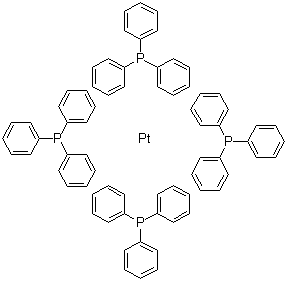 |
| Molecular Formula | C72H60P4Pt |
| Molecular Weight | 1244.23 |
| CAS Registry Number | 14221-02-4 |
| EC Number | 238-087-4 |
| SMILES | C1=CC=C(C=C1)P(C2=CC=CC=C2)C3=CC=CC=C3.C1=CC=C(C=C1)P(C2=CC=CC=C2)C3=CC=CC=C3.C1=CC=C(C=C1)P(C2=CC=CC=C2)C3=CC=CC=C3.C1=CC=C(C=C1)P(C2=CC=CC=C2)C3=CC=CC=C3.[Pt] |
| Water solubility | INSOLUBLE |
|---|---|
| Hazard Symbols |  GHS07 Warning Details GHS07 Warning Details | ||||||||||||||||||||||||||||
|---|---|---|---|---|---|---|---|---|---|---|---|---|---|---|---|---|---|---|---|---|---|---|---|---|---|---|---|---|---|
| Risk Statements | H302+H312+H332-H302-H312-H315-H319-H332-H413 Details | ||||||||||||||||||||||||||||
| Safety Statements | P261-P264-P264+P265-P270-P271-P273-P280-P301+P317-P302+P352-P304+P340-P305+P351+P338-P317-P321-P330-P332+P317-P337+P317-P362+P364-P501 Details | ||||||||||||||||||||||||||||
| Hazard Classification | |||||||||||||||||||||||||||||
| |||||||||||||||||||||||||||||
| SDS | Available | ||||||||||||||||||||||||||||
 chemBlink Chemical Story
|
Tetrakis(triphenylphosphine)platinum, with the chemical formula Pt(PPh3)4, is a well-known organometallic complex of platinum(0). It consists of a central platinum atom in the zero oxidation state coordinated by four triphenylphosphine ligands. Each triphenylphosphine (PPh3) ligand donates a lone pair of electrons from its phosphorus atom to the platinum center, forming a tetrahedral geometry around the metal. This complex is typically synthesized by the reduction of platinum(II) or platinum(IV) precursors in the presence of an excess of triphenylphosphine. One common method involves the reaction of potassium tetrachloroplatinate(II) (K2[PtCl4]) with triphenylphosphine and a reducing agent such as hydrazine or sodium borohydride under inert atmosphere conditions. The product is usually isolated as a white to pale yellow crystalline solid, which is air-stable and soluble in non-polar organic solvents like benzene, toluene, and chloroform. Structurally, Pt(PPh3)4 adopts a distorted tetrahedral geometry around the platinum atom. The steric bulk of the triphenylphosphine ligands leads to significant ligand–ligand repulsion, slightly distorting the ideal angles. Despite this, the complex is generally stable at room temperature and in the absence of strong oxidants or coordinating ligands. Tetrakis(triphenylphosphine)platinum is of particular interest in coordination and organometallic chemistry because it serves as a source of low-valent platinum(0), which is relatively rare and highly reactive. The complex is widely used as a precursor for the synthesis of other platinum complexes via ligand substitution reactions. The triphenylphosphine ligands are labile under suitable conditions, allowing replacement with other ligands such as alkenes, alkynes, carbon monoxide, or chelating ligands. In homogeneous catalysis, Pt(PPh3)4 has been investigated for its potential in facilitating reactions such as hydrosilylation, hydrogenation, and carbon–carbon coupling. Although it is less commonly used than its palladium or rhodium analogues in commercial catalysis, it remains important for mechanistic studies and model catalytic systems. The complex also provides insight into the electronic structure and reactivity of platinum(0) species. The phosphorus ligands stabilize the metal center through σ-donation and π-backbonding, making the complex relatively resistant to oxidation but still reactive enough to engage in oxidative addition and ligand substitution reactions. Tetrakis(triphenylphosphine)platinum is handled using standard laboratory precautions. Although the compound is not especially hazardous, all platinum compounds should be treated with care due to potential bioactivity and environmental concerns. It is recommended to store the complex under inert atmosphere to prevent oxidation and degradation over time. In summary, tetrakis(triphenylphosphine)platinum is a platinum(0) complex coordinated by four triphenylphosphine ligands in a distorted tetrahedral geometry. It is synthesized by reduction of platinum salts in the presence of triphenylphosphine and serves as a valuable reagent in the preparation of other platinum complexes and in studies of low-valent platinum reactivity. Its stability and ligand exchange capability make it an important compound in organometallic chemistry. References 2023. Recent Advances of Group 10 Transition Metal Hydrosilylation Catalysts. Perspectives of Hydrosilylation Reactions. DOI: 10.1007/3418_2023_99 2023. Synthesis and Reactivity of Organometallic Platinum Compounds containing one platinum-carbon bond. Reviews and Advances in Chemistry, 13(6). DOI: 10.1134/s2634827623700228 1973. Triphenylphosphine carboxylate complexes of platinum and palladium. Bulletin of the Academy of Sciences of the USSR, Division of chemical science, 22(4). DOI: 10.1007/bf00857088 |
| Market Analysis Reports |