Online Database of Chemicals from Around the World

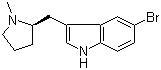
(R)-5-Bromo-3-((1-methylpyrrolidin-2-yl)methyl)-1H-indole
[CAS# 143322-57-0]

List of Suppliers
Shanghai Haoyuan Chemexpress Co., Ltd. China Inquire
www.chemexpress.com.cn
+86 (21) 5899-8985
5899-9585
5899-8590
+86 (21) 5895-5996 / 5370-0326 / 5899-8590
sales@chemexpress.com.cn
sales@chemexpress.cn
QQ Chat
Chemical manufacturer
chemBlink Standard supplier since 2007
Manus Aktteva Biopharma Llp China Inquire
www.manusaktteva.com
+91 ((79) 2646-3395
+91 ((79) 2646-3395
staff@manusakttevabiopharma.in
Chemical distributor since 2010
chemBlink Standard supplier since 2007
Manus Aktteva India Inquire
www.manusaktteva.in
+91 (79) 6512-3395
+91 (79) 2646-3395
products@manusakttevabiopharma.in
Chemical distributor
chemBlink Standard supplier since 2008
VIVAN Life Sciences Pvt. Ltd. India Inquire
www.vivanls.com
+91 (22) 2544-4584
+91 (22) 2544-4588
vivan@vivanls.com
Chemical manufacturer
chemBlink Standard supplier since 2010
BOC Sciences USA Inquire
www.bocsci.com
+1 (631) 485-4226
+1 (631) 614-7828
info@bocsci.com
Chemical manufacturer
chemBlink Standard supplier since 2010
Hangzhou Molcore Biopharmatech Co., Ltd. China Inquire
www.molcore.com
+86 (571) 8102-5280
sales@molcore.com
QQ Chat
Chemical manufacturer since 2010
chemBlink Standard supplier since 2017
Vegomega Biopharma Co., Ltd. China Inquire
www.veg-omega.com
+86 18062552845
+86 (27) 8669-8696
vegomega@163.com
Chemical distributor since 2017
chemBlink Standard supplier since 2017
Beijing TND Science and Technology Co., Ltd. China Inquire
www.tndtech.com.cn
+86 (10) 8075-1706
+86 13521671946
+86 (10) 8075-1706
sales@tndtech.com.cn
Chemical distributor since 2010
chemBlink Standard supplier since 2018
Neostar United (Changzhou) Industrial Co., Ltd. China Inquire
www.neostarunited.com
+86 (519) 8555-7386
+86 18015025600
+86 (519) 8555-7389
marketing1@neostarunited.com
Chemical distributor since 2014
chemBlink Standard supplier since 2020
Toronto Research Chemicals Inc. Canada Inquire
www.trc-canada.com
+1 (416) 665-9696
+1 (416) 665-4439
info@trc-canada.com
Chemical manufacturer since 1982

Identification
ClassificationOrganic raw materials >> Heterocyclic compound >> Indoles
Name(R)-5-Bromo-3-((1-methylpyrrolidin-2-yl)methyl)-1H-indole
Synonyms5-bromo-3-[[(2R)-1-methylpyrrolidin-2-yl]methyl]-1H-indole
Molecular StructureCAS # 143322-57-0, (R)-5-Bromo-3-((1-methylpyrrolidin-2-yl)methyl)-1H-indole
Molecular FormulaC14H17BrN2
Molecular Weight293.20
CAS Registry Number143322-57-0
EC Number422-390-5
SMILESCN1CCC[C@@H]1CC2=CNC3=C2C=C(C=C3)Br
Properties
Density1.4±0.1 g/cm3 Calc.*
Boiling point412.9±25.0 °C 760 mmHg (Calc.)*
Flash point203.5±23.2 °C (Calc.)*
Index of refraction1.655 (Calc.)*
*Calculated using Advanced Chemistry Development (ACD/Labs) Software.
Safety Data
Hazard Symbolssymbol symbol symbol symbol   GHS05;GHS07;GHS08;GHS09 Danger  Details
Risk StatementsH302-H317-H318-H332-H361-H370-H372-H400-H410  Details
Safety StatementsP203-P260-P261-P264-P264+P265-P270-P271-P272-P273-P280-P301+P317-P302+P352-P304+P340-P305+P354+P338-P308+P316-P317-P318-P319-P321-P330-P333+P317-P362+P364-P391-P405-P501  Details
Hazard Classification
up    Details
HazardClassCategory CodeHazard Statement
Acute toxicityAcute Tox.4H332
Reproductive toxicityRepr.2H361
Acute toxicityAcute Tox.4H302
Chronic hazardous to the aquatic environmentAquatic Chronic1H410
Specific target organ toxicity - repeated exposureSTOT RE1H372
Skin sensitizationSkin Sens.1H317
Specific target organ toxicity - single exposureSTOT SE1H370
Serious eye damageEye Dam.1H318
Acute hazardous to the aquatic environmentAquatic Acute1H400
Reproductive toxicityRepr.2H361f
SDSAvailable
up Discovery and Applications
(R)-5-Bromo-3-((1-methylpyrrolidin-2-yl)methyl)-1H-indole is a chiral indole derivative that falls within a class of compounds known for their pharmacological relevance, particularly in neurochemistry and medicinal chemistry. Its structure combines an indole core—a scaffold found in many biologically active natural products and drugs—with a chiral 1-methylpyrrolidin-2-ylmethyl substituent at the 3-position and a bromine atom at the 5-position. The (R)-configuration at the pyrrolidine ring carbon bearing the methyl group contributes to its stereoselective biological activity, a key consideration in drug design.

Indole derivatives, especially those substituted at the 3-position, have a broad range of biological activities. The substitution of the pyrrolidine moiety introduces a nitrogen-containing heterocycle known to affect receptor binding and metabolic stability. The presence of the 5-bromo substituent on the aromatic ring can influence the compound’s electronic properties, receptor affinity, and overall pharmacokinetics. Halogen substitution in aromatic systems is often used to modulate lipophilicity and facilitate interactions with binding pockets in protein targets.

The development of compounds such as (R)-5-bromo-3-((1-methylpyrrolidin-2-yl)methyl)-1H-indole is often linked to studies of neurotransmitter systems, especially the serotonin (5-HT) receptor subtypes, due to the indole’s structural similarity to serotonin itself. Derivatives of this type have been investigated for their binding affinities to 5-HT2A, 5-HT1A, and other central nervous system receptors. The stereochemistry plays a pivotal role in binding interactions, as enantiomers may exhibit different potency, efficacy, or receptor subtype selectivity.

Research in the area of synthetic tryptamines, which are structurally related to this compound, has explored various analogs as potential tools for neuroscience research, as well as for therapeutic applications in psychiatry. The design of chiral indole derivatives also aligns with trends in precision pharmacology, where receptor-specific and stereoselective ligands are desirable for minimizing side effects and improving clinical outcomes.

Synthetic routes to such compounds typically begin with functionalized indole precursors, where a halogen (such as bromine) is introduced through electrophilic aromatic substitution or halogen exchange reactions. The chiral pyrrolidine moiety may be incorporated through alkylation strategies involving enantiomerically enriched intermediates or by using chiral auxiliaries or catalysts to control the configuration at the stereocenter.

Applications of compounds with this scaffold extend to the study of G protein-coupled receptors (GPCRs), monoamine oxidase inhibition, and as ligands in molecular imaging. Depending on further substitution and structural modification, such compounds can act as agonists, antagonists, or modulators, contributing to both therapeutic and diagnostic developments.

(R)-5-Bromo-3-((1-methylpyrrolidin-2-yl)methyl)-1H-indole is one example among many in the broader category of indole-based molecules engineered to target central nervous system pathways. Its unique structure offers opportunities for selective interaction with biological targets, making it valuable for research into neuroactive drugs and receptor pharmacology.

References

none
Market Analysis Reports
List of Reports Available for (R)-5-Bromo-3-((1-methylpyrrolidin-2-yl)methyl)-1H-indole
Related Products
3-(Bromomethyl)...  2-(Bromomethyl)...  (3S)-3-(Bromome...  (3R)-3-(Bromome...  2-(Bromomethyl)...  L-2-(Bromomethy...  (S)-5-(Bromomet...  (R)-5-Bromometh...  5-Bromo-3-(1-me...  (R)-5-Bromo-3-(...  5-Bromo-3-[[(2R...  5-BroMo-4-Methy...  3-BroMo-2-Methy...  2-(Bromomethyl)...  2-Bromo-6-methy...  3-Bromo-6-methy...  4-Bromo-6-methy...  5-Bromo-7-methy...  6-Bromo-1-methy...  5-Bromo-2-methy...