Abscisic acid (ABA) is a plant hormone that plays a critical role in regulating plant growth, development, and stress responses. First discovered in the 1960s, ABA was initially thought to be involved in the process of abscission, the shedding of leaves and fruits, which is how it got its name. However, over time, researchers discovered that ABA has a much broader function in plants, influencing a wide range of physiological processes, including seed dormancy, stomatal closure, and responses to environmental stress.
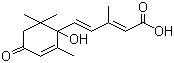
ABA is a sesquiterpenoid compound, meaning it is derived from a 15-carbon backbone. It is synthesized in various plant tissues, including leaves, roots, and seeds, and its production is highly regulated by environmental conditions. Under conditions of drought or other abiotic stresses, plants increase the synthesis of ABA as part of a protective mechanism. One of its primary functions is to help plants conserve water during times of water stress by inducing the closure of stomata, the small pores on the surface of leaves through which water vapor is lost. By reducing water loss, ABA helps plants survive under dry conditions.
Abscisic acid also plays a crucial role in seed dormancy and germination. High levels of ABA in seeds prevent premature germination, ensuring that seeds remain dormant until environmental conditions are suitable for growth. When conditions are favorable, a decrease in ABA levels allows seeds to break dormancy and begin germination. This regulation ensures that plants only germinate when there is sufficient water and favorable temperatures.
In addition to its role in drought tolerance and seed dormancy, ABA is involved in various aspects of plant development, including root growth and the response to environmental cues such as light and temperature. It also helps regulate the plant’s response to pathogens and other stresses, acting as part of the plant’s defense mechanisms. ABA works in concert with other hormones such as auxins, gibberellins, and cytokinins, which together regulate the complex processes of plant growth and development.
The discovery of ABA's role in plant stress responses and its involvement in processes like seed dormancy has led to its application in agriculture. Synthetic ABA and its analogs are being explored as potential tools to improve crop resilience to drought and other environmental stresses. For example, ABA application can promote water conservation in crops during periods of drought, enhancing agricultural productivity in areas with limited water availability. In addition, ABA is used in some crops to improve seed germination and establish uniform seedling growth, which is especially important in crops grown under controlled conditions, such as in greenhouses or for direct seeding.
Moreover, the use of ABA has expanded to commercial horticulture, where it is utilized to manipulate the ripening of fruits and vegetables. In some cases, ABA application has been shown to delay fruit ripening, which extends shelf life and reduces post-harvest losses. Conversely, in other situations, ABA can accelerate ripening, which may be desirable for certain crops.
Despite its promise in agricultural applications, the commercial use of ABA remains limited by its high cost and the complexity of its synthesis. Ongoing research is focused on developing more efficient methods of production and expanding its potential applications in crop management and food security. Advances in biotechnology and the development of ABA analogs with improved properties may increase the utility of this important hormone in agricultural practices.
References
2022. Properties of bee honeys and respective analytical methods. Food Analytical Methods, 15(6).
DOI: 10.1007/s12161-022-02243-0
2015. Role of exogenous abscisic acid in adapting of 'Sultana' grapevine to low-temperature stress. Acta Physiologiae Plantarum, 37(7).
DOI: 10.1007/s11738-015-1902-z
2003. Elucidation of the indirect pathway of abscisic acid biosynthesis by mutants, genes, and enzymes. Plant Physiology, 131(4).
DOI: 10.1104/pp.102.017921
|




 GHS09 Warning Details
 chemBlink Chemical Story